China congratulates Anutin on being elected Thai Prime Minister, stands ready to achieve greater progress in ties: Chinese FM
Bilateral ties expected to remain stable as strengthening cooperation with China is key to Thailand’s economic development: expert
By and Li Yawei Published: Sep 05, 2025 06:39 PM Updated: Sep 05, 2025 10:39 PM

The spokesperson noted that China and Thailand are close friends and neighbors. The two countries like one family are as close as ever. This year marks the 50th anniversary of the establishment of diplomatic relations between the two countries.
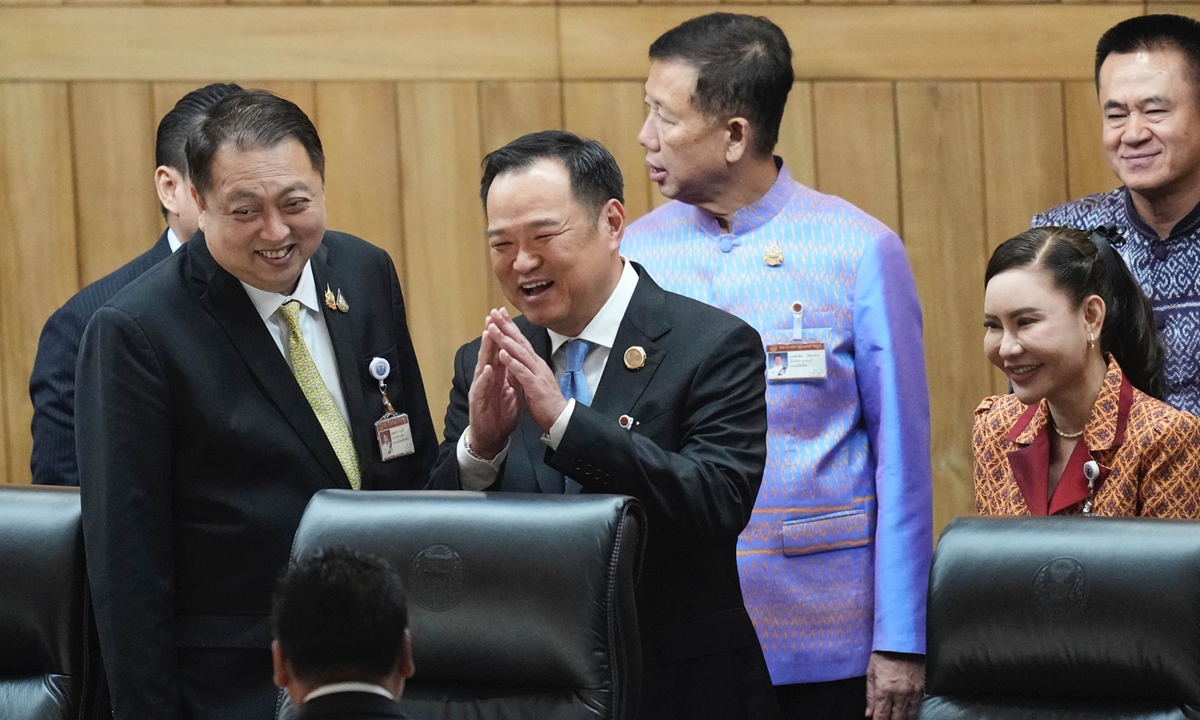
Veteran Thai politician Anutin won a parliamentary vote on Friday to become the country's 32nd Prime Minister, following last week's dismissal of Paetongtarn Shinawatra after the Constitutional Court found she had violated ethical rules, according to multiple media reports.
Some Chinese media also reported on Anutin's election as Thailand's new prime minister and reposted his remarks from a 2023 interview with CCTV News, when he was deputy prime minister and welcomed at the airport the first group of Chinese tourists arriving in Thailand after China eased its epidemic prevention measures.
In that interview, he said: "I'm very happy to see Chinese tourists. I am also 100 percent of Chinese descent — my parents, grandparents, and maternal grandparents all came from China. I was born in Thailand, and I have a Chinese name. At home, we speak Cantonese every day."
Luo Yongkun, professor from Institute of International Relations of Shanghai Academy of Social Sciences, told the Global Times on Friday that China-Thailand relations are expected to remain stable. Historically, no matter how politics shifted, their stability has never been fundamentally affected.
The key now lies in how the Anutin administration builds on this foundation to deepen cooperation with China. Amid a sluggish global economy and US tariff threat, strengthening dialogue and cooperation with China is not only crucial for stabilizing Thailand's politics but also essential for driving economic growth, said the expert.
The battle for the position of Thailand's new Prime Minister was played out on Friday between Anutin and Pheu Thai candidate Chaikasem Nitisiri. Anutin's path to the prime minister's office is supported by the People's Party with 143 votes, along with an additional 146 votes from other parties, enabling the formation of a minority government, according to Thailand's media outlet the Nation Thailand.
Anutin, also known as Sia Noo, was born on September 13, 1966, in Bangkok. He is the eldest son of Chavarat Charnvirakul, a former Minister of Interior under Prime Minister Abhisit Vejjajiva's government and founder of Sino-Thai Engineering and Construction (STECON). Anutin graduated in engineering from Hofstra University in the US and completed a Mini MBA at Thammasat University, according to the Nation Thailand.
The report also noted that Anutin's political career spans 29 years, beginning as an advisor to the Foreign Minister in 1996, later serving as Deputy Minister of Public Health and Deputy Minister of Commerce in Thaksin Shinawatra's government. Anutin was banned from politics for five years after being a board member of the Thai Rak Thai Party, which was dissolved in 2006. After his ban was lifted in 2012, he succeeded his father as the leader of Bhumjaithai.
A BBC report on Friday described Anutin as "a seasoned politician and dealmaker." It noted that Anutin is best known for liberalizing Thailand's marijuana laws when he was health minister in 2022. He is also an enthusiastic pilot who owns three of his own planes.
Currently, Thailand's political deadlock has been temporarily eased. The political situation among different political forces during Paetongtarn's suspension and eventual dismissal was intense, carrying high risks of instability. The election of a new prime minister has defused the immediate crisis, but it does not mean a lasting resolution, Luo said on Friday.
According to an AP report, Anutin's party has promised to dissolve Parliament within four months in exchange for support from the People's Party. The People's Party also said that an Anutin-led government would have to commit to organizing a referendum on the drafting of a new constitution by an elected constituent assembly.
Luo said that Thailand's political situation remains complex. Whether Anutin will dissolve parliament is uncertain, and even if new elections are held, the party landscape is expected to stay fragmented, with Pheu Thai and the other groups able to return. The current stalemate has only been temporarily eased, and the future remains unpredictable, the expert noted.
Thailand's recent political shifts have followed constitutional procedures, from Paetongtarn's removal to the election of a new prime minister. This adherence to established rules highlights the relative maturity of Thailand's electoral system and suggests a degree of overall stability despite political turbulence, said the expert.
RELATED ARTICLES