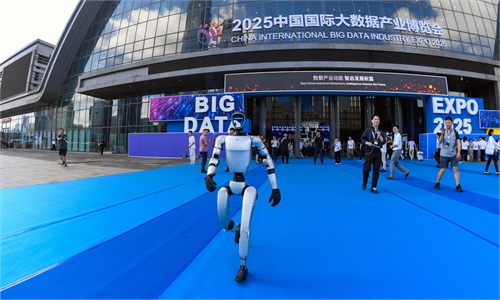
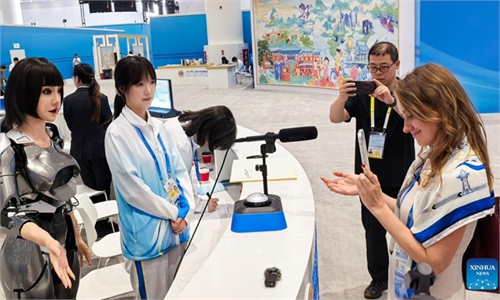
Xiconomics in Practice: AI should be an international public good that benefits humanity, Xi says in congratulatory letter to World Smart Industry Expo
Smart expo kicks off in SW China's Chongqing; open approach injects growth impetus into global intelligent industry: expert
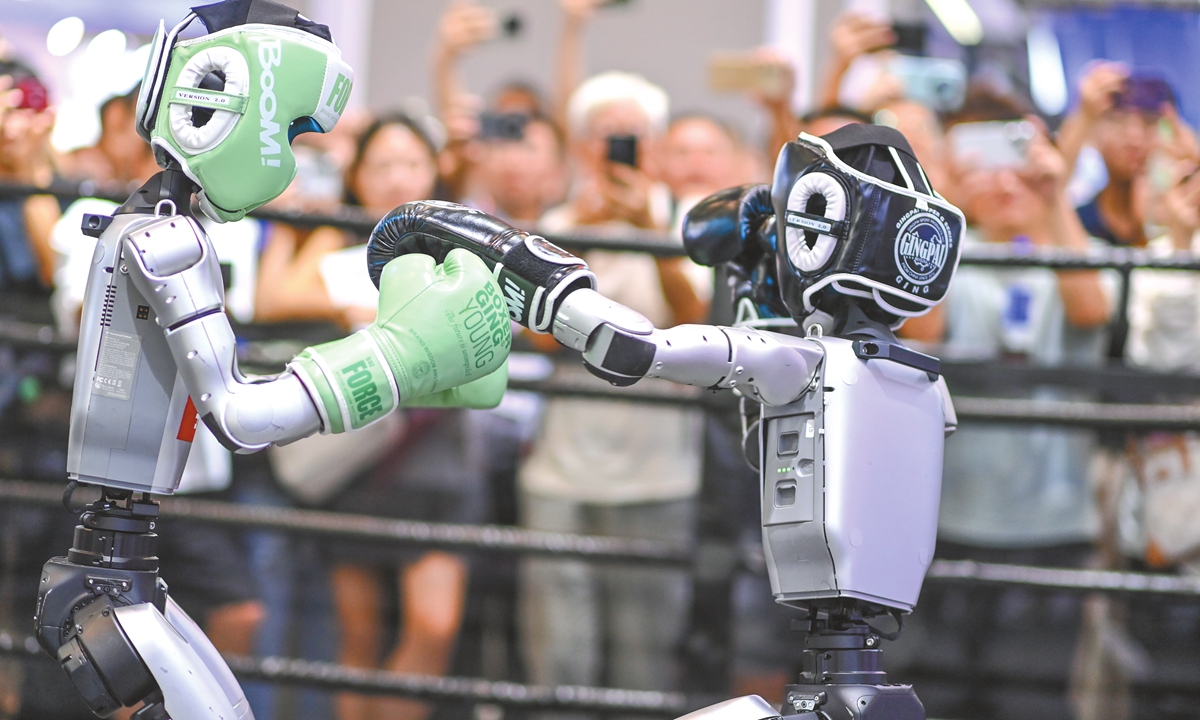
Unitree robots engage in a boxing match at the 2025 World Smart Industry Expo on September 5, 2025, attracting a large crowd of spectators. Photo: VCG
Artificial intelligence (AI) should be an international public good that benefits humanity, and China is willing to engage in extensive international cooperation with countries around the world in this field, Chinese President Xi Jinping said in a congratulatory letter to the World Smart Industry Expo 2025, which opened in Southwest China's Chongqing Municipality on Friday.
Currently, AI technology is rapidly evolving, profoundly transforming human production and lifestyles, and reshaping the global industrial landscape, Xi said in the letter, per Xinhua News Agency.
China attaches great importance to the development and governance of AI and actively promotes the deep integration of AI technological innovation with industrial innovation to empower high-quality economic and social development, thereby helping to improve people's lives, he added.
Xi also said that China is ready to strengthen international cooperation and coordination in development strategies, governance rules, and technical standards to promote the healthy and vigorous development of the industry, and bring greater benefits to people in all countries.
The expo, held under the themes "AI+" and "Intelligent Connected New Energy Vehicles," is co-hosted by the Chongqing municipal government and the Tianjin municipal government.
A Chinese expert said China has demonstrated its open and inclusive approach in international cooperation on AI, injecting strong momentum into the development of the global intelligent industry.
"By positioning AI as an 'international public good' and emphasizing enhancing alignment and coordination in strategy, rules, and standards, the Chinese government has demonstrated a profound understanding of the inclusive value of AI technology while also directly addressing current bottlenecks in international cooperation, such as regulatory barriers and fragmented standards," Wang Peng, associate research fellow at the Beijing Academy of Social Sciences, told the Global Times.
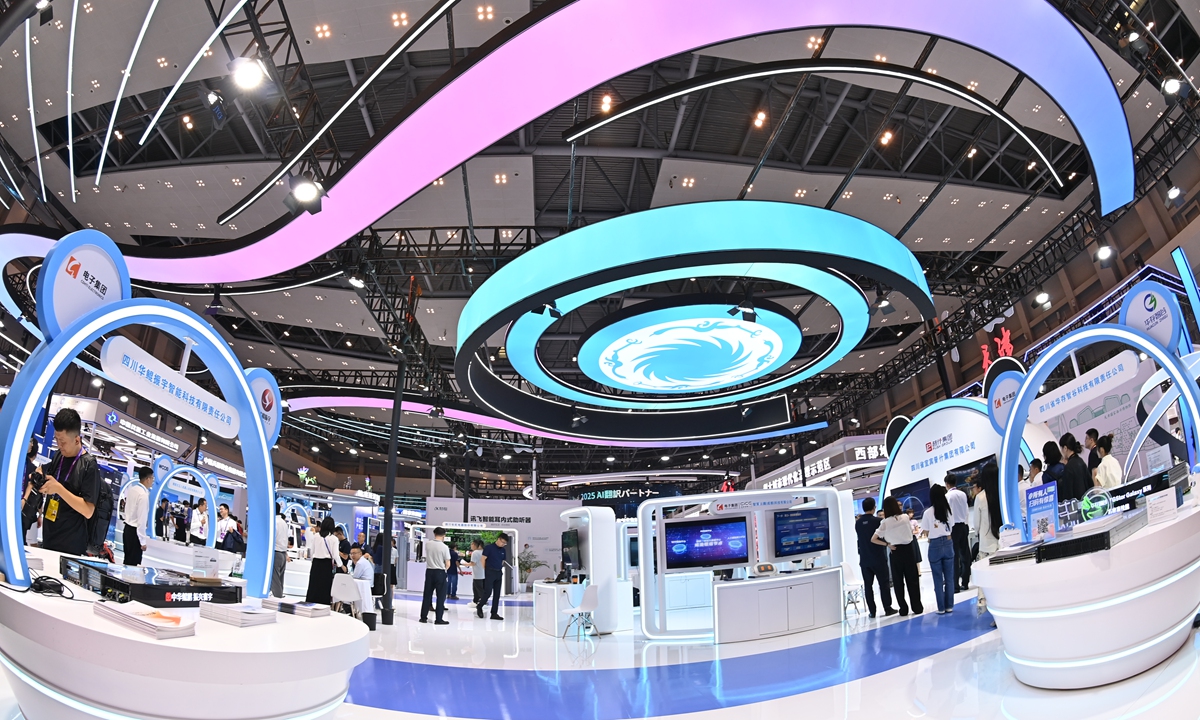
Visitors attend an exhibition at the venue of the 2025 World Smart Industry Expo on September 5, 2025. Photo: VCG
Transforming technology
With an indoor exhibition area of 130,000 square meters, the expo presents cutting-edge achievements in the smart industry. Over 600 leading domestic and foreign companies participated, displaying more than 3,000 new products, new technologies and new achievements in five areas including intelligent connected new-energy vehicles (NEVs), digital cities, intelligent robots, low-altitude economy and smart homes.
Boxing robots, digital humans, a one-stop research and development platform for intelligent driving and electric vertical takeoff and landing (eVTOL) aircraft were among items displayed at the expo, according to Xinhua.
Industry players attending the expo have highlighted the expansive nature of the smart technologies and their great potential in powering up economic growth.
"Leveraging AI to empower globalization, iFlytek's large language model now supports over 130 languages," Liu Qingfeng, chairman of Chinese tech giant iFlytek, said at the expo, per a release the company shared with the Global Times on Friday.
"iFlytek's AI Open Platform has attracted more than 9 million developers across the world, and the number of overseas developers has surpassed 530,000, with over 3.5 million applications being developed. Notably, Chongqing's developer ecosystem has demonstrated the fastest growth nationwide, as we continue to build a robust AI industrial ecosystem in the region," Liu said.
Yu Yingtao, CEO and president of Chinese tech company H3C, said at the expo that "the global AI boom is triggering a new round of technological and industrial transformation. Applications of AI in government affairs, education, healthcare, autonomous driving, and embodied intelligence are constantly emerging," according to a transcript of the speech the company shared with the Global Times.
"At the same time, it also faces imperative developmental tasks such as building and nurturing ecosystems," Yu said.
Chinese automaker Geely displayed its smart EVs and assisted driving system backed up by a smart computing center with a comprehensive computing power of 23.5 EFLOPS, per a press release the company sent to the Global Times.
US-based electric car maker Tesla also participated, bringing its sedans, robots, electric utility trucks and charging poles, according to a press release the company sent to the Global Times.
The development of AI has become a keyword of the Chinese economy since the beginning of the year, heralded by Chinese AI product DeepSeek and progress made by Chinese intelligent connected NEVs. DeepSeek and its open-source AI model, in particular, have been hailed by analysts as essentially democratizing access to advanced technology.
To provide further impetus to the development of AI, China's State Council, the cabinet, released a guideline last month on deepening the implementation of the AI Plus Initiative to promote the in-depth integration of AI and various industries, vowing to achieve extensive and deep integration of AI with six key areas -sci-tech, industry, consumption upgrading, people's wellbeing, governance and global cooperation in the next two years.
The document, which called for AI to become a full enabler of China's high-quality development by 2030, also emphasized efforts in promoting AI as an international public good that benefits humanity, fostering an open ecosystem for AI capacity building based on equality, mutual trust, diversity, and win-win outcomes.
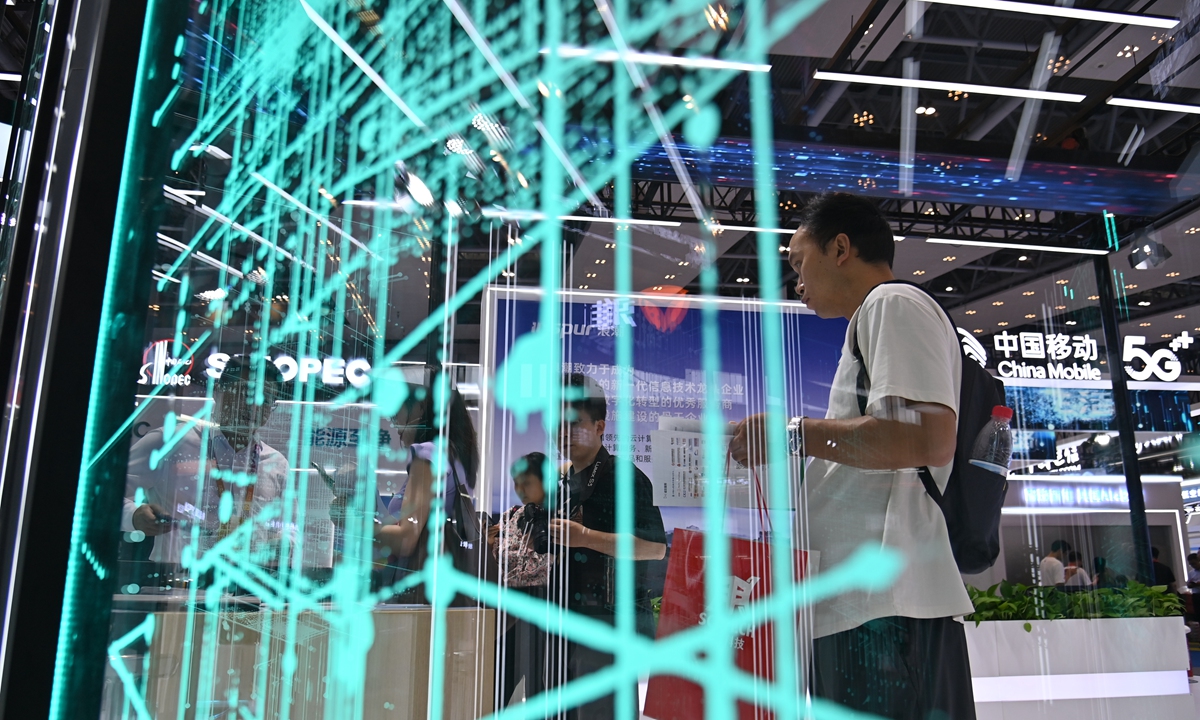
Visitors attend an exhibition at the venue of the 2025 World Smart Industry Expo on September 5, 2025. Photo: VCG
Global AI cooperation
The Chinese government is committed to continuously deepening people-to-people exchanges and strengthening cooperation in scientific and technological innovation, and to sharing the dividends of progress in a wide range of fields, including AI, green energy, and the digital economy, Chinese analysts said.
In 2023, China launched the Global Artificial Intelligence Governance Initiative, systematically outlining China's proposals on AI governance from three aspects, namely, the development, security and governance of AI.
The core components of the Initiative include upholding a people-centered approach in developing AI and adhering to the principle of developing AI for the good of humanity.
AI is a new frontier of human development, and it comes with major opportunities and hard-to-predict risks and challenges that require a global response, a Chinese Foreign Ministry spokesperson noted at the time.
The Chinese model of alignment and coordination, rather than unilateral dominance, not only safeguards the voices of developing countries but also expands market opportunities for developed nations, achieving mutual empowerment, Wang noted.
"For China, the future of AI does not lie in zero-sum games but in leveraging international cooperation to ensure technological benefits transcend national borders and genuinely benefit people across all nations," Wang said.
At the recently concluded 2025 Shanghai Cooperation Organisation (SCO) Summit in North China's Tianjin Municipality, Xi proposed the Global Governance Initiative, calling on countries to work in concert for a more just and equitable global governance system. The Chinese President also mentioned sharing the dividends of progress in artificial intelligence.
At the summit, China pledged to establish 10 Luban Workshops - a vocational education program - in SCO member countries and provide 10,000 human resources training opportunities, facilitating students' access to practical training in emerging technologies such as cloud computing and AI.
China's AI sector has seen comprehensive advances, with China accounting for 60 percent of global AI patents and achieving breakthroughs in humanoid robots and intelligent hardware, said Liu Liehong, head of the National Data Administration, at a press conference on August 14, highlighting China's notable strides in digital technologies during the 14th Five-Year Plan period (2021-25).
China's computational power now ranks second in the world, providing robust support for economic and social development, Liu said.
RELATED ARTICLES