Europe should stand with China in upholding correct historical perspective on WWII: Global Times editorial
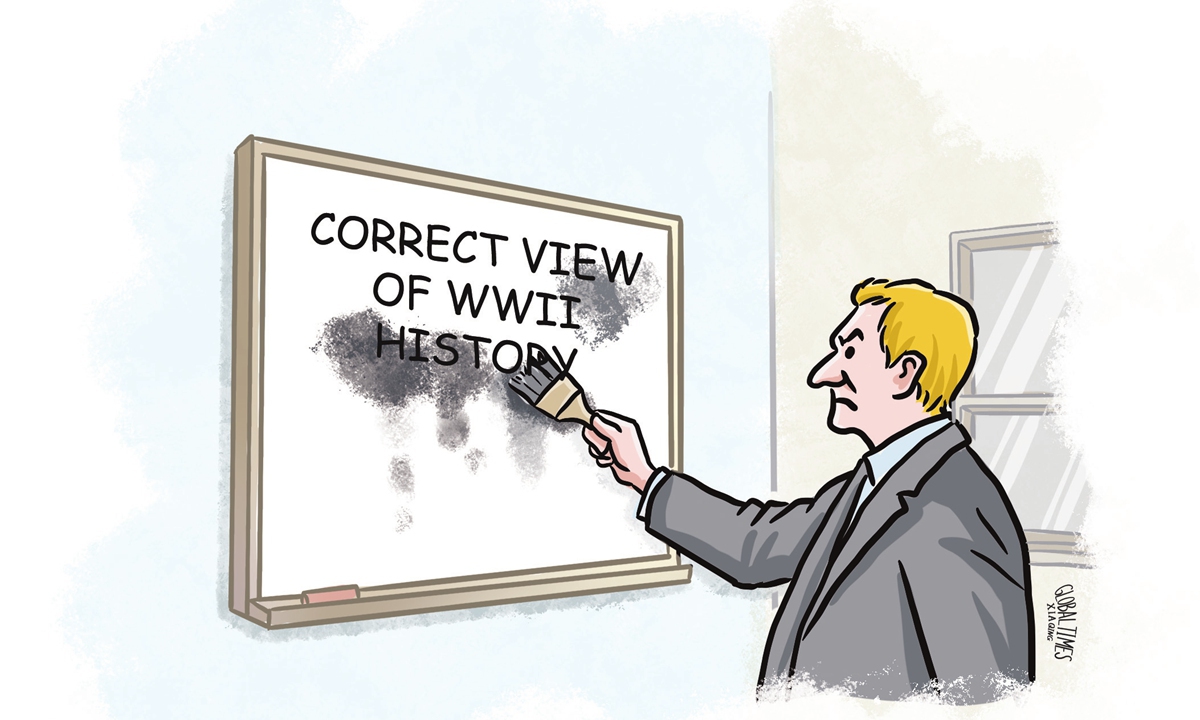
Illustration: Xia Qing/GT
Kaja Kallas, EU High Representative for Foreign Affairs and Security Policy, recently claimed that China stands with Russia, Iran and North Korea during its commemorations on September 3 marking the 80th anniversary of the victory in the Chinese People's War of Resistance against Japanese Aggression and the World Anti-Fascist War. "It isn't just anti-Western optics but is also a direct challenge to the international system built on rules," said Kallas. She also questioned the contribution of China and Russia in the global anti-fascist war. It is hard to believe that such statements, lacking historical common sense and full of ideological bias, are coming from the EU's top diplomat. Europe, where World War II (WWII) was unleashed, is supposed to have a far deeper understanding of the lessons of history, yet some politicians openly distorted history, incited confrontation and antagonism. We urge the EU to immediately correct these erroneous remarks and mitigate their negative impact.
Eighty years ago, with an enormous national sacrifice, the Chinese people made great contributions to saving humanity's civilization and defending world peace. At that time, friends from Russia, the US and some European countries offered precious assistance and support to the Chinese people in their resistance against Japanese aggression. Eighty years later, China hosted grand commemorative events in order to remember history and honor the fallen heroes together with countries around the world, and call for cherishing peace and shaping the future. On this year's Victory in Europe Day in May, many European countries also held commemorations, remembering the war dead, reaffirming commitments to peace, and calling for the protection of multilateral cooperation mechanisms. It is not hard to see that China's commemorative activities for the victory in the anti-fascist war are, in essence, aligned with those of countries around the world, including European nations; Europe should not find it difficult to understand China's perspective.
After attending China's commemorative events, Slovak Prime Minister Robert Fico praised the military parade as "a global event," affirming that "China has the will to play a decisive role in shaping the new peaceful order of the world." He added, "If anyone was isolated today, it was [some politicians in] the EU." Fico spoke the truth. China's commemorative events received broad international support: 26 foreign heads of state and government, more than 20 high-level representatives of foreign governments and heads of international organizations, and over 100 diplomatic envoys from other countries, including 19 European countries, attended the events. They came from five continents across the world. That shows exactly how the international community widely recognizes the historic contribution of China's War of Resistance and its world significance as well as the common aspiration and determination to safeguard world peace and stability. Many Europeans have noted that China made an irreplaceable contribution to the victory in the world anti-fascist war and played an important role in promoting world peace and development.
The remarks from Kallas cannot represent the EU members and European people. In the face of historical justice and international consensus, they carry little weight and are hardly worth refuting. Yet, what they reveal - the pride and prejudice of some Europeans points to one of the roots of today's global instability. It also underscores the necessity and urgency of China's solemn commemoration of this great victory and its advocacy of a correct historical perspective on WWII. Because of errors and distortions in historical understanding, and adherence to Cold War thinking and bloc confrontation, some attempt to recast multilateral cooperation and the WWII narrative into an ideological story of "democracy versus autocracy." They are obsessed with labeling other countries, constantly stirring up disputes and creating instability.
Against the backdrop of repeated public commitments by EU leaders to "jointly uphold multilateralism and safeguard the purposes and principles of the UN Charter," Kallas's shallow words not only run counter to the EU's own interests but also risk further undermining the EU's international credibility and influence. In other words, Kallas has smeared mud on the EU's own face.
During those arduous years of resistance against fascism, China and the anti-fascist forces in Europe stood together in mutual support, forging a profound bond of shared destiny through fire and blood. More than 20 Chinese naval officers traveled to the Royal Naval College in the UK for training, later taking part in the Battle of North Cape, the Normandy landings, and escorting former British Prime Minister Winston Churchill on British warship to the Yalta Conference. Despite extreme hardship and a sharp imbalance in strength, China, at Britain's request, urgently dispatched troops to Myanmar in direct support of the Allied war effort against Japan. German businessman John Rabe established an "international safety zone" during the Nanjing Massacre perpetrated by the invading Japanese army; French doctor Jean Jérome Augustin Bussiere braved mortal danger to set up the "hump route by bike," bring precious drugs to China's anti-Japanese base. The friendship forged in blood between the Chinese and European peoples on the anti-fascist battlefield has stood the test of time. This shared memory of WWII should serve as one of the driving forces for China and Europe to join hands under new historical conditions.
A correct historical perspective on WWII is the cornerstone for building post-war world peace. From the vision of building a community with a shared future for humanity to the four major global initiatives, China has taken concrete actions to firmly defend this correct historical perspective on WWII and to promote the international political and economic order toward democracy, fairness and justice.
As two great forces that once supported each other in life-and-death struggles, and as builders and defenders of the post-war international order, China and Europe should resolutely stand on the right side of history, jointly uphold the correct perspective on the history of WWII, safeguard the fruits of victory, follow the trend of the times, and shoulder their responsibilities. It is hoped that the EU will do more things conducive to world peace and stability and to China-EU relations, rather than the opposite.
RELATED ARTICLES