Philippine Department of Tourism reportedly pushes to restore e-Visa program in China; Manila's move exposes anxieties, self-contradicting policy likely to backfire, expert says

People visit the Manila Bay Dolomite Beach in Manila, the Philippines, Oct. 21, 2021.(File photo: Xinhua)
Philippine Department of Tourism (DOT) is pushing for the easing of visa policy, including the resumption of e-Visa program in China, to ease travel and stimulate demand from its outbound market, according to the Philippine News Agency (PNA).
PNA citing a statement from the state DOT, reported on Sunday that visa facilitation remains a "decisive factor in capturing travelers from major markets such as China."
Chinese expert noted that relaxing visa requirements reflects the Philippines' recognition of the Chinese market's importance. However, the country's provocative stance on issues concerning China's core interests contradicts with its desire to attract Chinese tourists for economic growth, revealing conflicts in its policies and the government's underlying anxieties, and the self-contradicting policy is likely to backfire.
"While many of our ASEAN neighbors have eased or waived requirements and reaped significant gains, the suspension of the Philippines' e-visa program —combined with strict daily visa caps for free independent travelers (FITs)— constrains our ability to serve charter flights that typically operate two to three times a week," the statement said, PNA reported.
The DOT said appointment slots for FITs or those who book their own flights and hotels remain "limited" while group visa applications are "restricted to only twice a week," per the report.
In 2019, the Philippines attracted 1.74 million Chinese tourists. However, by the end of 2024, only a little over 300,000 were recorded, according to the local media outlet Philstar.com.
According to the Philippine local media Manila Bulletin on Saturday, the Department of Foreign Affairs (DFA) on Saturday maintained that visa requirements on Chinese nationals did not result in the decline of tourist arrivals from China.
This was after DOT Secretary Christina Garcia Frasco said that Chinese tourist arrivals went down last year because of the more stringent visa requirements and the suspension of the electronic visa (e-visa) program.
Philippines Department of Foreign Affairs (DFA) on Saturday also claimed that its embassy and consulates are meeting the current demand in China, and are ready to cater to more tourists should visa applications increase.
Earlier, considering that the social security situation in the Philippines has been deteriorating in recent times, with a notable increase in criminal activities targeting Chinese citizens, the Chinese Foreign Ministry, along with the Chinese Embassy and Consulates in the Philippines, reminded fellow Chinese nationals on August 30 to closely monitor the local security situation, enhance their safety awareness, strengthen self-protection measures, avoid areas with security concerns, and ensure the safety of both individuals and property.
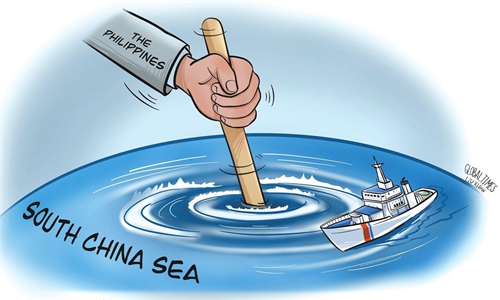
Senior Colonel Tian Junli, a spokesperson for the People's Liberation Army (PLA) Southern Theater Command, said on Thursday that the naval forces of the PLA Southern Theater Command conducted a routine patrol in the South China Sea on Wednesday.
Tian's statement was made in response to a joint patrol by the Philippines, Australia, and Canada.
The Philippine Navy deployed the BRP Jose Rizal, its first missile-guided frigate, while Australia sent the HMAS Brisbane, a Hobart-class destroyer, according to Asia News Network. Canada dispatched the HMCS Ville de Québec, a Halifax-class frigate. Maritime patrol aircraft from Canada, CH-148 Cyclone aircraft, the Philippines, AW-159 Wildcat, and Australia, P-8A Poseidon also joined the exercise, the report said.
As the Philippines is rallying external countries for a so-called "joint patrol," which undermines regional peace and stability, the troops of the theater command maintain a high level of readiness at all times and are determined to defend national territorial sovereignty and maritime rights and interests, said the spokesperson.
Xu Liping, director of the Center for Southeast Asian Studies at the Chinese Academy of Social Sciences, told the Global Times on Sunday that the Philippine government's contradictory actions stem from its internal anxieties. It seeks geopolitical gains by provoking China on South China Sea issues while simultaneously trying to leverage the Chinese market for economic growth. This self-contradicting strategy is likely to backfire.
"If the Philippines wants to genuinely attract Chinese tourists, it must improve its business environment and revise its unfriendly policies toward China, particularly those from hostile sectors," Xu added.
RELATED ARTICLES