From labs to real-world use, China speeds up commercialization of dexterous tools
Transformative robotic hands
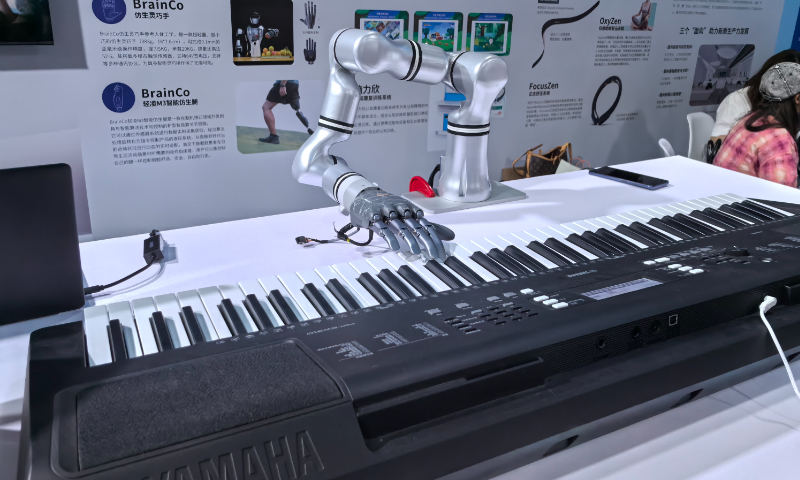
A robotic dexterous hand from Brain Co plays piano at the China International Big Data Expo in Guiyang, Southwest China's Guizhou Province on August 29, 2025. Photo: Zhang Yiyi/GT
At the 2025 China International Big Data Industry Expo in Guiyang, Southwest China's Guizhou Province, visitors stopped to watch a dexterous robotic hand play an electric piano. Its five fingers moved in coordination, striking each key with precision. While it resembled a performance, it was actually a precise engineering demonstration by BrainCo, where every keystroke was pre-programmed to highlight the dexterity of the hand.
"This hand doesn't have a brain - it's just a tool," a BrainCo staff member told the Global Times. "But we programmed it to follow sheet music using finger coordinates. What's demonstrated here is thumb control, finger dexterity, and material flexibility - all of which are critical for real-world applications."
Building on its experience developing bionic prosthetics, the company expanded into producing robotic hands for humanoid robots, applying years of research and data. A mature dexterous hand typically requires six months to a year of standardized R&D, the staff member said.
Dexterous hands, which mimic human movement, are now a key link in the embodied intelligence chain. As humanoid robots scale up, demand is rising for hands that are tactile, reliable, and affordable for real-world use, industry insiders said.
"Improving the dexterity of robotic hands is the 'last mile' in developing humanoid robots," said Liu Gang, chief economist at the National Research Institute for New Generation Artificial Intelligence Development Strategies.
Evolving robot hands
BrainCo's latest dexterous hand, the Revo 2, is among the world's lightest professional-grade models, the company said. Weighing just 383 grams, it features 11 degrees of freedom (DoF) and integrates multi-dimensional tactile sensors into the finger structure, enabling it to detect pressure, texture, hardness, and proximity, combining compact form with strong perceptual ability for real-world use, according to the technician.
DoF in robotic hands refer to independently controlled joints. More DoF means greater flexibility and more human-like movements.
"The focus has shifted from enabling robots to walk or stand, to refining their ability to operate. Whether it's in industrial manufacturing or household service, the hand's sensitivity is vital. Breakthroughs in this area will enable large-scale deployment in the not-too-distant future," Liu told the Global Times.
Liu said the gap between China and global front-runners is narrower than people had assumed. "Most advanced robotic hands worldwide remain in laboratories. China's strength lies in scaling and cost control - especially in materials, sensors, and tactile technologies."
One example of commercial adoption is AgiBot's OmniHand 2025. The Interactive version, weighing 500 grams with 16 degrees of freedom, can guide customers, play games, or hand out brochures. The Professional version boasts 19 degrees of freedom and sub-0.1N sensing precision for industrial and research applications.
From R&D to application
In 2023, China's Ministry of Industry and Information Technology (MIIT) issued a set of guidelines that listed dexterous hands as part of the core "machine limb" technologies to be systematically improved and used. By 2027, China aims to enhance innovation in humanoid robotics, secure its supply chains, and build a globally competitive ecosystem, with the sector expected to expand and diversify its applications, the guidelines said.
Specialized dexterous hand makers, robotics firms such as Unitree, and academic institutes across China, are stepping up their R&D efforts. A representative from Shenzhen-based Rui Intelligent Control told Global Times that their dexterous hands range from several thousand yuan to as much as 60,000 yuan ($8,411.8), noting that "a top-tier hand can cost more than a standard robot."
"China's vast market offers unique advantages," Liu said. "Application scenarios create real demand, which in turn drives advances in algorithms, computing power, and materials."
Chinese scientists are also making global headlines. A joint team from Peking University and the Beijing Institute for General Artificial Intelligence in June developed the F-TAC Hand, the world's first robotic hand to combine full-hand high-resolution tactile perception with complete motion capabilities.
The team told the Global Times that the system mimics the human palm by sensing contact changes in real time and making rapid adjustments, significantly improving robotic stability in unpredictable environments.
"This achievement deepens our understanding of intelligence and provides valuable insights for developing next-generation AI systems," the researchers said.
"From precision inspections in mines to stem cell production in medical labs," Liu concluded, "China is well positioned to lead the commercialization of intelligent robotic hands."
China's robotics industry size grew 27.8 percent year-on-year in the first half of 2025, with industrial and service robot output up 35.6 percent and 25.5 percent respectively, according to the Ministry of Industry and Information Technology. The country remained the world's largest industrial robot market for the 12th consecutive year, with 302,000 units sold.
According to incomplete statistics from the Sci-Tech Innovation Board Daily, more than 20 funding deals related to robotic dexterous hands have been recorded in China since last year, with total investment exceeding 3 billion yuan ($410 million).
Driven by technological advances and rising demand, dexterous hands are rapidly moving from R&D to industrial application. Forecasts suggest that global shipments of robotic dexterous hands could exceed 860,000 units in 2025, worth $1.92 billion. Over the same period, China's humanoid robotics industry size is projected to reach 5.5 billion yuan and expand to 38.7 billion yuan by 2028.
RELATED ARTICLES