IN-DEPTH / IN-DEPTH
Witness to history: 99-year-old Chinese veteran relives passion at V-Day parade: I felt like 'traveling through time' to see myself as young soldier
Pride in prosperity
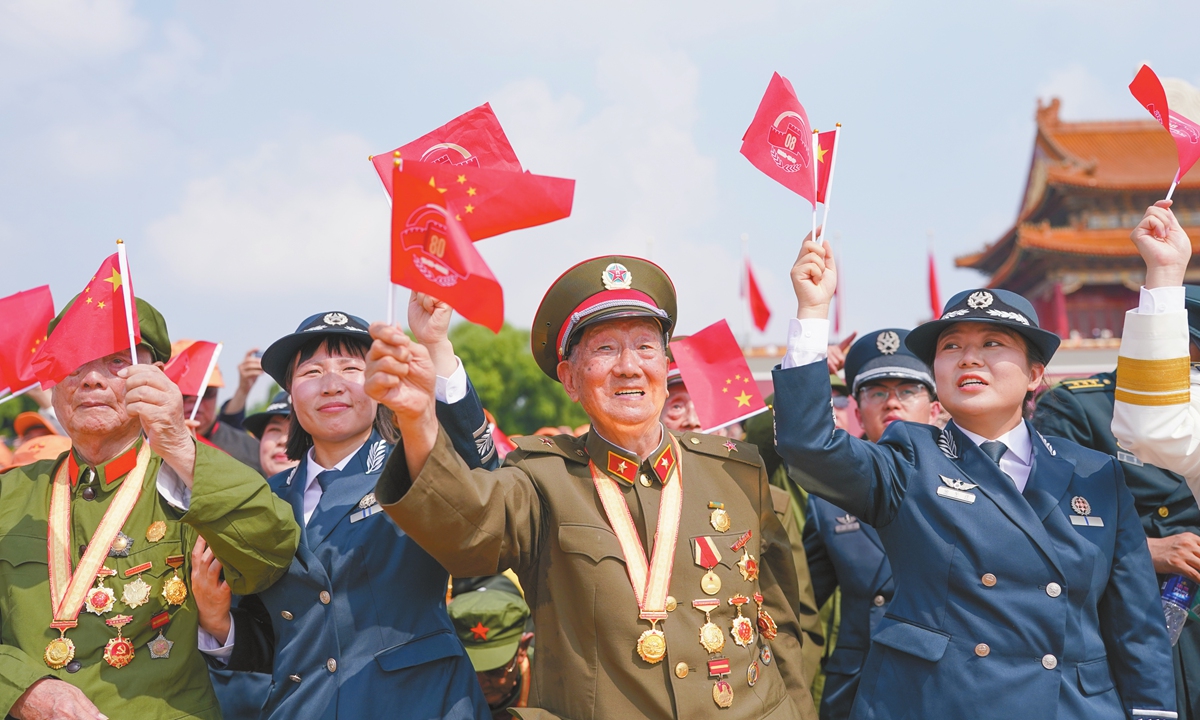
Some veterans wave flags during the ceremony marking the 80th anniversary of the victory of the Chinese People's War of Resistance Against Japanese Aggression and the World Anti-Fascist War. Photo: VCG
Editor's Note:
On September 3, 2025, at the Tian'anmen Rostrum in Beijing, a cohort of extraordinary senior citizens sat upright in their wheelchairs. Despite their age and physical constraints, they held their heads high, just as they had done when standing at attention before heading off to battle all those years ago.
They are Shen Bingchen, Zhang Ping, Liu Shiyue, Fu Ying, Luo Jinghui, and Song Qixiang, six veteran soldiers and comrades who emerged from the flames of the Chinese People's War of Resistance Against Japanese Aggression (1931-45). The oldest among them is over 100 years old, while the youngest is 94.
Ahead of the ceremony, Chinese President Xi Jinping, also general secretary of the Communist Party of China (CPC) Central Committee and chairman of the Central Military Commission, stepped onto the Tian'anmen rostrum, shaking hands with Chinese war veterans in turn.
The Global Times spoke with two of these veterans, capturing their reflections on an arduous wartime past and their feelings of pride amid the solemn occasion of honoring the war victory.
This story is also part of the Global Times' "Witness to History" series, which features first-hand accounts from individuals who were at the forefront of historic moments.
From scholars, politicians, and diplomats, to veterans and ordinary citizens, their authentic reflections on the impact of historical moments help reveal a sound future for humanity through the solid steps forward taken in the past and present.
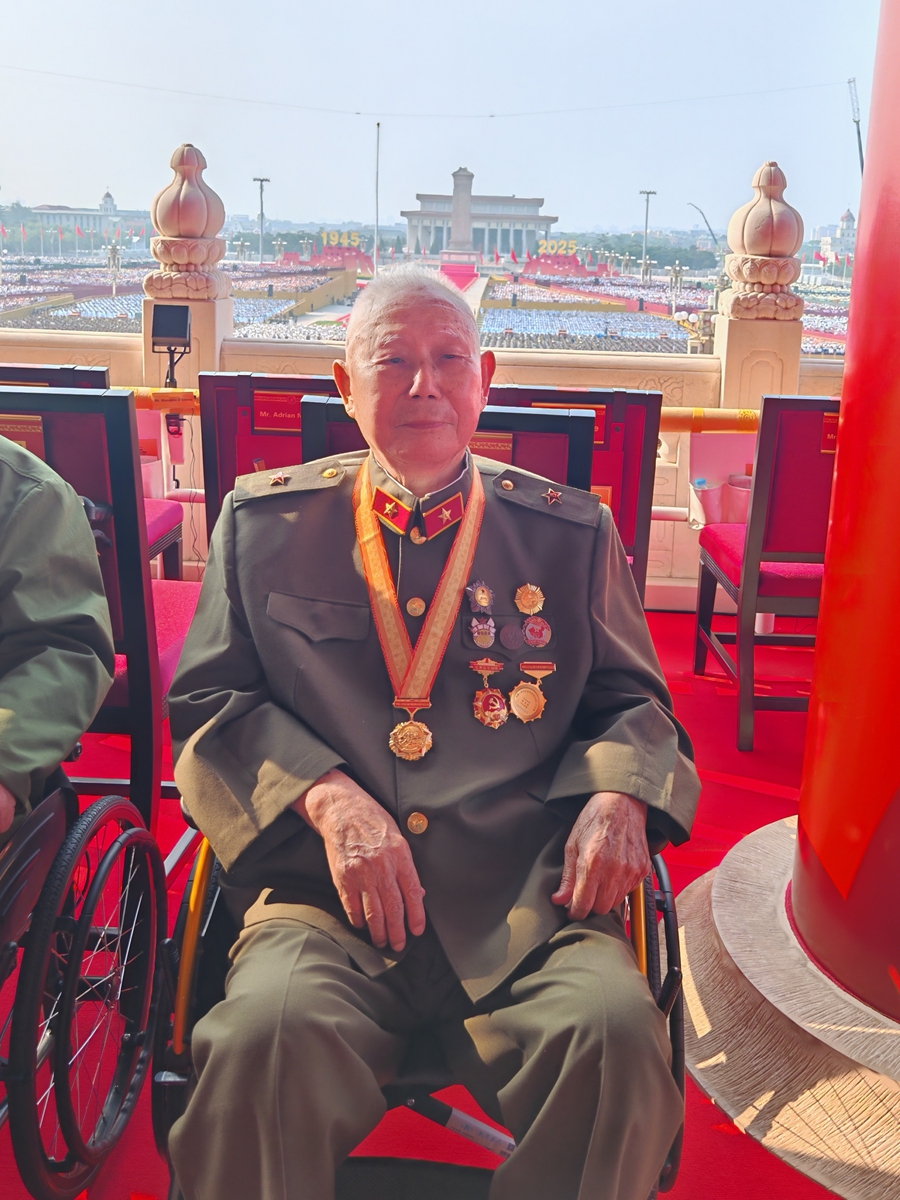
Shen Bingchen, a 99-year-old veteran of the Chinese People's War of Resistance Against Japanese Aggression and the World Anti-Fascist War Photo: Courtesy of Shen
On September 3, at the ceremony marking the 80th anniversary of the victory of the Chinese People's War of Resistance Against Japanese Aggression and the World Anti-Fascist War, 99-year-old veteran Shen Bingchen stood on the Tian'anmen Rostrum, holding the railing with both hands as the reviewing formations marched past. Clad in military uniform, his eyes shone bright with patriotic pride.
As a representative of the veterans, Shen was cordially received by Chinese President Xi Jinping, also general secretary of the Communist Party of China (CPC) Central Committee and chairman of the Central Military Commission, and shook hands with him. On September 6, when interviewed by the Global Times, the veteran, a Party member for 82 years, said that it was an extremely glorious and fortunate moment. "I looked at the young soldiers being reviewed and it was as if I had traveled through time and saw my own youthful appearance when I joined the army."
"I remember feeling very lucky when I first received the notice. There were so many veteran soldiers, and they chose me!" Shen still couldn't hide his excitement when talking about the situation at that time. "At first, I only knew that I would be seated on the Tian'anmen Rostrum to watch the ceremony. I didn't expect to later learn that I would be received by President Xi. It was a great honor. As a representative of the veterans, I should show the image of the veterans," Shen told the Global Times, noting that from then on, he began daily preparations, repeatedly considering every detail from whether his buttons were neatly fastened to how standard his salute posture was.
The day before the parade, Shen was so excited that he couldn't sleep. "I got up at around 4 am and repeatedly checked whether I had all my documents with me. I set off on time at 6 am."
Extremely excited, on September 3, Shen took his place on the Tian'anmen Rostrum. "Standing on the rostrum and looking out at Tian'anmen Square, where the Great Hall of the People is on the right and the National Museum of China is on the left, I felt very excited." As he spoke, Shen's voice shook, heavy with emotion.
As a representative of the veterans, Shen was the first to shake hands with President Xi. "I saluted him first, and he nodded and smiled in response and extended his hand. It felt kind, warm, and jovial." The nearly centenarian happily recalled the details of the great day. Shen declared the seemingly simple handshake to be the highest affirmation of his past military career. At that moment, he represented not only one veteran, but also the countless soldiers who bled and sacrificed for the country during those arduous years.
The parade had 45 formations (echelons), and the weapons and equipment on display were all selected from the current main battle equipment made in China, with a large proportion of new equipment. From the difficult years of "having no guns, no cannons, and the enemy making them for us," to the powerful lineup of "ironclad vehicles rushing, eagles soaring in the sky, and long swords pointing to the sky" today, the Chinese military has undergone earth-shattering changes.
"As I watch the heavy military equipment rolling through the square, I am truly overwhelmed with emotion," said Shen. The scene stirred Shen's memories of the arduous years during the resistance war against Japanese aggression. "Thinking about the time when we fought against the Japanese army, our equipment was very simple. We only had millet and rifles, and even broadswords and spears. But now, our military boasts comprehensive and advanced systems, with high-tech weaponry covering the skies, the land, the seas, and even underwater domains. All kinds of advanced weapons are available."
"Our troops are highly trained, advancing with the relentless force of a steel tide. Our country's military has become powerful. It is no longer a situation where the enemy is strong and we are weak, but one in which we are stronger when the enemy is strong," Shen said.
During the interview, Shen wore a golden medal on his chest - the Commemorative Medal for the 80th Anniversary of the Victory of the Chinese People's War of Resistance Against Japanese Aggression. "This medal holds extraordinary meaning. Wearing it feels like carrying this glorious moment close to my heart at all times," he explained, stressing that "the medal also represents our nation's care for its veterans and symbolizes how the history of the war will never be forgotten."
"Watching this parade, I am deeply impressed by the leaps in our country's comprehensive national strength," Shen remarked, his tone resolute. "From standing up at the time of liberation to growing in prosperity, and now to becoming strong, there has been all-round progress in the economy, science and technology, industry, and the modernization of the military. As the country becomes stronger, its status and influence in the international community are also increasing day by day."
"This military parade not only makes us veterans feel deeply gratified, but also inspires the people of the whole country to remember history, cherish the memory of the martyrs, value the hard-won peace, and strive to contribute to the great rejuvenation of the Chinese nation," he said.
RELATED ARTICLES