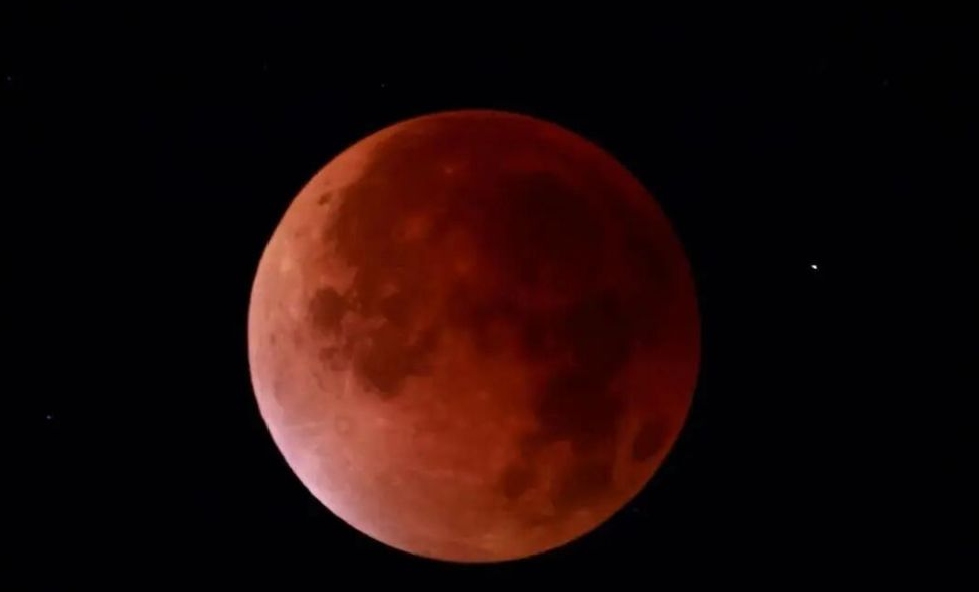
September 8th, Total Lunar Eclipse in Beijing Photo:Xinhua News Agency
For the first time in nearly three years, people across China were able to witness the total lunar eclipse. From last Sunday midnight to the early morning Monday, Beijing time, a spectacular total lunar eclipse occurred, visible in its entirety across the country, during which the moon appeared a rare crimson hue.During the total lunar eclipse, the "red moon" lasted nearly 83 minutes, with the most spectacular phase occurring from 1:30 am to 2:53 am on Monday, according to Purple Mountain Observatory of the Chinese Academy of Sciences.
"The moon appears a rare dark red, because of the refraction and scattering of sunlight by the Earth's atmosphere, during which a small portion of longer-wavelength red light passes through the atmosphere and illuminates the lunar surface," Song Yuanyuan, a member of the Chinese Astronomical Society, explained to the Xinhua News Agency.
On Sunday evening, social media platforms were abuzz with discussions about the red moon, as netizens eagerly awaited this rare astronomical event. Some netizens said that the moon appeared noticeably redder than usual to the naked eye, while others cheerfully admitted that though they might not stay up for the midnight lunar eclipse, enjoying the "prelude" was already a delight.
Across China, many astronomy and photography enthusiasts set up their cameras, capturing the "red moon" and its trajectory. "This total lunar eclipse offered a remarkably complete viewing process, requiring patient observation from start to finish," one photography aficionado told Qianjiang Evening News. Many netizens also shared their awe, with one commenting, "Gazing at the starry sky is a romantically wondrous experience," and another exclaiming, "It was incredibly cool — a whole new life experience."
From Sunday night through Monday morning, social media was dominated by the celestial event, with users flooding platforms like WeChat Moments to share photos.
Late-night sky watchers saw not only a stunning red moon, but also to a rare astronomical sight: Saturn appearing slightly above and to the left of the Moon, according to Qianjiang Evening News.
Several astronomical institutions, such as the Shanghai Astronomy Museum and Beijing Planetarium, livestreamed the total lunar eclipse on social media platforms Sunday night, inviting relevant experts to provide commentary. Many schools in Beijing also organized students to watch the lunar eclipse in open areas on their campuses, according to schools' official Wechat accounts.
The astronomical base located in Shimen Mountain, East China's Anhui Province, organized a camping event for astronomy enthusiasts on Sunday night to observe the lunar eclipse under the stars. In the days prior, the base also arranged science outreach activities such as lunar eclipse-themed handcrafts and quiz competitions, according to its official WeChat account.
The last total lunar eclipse visible in China occurred on November 8, 2022, mainly observable possible in central and eastern regions, according to Chinese Academy of Sciences.
According to astronomical calculations, another lunar eclipse, in which the moon will rise already partially eclipsed, will be visible in central and eastern China on March 3 next year. The next occasion when the entire process of a total lunar eclipse can be observed nationwide will fall between December 31, 2028, and January 1, 2029, requiring a wait of more than three years, China News Agency reported.
Global Times
RELATED ARTICLES