ARTS / CULTURE & LEISURE
China’s earliest known wooden coffins from 8,000 years ago unearthed in Henan Province
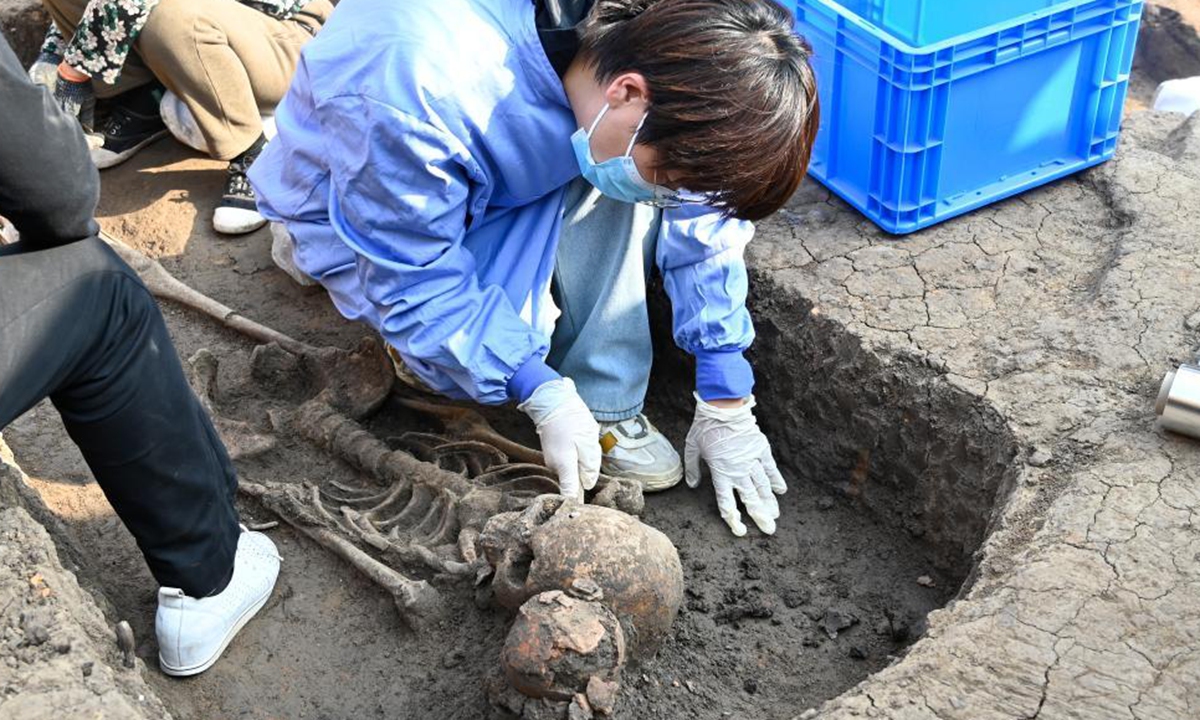
Archaeologists work at the Jiahu site in Central China's Henan Province. Photo: Xinhua News Agency
Archaeologists in Central China's Henan Province have unearthed the country's earliest known wooden coffins. This discovery indicates that the coffin-and-chamber burial system, an important part of ancient Chinese ritual practices, had already emerged more than 8,000 years ago, according to the Xinhua News Agency on Monday, citing the Henan Provincial Institute of Cultural Heritage and Archaeology.The discovery was made at the Jiahu site in Henan Province's Wuyang county, a large and culturally rich Neolithic settlement already known for being the birthplace of China's earliest bone flutes. It had previously yielded large numbers of bone flutes, turtle shells, pottery and stone tools, offering key insights into the origins of Chinese civilization.
"These are the earliest wooden coffins discovered in China to date, pushing back the appearance of wooden burial furniture by about 2,000 years," Wei Xingtao, deputy director of the institute, told the Global Times on Monday.
"Previously, scholars had generally believed that wooden coffins first appeared about 6,000 years ago during the early Dawenkou culture," said Han Jianye, professor at the School of History at Renmin University of China. "The discovery of wooden coffins at the Jiahu site provides new material for exploring the origins of prehistoric wooden coffins."
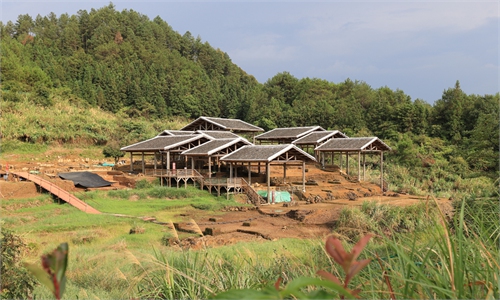
Since 2023, the researchers at the institute have carried out ongoing excavations at the site, recently confirming it as a 65,000-square-meter moat-surrounded settlement with distinct functional zones, according to the report.
"In the central cemetery, we have uncovered more than 200 tombs, 10 of which show evidence of wooden coffins," Li Jindou, head of the site excavation, told the Global Times. Some coffins measured approximately 2 meters in length, 0.6 meters in width and 6 centimeters in thickness, he said, adding that soil analysis from the sites showed significantly higher lignin content than the surrounding areas.
Most of the tombs in the central cemetery contained grave goods such as bone flutes and turtle-shell objects, some of them finely crafted. The coffins could be visually identified as made from wood, and the scale and richness of the burials suggest that many were clearly of a higher status than others in the settlement, according to Wei.
"For example, one tomb yielded 600 pieces of turquoise," Wei said. Even more significantly, archaeologists uncovered five flutes in a single tomb - a first for the site. The bone flutes bore engraved symbols and evenly spaced notches along one side, resembling early measurement marks. "They are quite different from others," he added.
Excavations over the past two years also confirmed a surrounding moat at the settlement. Wei said the material evidence points to social stratification. The confirmation of wooden coffins pushes back the appearance of the burial practice by more than 2,000 years, showing that the ritual system of coffins was already emerging. Sets of ritual vessels, including pots, jars and tripods, along with different types of sacrificial pits, indicate that early funerary rites had taken shape. Unequal access to rare resources such as turquoise, and their concentrated spatial distribution, suggest the formation of elite social groups. The construction of the moat demonstrates a degree of social organization, likely based on collective authority.
In his view, these recent discoveries together reveal a relatively "advanced" pattern of social development clearly distinct from surrounding regions of the same period. They also align with the ideas and social conditions reflected in previously known artifacts such as bone flutes, turtle-shell instruments, and fork-shaped tools.
"Jiahu site is a representative and key site for understanding the origins of civilization," noted Wei.
Protective shelters have now been built over the core burial area. "Our next step will be to extract the key tombs in their entirety and transfer them to a laboratory for more detailed excavation and study," said Li.
RELATED ARTICLES