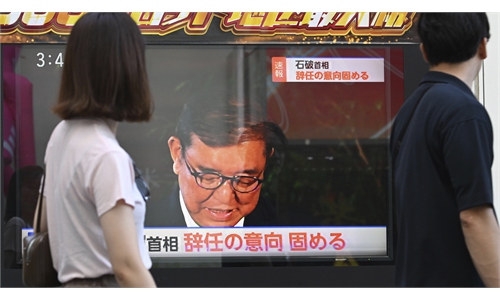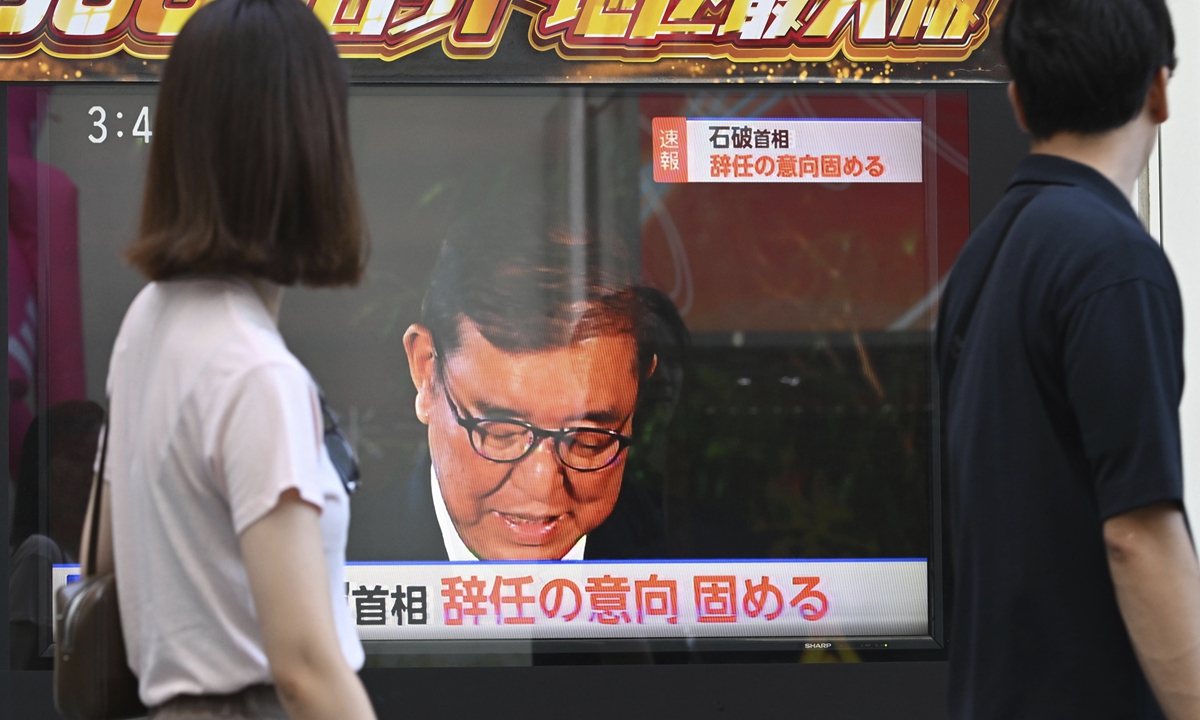
Passersby in Tokyo on September 7, 2025 watch a TV broadcast reporting that Japanese Prime Minister Shigeru Ishiba decided to resign as LDP head. Photo: VCG
On Sunday, Japanese Prime Minister Shigeru Ishiba announced his resignation as the head of the Liberal Democratic Party (LDP), triggering uncertainties in Japan's political scene. Although Ishiba claimed that the resignation was aimed at avoiding a split within the LDP and that the conclusion of Japan-US trade negotiations provided an appropriate time to resign, the upcoming LDP presidential election will plunge Japan's political arena into new uncertainties in politics and diplomacy. This raises questions about whether policies, such as regional revitalization and economic growth measures, will continue. In particular, the short-lived tenure of Ishiba's cabinet, which lasted less than a year, along with the repeated changes of leadership in postwar Japan, has sparked further concerns over the impact of frequent leadership change on Japanese politics and foreign policy.First, the frequent change of prime ministers has multiple impacts on Japanese politics. Since the beginning of this century, Japan has repeatedly experienced "revolving-door" changes of prime ministers. For instance, between 2006 and 2012, Japan went through seven prime ministers in seven years.
This frequent leadership change undermines political stability and policy continuity, triggering electoral competition and bringing policy differences with the election of different candidates. As a result, implementing established policies and forming long-term, effective governance strategies that are trusted by the public becomes increasingly difficult.
Moreover, it intensifies domestic political divisions and power struggles within the political arena. Since being elected as LDP president usually means becoming prime minister, the contest for succession has always been fierce. Factional struggles and behind-the-scenes maneuvering exacerbate internal confrontation and increase the risk of division within the LDP, further weakening its cohesion as the ruling party. Additionally, the situation seriously affects domestic economic recovery and social stability, expanding public distrust and opposition toward the government.
Second, frequent changes of prime ministers bring overlapping shocks to Japan's diplomacy. Since the postwar period, Japan has adhered to a diplomacy centered on the US, encompassing bilateral, regional and global diplomacy. The frequent change of prime ministers creates diplomatic vacuums and reduces Japan's ability to coordinate in foreign affairs.
The frequent change increases doubts and mistrust toward Japan's global diplomacy. It conveys the impression that the state is unable to maintain a consistent diplomatic stance in international affairs, shaking the foundations of its diplomacy and trust relationships, and raising greater concerns over its lack of coherence in handling global issues.
Finally, frequent leadership change has become the norm in Japan's political arena. The political culture's emphasis on the pursuit of power and interests has further intensified leadership change.
It reflects the cyclical dilemma of Japan's party politics. Since the establishment of the LDP in 1955, the 28 presidents in the postwar era have served an average of less than three years. Former prime minister Sosuke Uno, who resigned in August 1989 after just 69 days, holds the record for the shortest-lived cabinet in LDP history, underscoring that prime ministerial change is not an isolated incident but a persistent feature of Japan's politics over the past 70 years.
Diplomatic adjustments under such leadership change are hardly surprising. Frequent changes in leadership push Japan's bureaucratic system to adjust diplomacy according to shifts in domestic politics, regional circumstances and international developments. Yet these adjustments still leave behind difficulties and uncertainties in the implementation of foreign policy, undermining Japan's long-term planning and strategic thinking in international affairs.
Finally, it has fueled public disillusionment with Japanese politics. The ripple effects of political reshuffling - where one change pulls down others - have left citizens dissatisfied with short-lived successive cabinets and the excessive turnover of prime ministers. Growing discontent has further deepened public doubts about the LDP's governing legitimacy and the nation's development path.
Ishiba's resignation reflects not only the institutional flaws and weakened checks in Japan's postwar party politics, but also the LDP's attempt to regroup after repeated election defeats and mounting public criticism. Since prime ministerial changes are often seen as sensitive moments and periods of diplomatic adjustment, the rise of a new party leader - or even a new prime minister - will shape Japan's political and diplomatic course, with consequences for both domestic stability and foreign policy.
The author is research fellow at the Institute of Northeast Asian Studies at Heilongjiang Provincial Academy of Social Sciences and expert of Research Center of Revitalization of Northeast China. opinion@globaltimes.com.cn
RELATED ARTICLES