Illustration: Xia Qing/GT
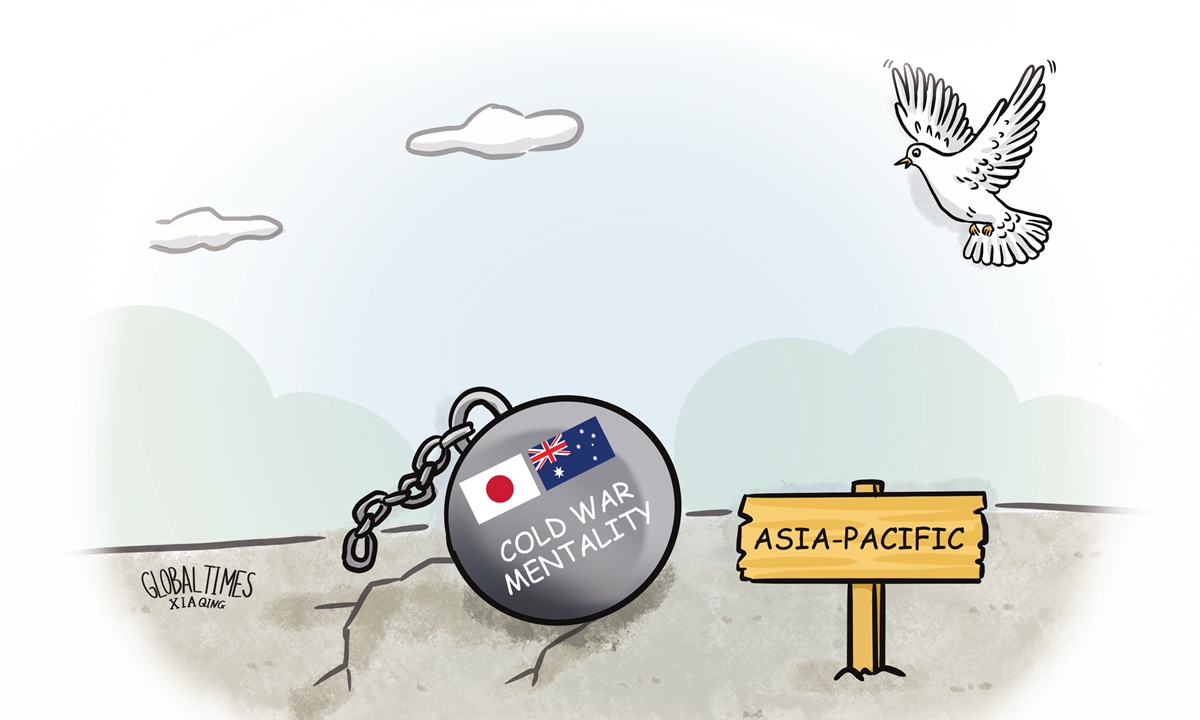
On Saturday, Japan and Australia issued the Joint Statement on the 12th Japan-Australia 2+2 Foreign and Defence Ministerial Consultations ("2+2"). Rife with ideological bias and deliberately inflating regional tensions, the statement claims to promote "a peaceful and stable region," while in reality, both countries seek to forge an exclusive military alliance and intensify bloc confrontation. Its outdated Cold War mentality, constant hype over regional flashpoints, and obsession with bloc politics will not contribute to regional stability; instead, they are attempting to push the Asia-Pacific to the dangerous brink of division and conflict.
At its core, the Japan-Australia "2+2" statement aims to construct a circle of "like-minded" countries under the banner of shared values - essentially a continuation and repackaging of Cold War-era bloc confrontation thinking. It flaunts its "unprecedented strategic alignment" and emphasizes strengthening "collective deterrence," centered on trilateral US-Japan-Australia cooperation, the US-led Quad and deeper integration with AUKUS.
The danger of this approach lies in its attempt to artificially divide regional countries into opposing camps. The statement's repeated references to coordinating with the US and other "key partners," as well as deepening cooperation with blocs such as NATO, reveal an attempt to introduce external military groupings into the region - a move that will inevitably destabilize the Asia-Pacific security architecture.
Even more alarming is the statement's explicit linkage of Japan-Australia cooperation with AUKUS, a military alliance rooted in Anglo-Saxon traditions. It prominently welcomes Japan's first participation in an AUKUS Pillar II maritime exercise and pledges to explore expanded collaboration on advanced capability projects. This signals that the Japan-Australia partnership is accelerating its integration into a more offensive and confrontational military-technological bloc, with an unspoken but evident target. Such overlapping and expanding military cliques will erode mutual trust among regional countries, and ultimately drag the Asia-Pacific into a vortex of arms races and geopolitical conflict.
On the Taiwan question, Japan and Australia reiterated the importance of cross-Straits "peace and stability" and expressed "strong opposition to any unilateral attempts to change the status quo by force or coercion." Such statements not only interfere in China's internal affairs but also send a gravely wrong signal to "Taiwan independence" separatist forces - a move that itself severely undermines cross-Straits peace and stability.
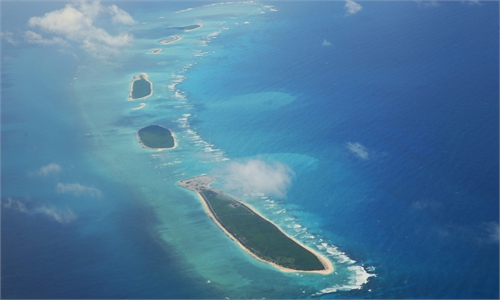
On maritime issues, Japan and Australia ignored China's consistent commitment to resolving South China Sea disputes through dialogue and consultation and turned a blind eye to the Philippines' provocative and infringing acts. They even endorsed the unlawful and non-binding "award on the South China Sea arbitration" - a document long rendered invalid. By taking these actions, they have adopted a biased and provocative stance that will only exacerbate regional tensions.
Ironically, Japan and Australia claim that China's military activities are destabilizing and non-transparent, while it is their own large-scale joint military exercises, coupled with expanding forward deployments, that are fueling escalating tensions and increasing the risk of miscalculation in the region.
Within Australia-Japan cooperation, Japan's ambitions demand special vigilance. In recent years, right-wing forces in Japan have sought to break free from the constraints of the post-war international order, revise Japan's "Peace Constitution," and pursue "national normalization." Deepening defense cooperation with Australia has become a key step toward this strategic goal. The joint statement elevates Japan-Australia defense industry collaboration to an unprecedented level: Australia's selection of Japan's Mogami-class frigate as the preferred platform for its next-generation general-purpose frigates marks a significant breakthrough in Japan's post-war arms exports.
Furthermore, the Japan Self-Defense Forces' first overseas launches of the Type 03 medium-range surface-to-air missile and the Type 12 surface-to-ship missile during the "Talisman Sabre 2025" exercise send another dangerous signal. The extended-range Type 12 missile, in particular, is widely believed to enable long-range strikes against enemy land targets - capabilities that go far beyond Japan's "exclusively defense-oriented" policy.
Australia shouldn't allow itself to become a "strategic springboard" for Japan's attempts to shed its post-war restraints and revive its militaristic ambitions. The Japan-Australia "2+2" meeting has revealed a misguided path toward division, confrontation and conflict. The Cold War script they cling to will not solve real-world challenges; instead, it will create more contradictions and crises. The zero-sum Cold War mentality embedded in Japan-Australia military cooperation is unlikely to bring true security to either country; instead, it will only mire them deeper in an inescapable security dilemma.
The author is a distinguished research fellow at the Department for Asia-Pacific Studies of the China Institute of International Studies. opinion@globaltimes.com.cn
RELATED ARTICLES