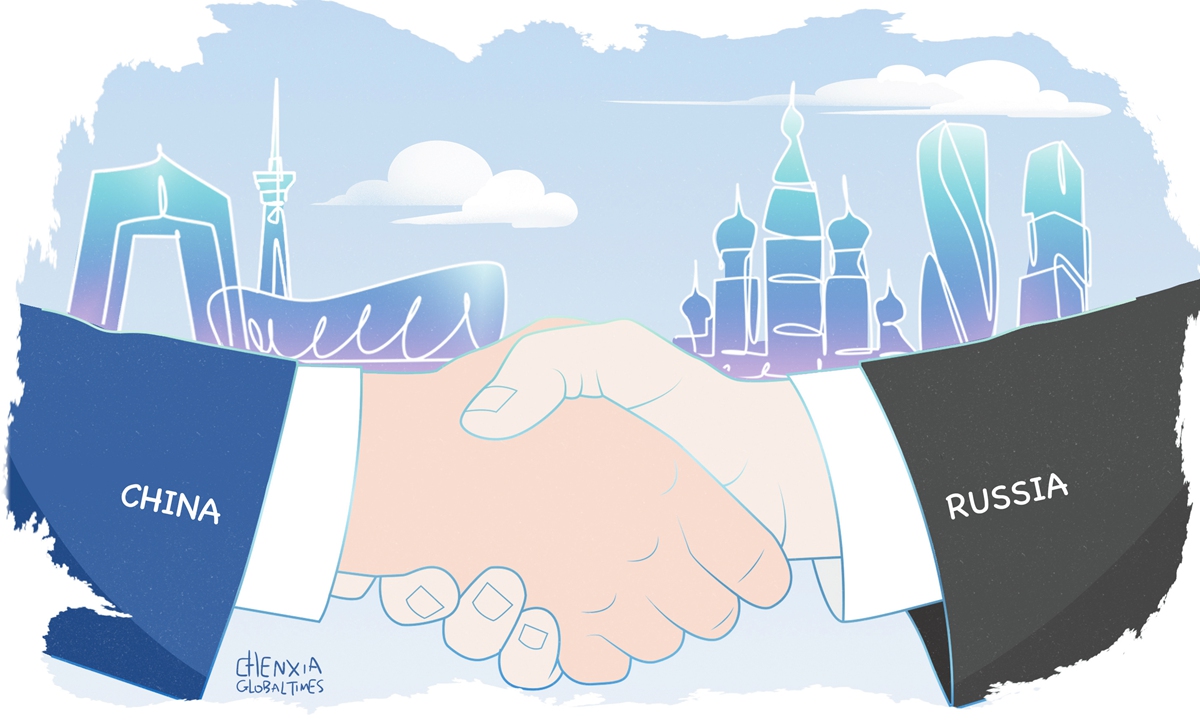
Illustration: Chen Xia/GT
China is one of the countries that Russian President Vladimir Putin has visited most frequently during his time as head of the Russian state. The significance and results of these visits extend far beyond the bilateral dimension, influencing the development of global politics and economics. Relations between China and Russia have already become one of the most important foundations of contemporary international life.
First, a high level of mutual trust has been established between the two countries and continues to deepen. Second, the two countries share common views on what a fairer world order should look like. Finally, both sides contribute actively to building such an order, based on the principles of the UN Charter, international law, and respect for the sovereignty of all states.
President Putin's recent visit to China was one of the longest high-level meetings in history. It included participation in the Shanghai Cooperation Organisation Summit, bilateral talks between Russian and Chinese leaders, and ceremonial events commemorating the victory in World War II. The central event was the military parade in Beijing, attended by 26 foreign heads of state and government from around the world. The symbolic significance of this parade lay in the unity of those who gathered in Beijing to honor one of the defining international events of the 20th century. It was China and Russia that made the most significant contributions to the victory over German and Japanese fascism and bore the heaviest human losses along the way. In May 2025, Chinese President Xi Jinping attended the V-Day parade in Moscow, which became the central event of Russia's jubilee year.
Equally important for both China and Russia was the fact that the meetings and events in China brought together leaders from countries whose interests do not always coincide but whose values regarding the world order are shared. These gatherings also triggered an emotional response in Western media and political circles. Western commentators focused particularly on the progress in China-Russia relations and the participation of numerous states in the celebrations. In the West, this was interpreted through the traditional "black-and-white" worldview, in which countries are pressured to make choices against their own interests.
The emotional reaction in the West is not surprising, as relations between the US and Europe are currently undergoing serious turbulence. Two complex issues stand at the forefront. First, political disagreements over how to resolve the crisis in Ukraine. Second, internal divisions within the West caused by trade and economic disputes. The US government is pressing Europe on many issues, from energy imports to tariff restrictions on products. If unity existed within the West - which it does not - they would view the relations between China and Russia with less envy.
Meanwhile, China-Russia bilateral relations received several new impulses during President Putin's visit. An agreement on the transit gas pipeline through Mongolia, which is effectively part of the Power of Siberia 2 project, was reportedly signed. It is obvious to all observers that Mongolia will not be the final destination of Russian gas exports, and the new volumes will be directed to the Chinese market. Equally important was the noted increase in supplies through the already operating Power of Siberia 1 pipeline, which rose from 38 billion to 44 billion cubic meters annually. Now, China will receive 56 billion cubic meters of East Siberian gas each year. Altogether, total gas exports may exceed 100 billion cubic meters annually. For comparison, until 2022, nearly 150 billion cubic meters of gas per year were exported from Russia to Europe, where cooperation had been built over decades.
The most unexpected breakthrough, however, was in the matter of visa-free travel between China and Russia. Negotiations on this issue had been ongoing for quite some time. The breakthrough occurred when China first announced visa-free entry for Russians, followed by President Putin's pledge to "do the same." Moscow highly valued China's determination to facilitate people-to-people and business contacts and welcomed the new strategy of mutual openness. This step fully aligns with the spirit of bilateral relations and represents an important example for the world.
Other countries can see that China and Russia not only call for the creation of a new type of international relations but also lead by example, demonstrating open cooperation based on shared values in interstate relations.
The author is the program director of the Valdai Discussion Club. opinion@globaltimes.com.cn
RELATED ARTICLES