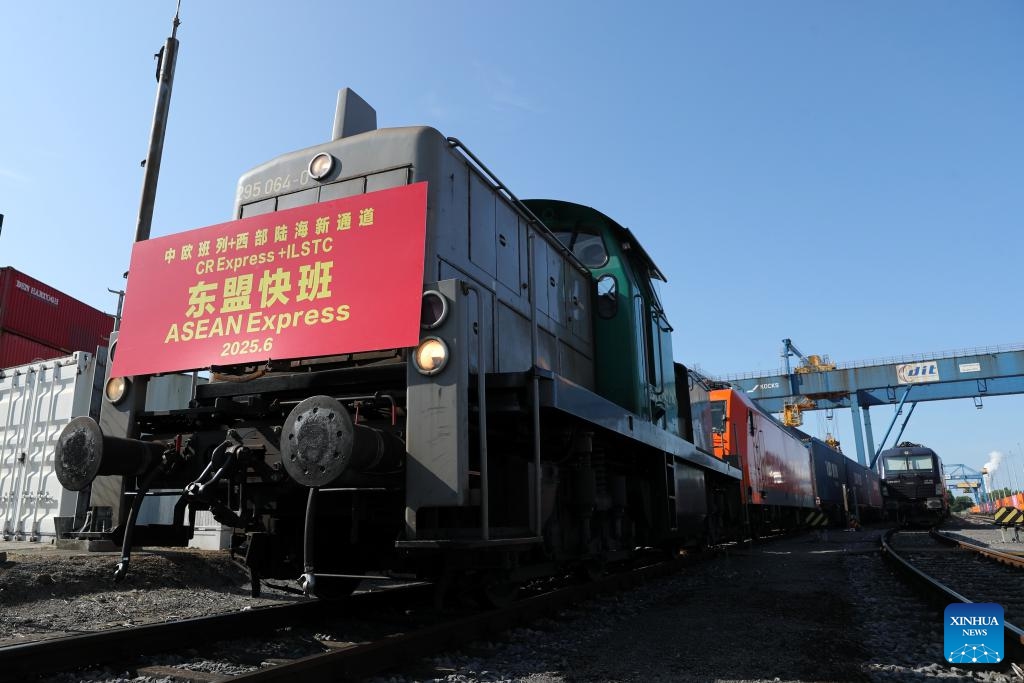
The launch of the return leg of the ASEAN Express service in Duisburg, Germany, June 21, 2025. Photo: Xinhua
China has remained ASEAN's top trading partner for 16 consecutive years, while ASEAN has been China's largest trading partner for five straight years, the Ministry of Commerce (MOFCOM) said on Monday, as the 22nd China-ASEAN Expo is set to open next week in Nanning, capital of South China's Guangxi Zhuang Autonomous Region.
To advance the implementation of the Version 3.0 China-ASEAN Free Trade Area (CAFTA), China will maintain close communication with ASEAN, actively advance their respective domestic ratification procedures, and work toward formally signing the upgraded protocol by the end of this year, Vice Minister of Commerce Yan Dong said at a press conference about the expo.
This year's China-ASEAN Expo, to be held from September 17 to 21 in Nanning, will serve as the latest platform showcasing the two sides' economic and trade cooperation.
The expo will feature about 3,200 exhibitors from 45 countries, the MOFCOM said. Meanwhile, new sections on artificial intelligence, new quality productive forces, the blue economy and premium foreign trade products will be set up in the 160,000 square meter exhibition space to showcase the latest achievements in China-ASEAN cooperation.
Yan said China looks forward to working with ASEAN countries to make full use of the expo platform, accelerate the signing of the upgraded Version 3.0 CAFTA protocol, and jointly build a closer China-ASEAN community with a shared future, contributing to free trade and the multilateral trading system.
In May, negotiations on the 3.0 CAFTA were fully concluded, marking the first time a comprehensive cooperation framework was established that linked both "hard connectivity" in digital infrastructure and "soft connectivity" in rules and standards, achieving an upgrade in regulations. The MOFCOM also said that future efforts will focus on mutually beneficial cooperation in nine priority areas agreed upon by both sides, including the digital economy.
In recent years, China and ASEAN have deepened practical cooperation across various fields, with economic and trade exchanges maintaining strong momentum. In the first eight months of 2025, ASEAN was China's largest trading partner, with total bilateral trade reaching 4.93 trillion yuan ($694.53 billion), an increase of 9.7 percent, accounting for 16.7 percent of China's total foreign trade volume, according to customs data on Monday.
In 2024, bilateral trade with Vietnam, Malaysia, Indonesia, Thailand, and Singapore each exceeded $100 billion, and trade with Vietnam and Malaysia each surpassed $200 billion, according to Yan.
The official also underlined growing investment ties between China and ASEAN, saying cumulative two-way investment had topped $450 billion by July, while Chinese companies had completed $480 billion in contracted projects across ASEAN. Cooperation has also been expanding in areas such as the digital economy, e-commerce, and green development, producing visible results, according to the MOFCOM.
Yan noted that industrial integration has advanced as both sides work together to safeguard stable supply chains against unilateralism and protectionism. A number of industrial parks and connectivity projects are progressing steadily, boosting regional economic and social development, he said.
Experts noted that amid growing global trade uncertainties, such a stable partnership will serve as an important force in countering economic fragmentation worldwide.
China and ASEAN have established multi-level cooperation mechanisms spanning local, departmental and central levels, and these mechanisms ensure that all-round cooperation stays on course and remains resilient despite external uncertainties, Xu Liping, director of the Center for Southeast Asian Studies at the Chinese Academy of Social Sciences, told the Global Times on Monday.
"As the largest country in the region, China shoulders the responsibilities of a major power and is committed to sharing the benefits of its development with neighboring countries, with ASEAN as a priority partner. This approach is also closely aligned with China's neighborhood diplomacy principles of sincerity, mutual benefit, and inclusiveness," Xu said, adding that ASEAN is not only a priority in China's neighborhood diplomacy, but also a key partner in jointly advancing the Belt and Road Initiative.
RELATED ARTICLES