Chinese researchers unveil world’s first brain-inspired spiking large model built on domestic GPUs: report
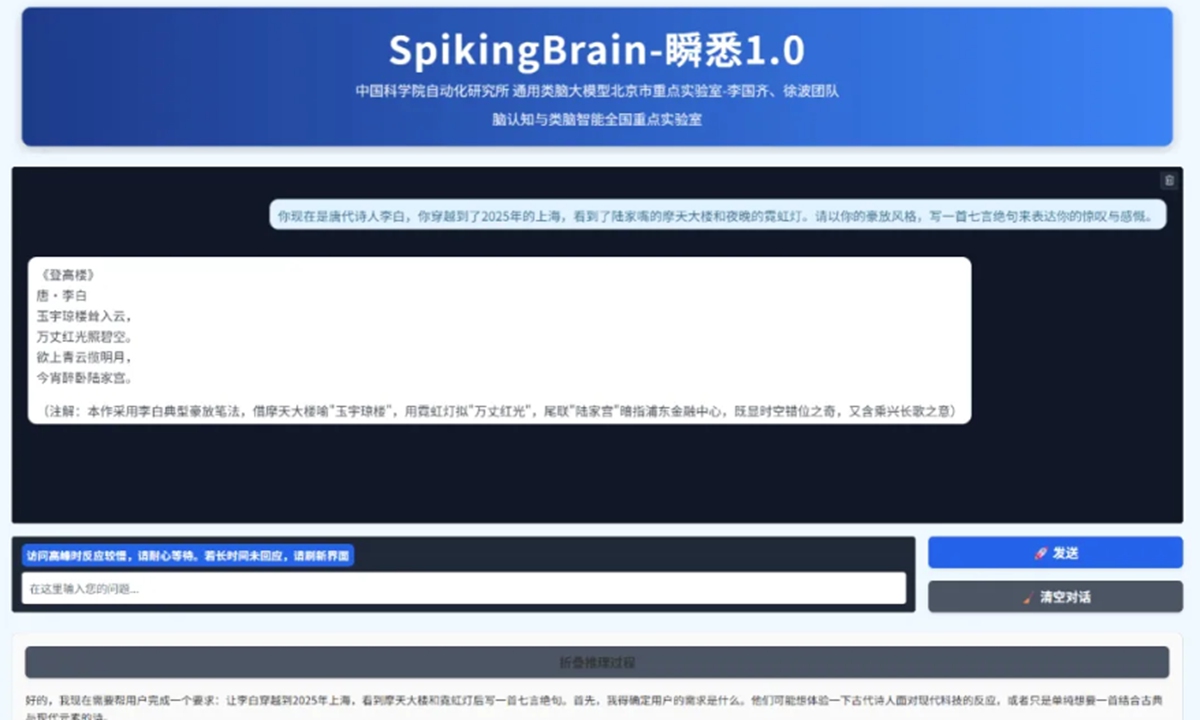
A screenshot of the SpikingBrain-1.0 interface Photo: CCTV News
Chinese researchers have, for the first time, completed the full-process training and inference of a native brain-inspired spiking large model, SpikingBrain-1.0, on a domestically developed GPU computing platform, the Science and Technology Daily reported on Monday.
The research team, drawn from the Institute of Automation under the Chinese Academy of Sciences (CASIA), officially open-sourced a 7-billion-parameter version of the model and launched a test website for a 76-billion-parameter version, according to the report.
This marks the debut of the world's first brain-inspired spiking large model built entirely with homegrown technology, signaling a significant breakthrough for China in merging brain-inspired computing with large-model innovation, the report said.
The model, developed based on the team's original theory of "endogenous complexity," was fully trained and inferred on a domestic GPU platform, CCTV News reported on the same day.
It significantly enhances the efficiency and speed of processing ultra-long sequences and demonstrates the feasibility of building a new, self-sufficient ecosystem of large-scale model architectures beyond Transformer in China, per the CCTV News report.
The model achieves performance in multiple language understanding and reasoning tasks that is comparable to many mainstream models, while requiring only about 2 percent of the training data typically used by such models, according to CCTV News.
Li Guoqi, a researcher at CASIA, said the achievement represents not only a milestone in the architecture of brain-inspired spiking large models and the full-process development of domestic computing capacity, but also provides a more efficient modeling tool for ultra-long sequence application scenarios such as law, healthcare and scientific simulation, according to the Science and Technology Daily.
"The advance is expected to inspire the next generation of neuromorphic computing theories and chip design," Li added.
Global Times
RELATED ARTICLES