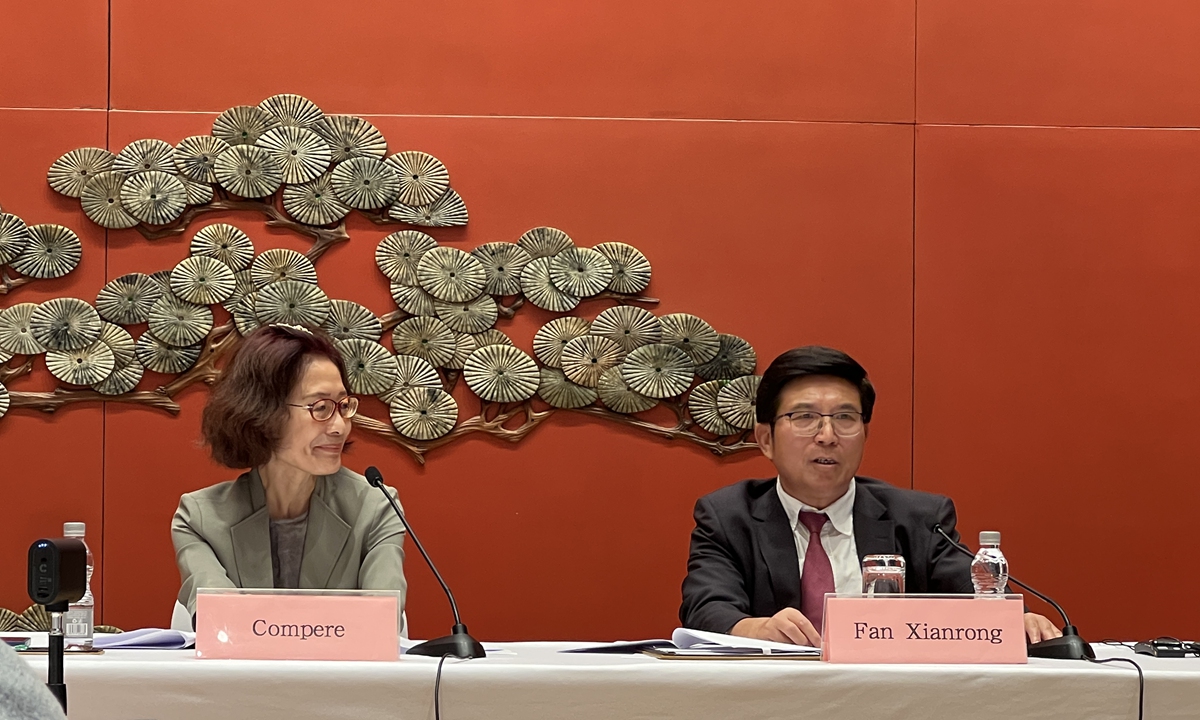
Ambassador Fan Xianrong, China's National Coordinator for the SCO, briefs media on the outcomes of the Shanghai Cooperation Organization Tianjin summit in Beijing on September 8, 2025. Photo: GT staff reporter
The just-concluded Shanghai Cooperation Organization (SCO) Tianjin summit has achieved a series of new breakthroughs, including approval for the establishment of a comprehensive center for addressing security threats, the decision to establish the SCO Development Bank, as well as new initiatives for cooperation in energy sustainability, green industries, and AI, Ambassador Fan Xianrong, China's National Coordinator for the SCO, said when briefing Chinese and foreign journalists in Beijing on Monday.
Responding to hype about the group being "anti-West or anti-US," Fan said those suspicions are "completely groundless" and based on narrow perceptions and misunderstandings. With the vast population and economic weight it carries, the SCO's own development is itself an important contribution to global peace and stability - therefore, far from being anti-West, it can instead inject positive energy into global development.
One of the most far-reaching outcomes, Fan said, was the approval of the Comprehensive Center for Addressing Security Threats and Challenges, with four specialized security centers established under its framework - the Information Security Center, the Center for Combating Transnational Organized Crime, the SCO Counter-Narcotics Center, and the main Comprehensive Center.
"This marks a major step forward in SCO security cooperation, providing an 'SCO solution' to both traditional and non-traditional security challenges, comprehensively enhancing member states' capacity to address new threats and challenges, and more effectively safeguarding regional peace and stability," Fan noted.
Security cooperation has been the earliest and most effective area of SCO cooperation. Member states pioneered border military confidence-building mechanisms, and conducted multilateral operations against the "three evil forces," creating a new model of "dialogue over confrontation, partnership without alliance, and flexible cooperation."
With the world entering a new period of turbulence, enhancing law enforcement and security cooperation is a shared goal. The next step will be to formulate legal documents to put the centers into operation. Once launched, their staffing and efficiency will be further optimized, and their functions in combating terrorism, extremism, information security threats, transnational crime, and narcotics will become more comprehensive, Fan said.
Another breakthrough of the summit was the formal decision to establish the SCO Development Bank, first proposed by China more than a decade ago, according to Fan. Once established, all SCO countries will benefit, providing new momentum for regional infrastructure development and economic integration.
In addition, the summit also adopted five statements on promoting energy sustainability, green industries, the digital economy, artificial intelligence, and scientific and technological innovation. These represent major steps in cultivating new quality productive forces among SCO member states, boosting trade and investment flows, and stabilizing industrial and supply chains.
Elaborating on the significance of the Global Governance Initiative put forward by Chinese President Xi Jinping during the summit, Fan told the Global Times that effective global governance can ensure that the governance systems reflect the common aspirations of all peoples for progress and a safer world.
"The initiative's core principles address the very deficiencies of today's system - such as the need for multilateralism in the face of rising protectionism, and the need for joint consultation rather than domination by a few states," Fan said. "These principles carry both practical and historical significance. They reflect the genuine aspirations of all peoples, not just China's perspective, and are therefore widely welcomed by the international community."
On whether the SCO, as well as BRICS, are "anti-West or anti-US" blocs, Fan pointed to the SCO Charter signed at its founding 24 years ago, which clearly states that the organization is "not directed against other States and international organizations."
"Key documents, including the Tianjin Declaration and the SCO development strategy from 2026-2035, all reaffirm the principle of openness and the willingness to develop friendly relations with any country or organization that shares the 'Shanghai Spirit'," Fan said.
"The SCO is by no means a closed organization, but an open platform with its doors wide open," Fan stressed.
"The SCO spans a vast territory, has a large population, and a substantial economic aggregate. Its very development constitutes an important contribution to the progress of global security and stability. It is not directed against Western countries; on the contrary, it can inject positive energy into global unity and cooperation. We hope that countries with doubts can see the truth," Fan said.
As the largest-ever SCO summit in history, the Tianjin meeting also welcomed a new member to the SCO family: Laos has been accepted as a partner, bringing the total to 27 members and further expanding the team of like-minded partners.
Fan said China will continue to work with other members to respond positively to countries wishing to join, expanding the group of partners committed to the "Shanghai Spirit."
RELATED ARTICLES