Illustration: Liu Rui/GT
Editor's Note:
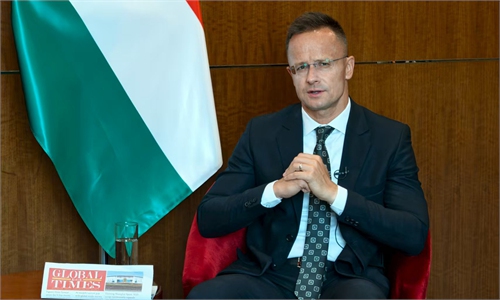
Hungarian Minister of Foreign Affairs and Trade Peter Szijjarto (Szijjarto) recently visited China to attend the grand military parade in Beijing which solemnly commemorated the 80th anniversary of the victory in the Chinese People's War of Resistance against Japanese Aggression and the World Anti-Fascist War. He also held talks with Chinese Foreign Minister Wang Yi. In an exclusive interview with Global Times (GT) reporters Su Yaxuan, Wang Wenwen and Qian Jiayin, Szijjarto criticized the EU's overly politicized and ideological approach toward China, emphasizing that those who argue against China-Europe cooperation are not being honest. Hungary's choices and practices demonstrate that the more Chinese investments in Hungary, the better, Szijjarto added.
GT: During your visit, did you discuss any cooperation plans with China?
Szijjarto: Of course, I had a good meeting with Foreign Minister Wang Yi, a good old friend of mine. We have been working together for almost 11 years now. We have a very friendly, respectful and mutually beneficial relationship. I usually ask him to convince and encourage more Chinese companies to look at Hungary as a possible venue for investment.
It's a success story: In 2024, Chinese companies brought the most investments into Hungary. This has not been interrupted in the first half of 2025 either. On top of that, our trade has been growing constantly.
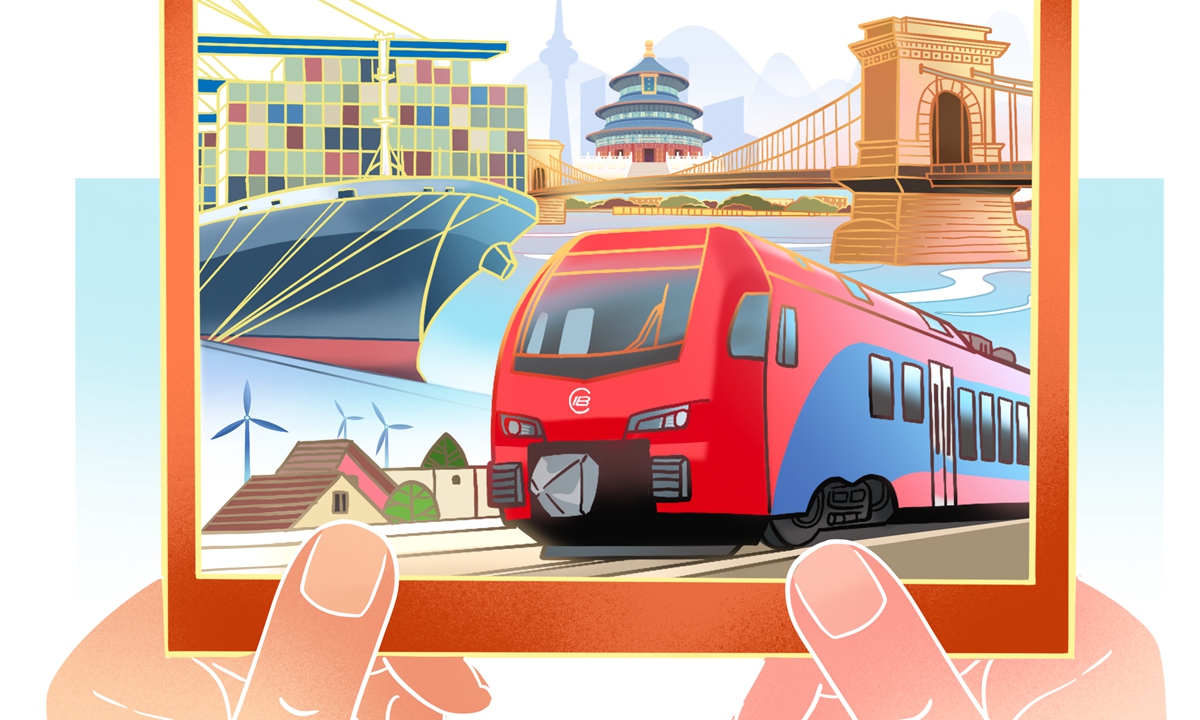
In the future, infrastructure development will be a very profitable part of our cooperation. The new, modern railway line between Belgrade and Budapest has been constructed with Chinese technical and financial contributions. This new railway line will be inaugurated very soon.
In addition, we are very interested in continuing our cooperation in the modern automotive industry. For example, BYD is building its first European factory in Hungary. They enjoy being in Hungary and continue to invest, which we encourage them to do.
GT: You never shy away from advocating for cooperation with China. China and Hungary have cooperated closely in various fields. Why do you think Hungary can maintain such a momentum with China?
Szijjarto: We have a very rational approach: Whatever is in our interest, we argue in favor of. The fact is that China-Hungary cooperation has brought a lot of benefits to Hungary. The Chinese investors who have chosen to locate their capital and factories in Hungary have created new jobs and opportunities for the Hungarian people. They have brought the most modern technology to Hungary and contributed to the economic performance of the country. So, it has shown very clearly that the more Chinese investments in Hungary, the better.
Those who argue against China-Europe cooperation are not being honest, because when I compete to convince a Chinese investor to come to Hungary, my competitors are usually Western European countries. And these Western European countries usually argue against the China-Europe relationship after they lose such competitions for Chinese investments.
If you look at Hungary, you see that there's a big German factory constructed. Then next to it, there will be a big Chinese factory. Major Western European companies cannot be successful unless their Chinese suppliers are close to them. So therefore, Hungary has become a meeting point for the Eastern and Western economies, and we have taken a lot of benefits out of it.
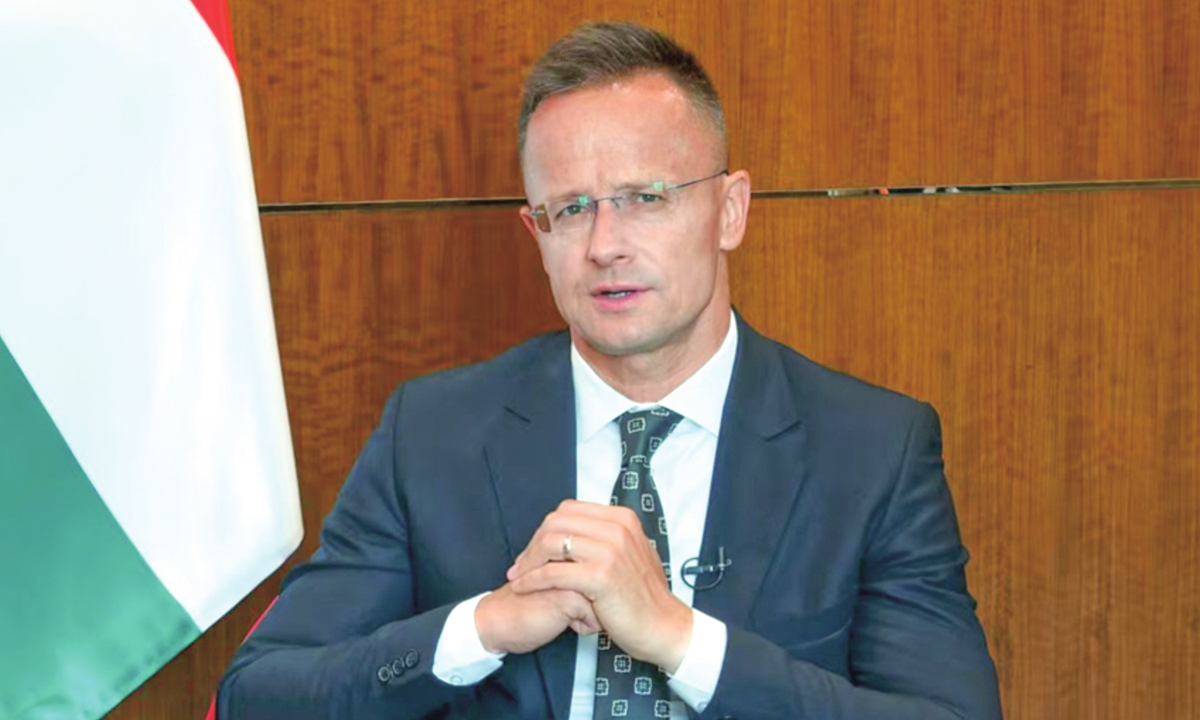
Hungarian Minister of Foreign Affairs and Trade Peter Szijjarto Photo: Qian Jiayin/GT
GT: This year marks the 50th anniversary of diplomatic relations between China and the EU. Nonetheless, the bilateral relationship seems to be perplexed by various issues. In a recent financial forum in Budapest, you described the EU's strategies toward both the US and China as misguided. Can you elaborate? What can Hungary do to improve how the EU engages with China?Szijjarto: Unfortunately, the leadership of the EU is extremely weak and inappropriate. They have caused a lot of trouble and harm to Europe. The problem is that the current leadership of the EU over-politicizes and over-ideologizes everything, even the most pragmatic issues, such as the economy or energy deliveries.
We don't like the fact that European leaders over-ideologize and over-politicize the China-Europe cooperation. We don't like that Europe considers China a systemic rival. We consider China a huge opportunity - a huge opportunity for cooperation. I think Europe can benefit a lot from working together with China.
So, we'll continue to argue in favor of a pragmatic approach. And this pragmatic approach includes very heavily an active, mutually beneficial, and tight cooperation with China.
To improve how the EU engages with China, we have to lead by example. We need to demonstrate that respectful cooperation brings many benefits. There are very few countries - maybe one or two European countries - that are able to maintain similarly successful relationships in both directions, East and West. This is basically only Hungary. We have a very friendly relationship with Washington. We have a very respect-based cooperation with the non-Western countries, including China and Russia.
The EU has unfortunately been isolating itself. The EU has isolated itself from the US by saying very rude things about the US. The EU has isolated itself from China by considering it a systemic rival and imposing tariffs on the electric automotive industry. The EU has isolated itself from Russia by imposing sanctions. The EU has isolated itself from Africa by putting weird conditions on economic cooperation. So, the fact is that the EU is now isolated in global politics.
GT: You recently slammed the EU for preparing for a "long war, not peace." What are the prospects of a ceasefire in the Russia-Ukraine war?
Szijjarto: Europeans are encouraging this war to continue, which is very regrettable. Having this war in the heart of Europe between two European countries for more than three years has a deteriorating impact on Europe, its economy, people, and families.
Western European leaders don't want to be confronted with the question of why they have carried out such an unsuccessful and harmful strategy. We have to be honest: The strategy implemented by the EU has been harmful and dangerous to the EU by globalizing this conflict instead of isolating it.
GT: Hungary has offered to host peace talks between Russia and Ukraine, amid reports that the White House was eyeing the Hungarian capital Budapest as a venue for a possible trilateral meeting between the US, Russia and Ukraine. How do you see Hungary's role in this process? China promotes the political settlement of the Ukraine crisis. How could China and Hungary collaborate in this issue?
Szijjarto: It's a great honor for us that we have been mentioned continuously as a possible venue for such negotiations. We are ready, we are open. Thirty-four days after the war broke out, I called both Minister Sergey Lavrov and the head of the Office of the Ukrainian Presidency, Andriy Yermak, and told them that Hungary is ready to provide a location for any kind of talks between the two. This offer of ours is still valid. Whenever they need us, we are there.
I think it's an honor that we have been constantly mentioned as a possible venue, because this underlines the rightfulness of our foreign policy strategy, which has the consequence that both Western and Eastern countries look at us as a possible fair location based on our good relationship with both sides of the world.
We appreciate the efforts of China to create peace. We appreciate that we are both members of the so-called peace camp. We both support the "Friends of Peace" Group in the UN. I do hope, I trust, that China will continue to speak up in favor of peace and peaceful solutions to all wars, including the one in Ukraine.
RELATED ARTICLES