Chinese auto companies shine at IAA Mobility 2025, driving China-Europe cooperation
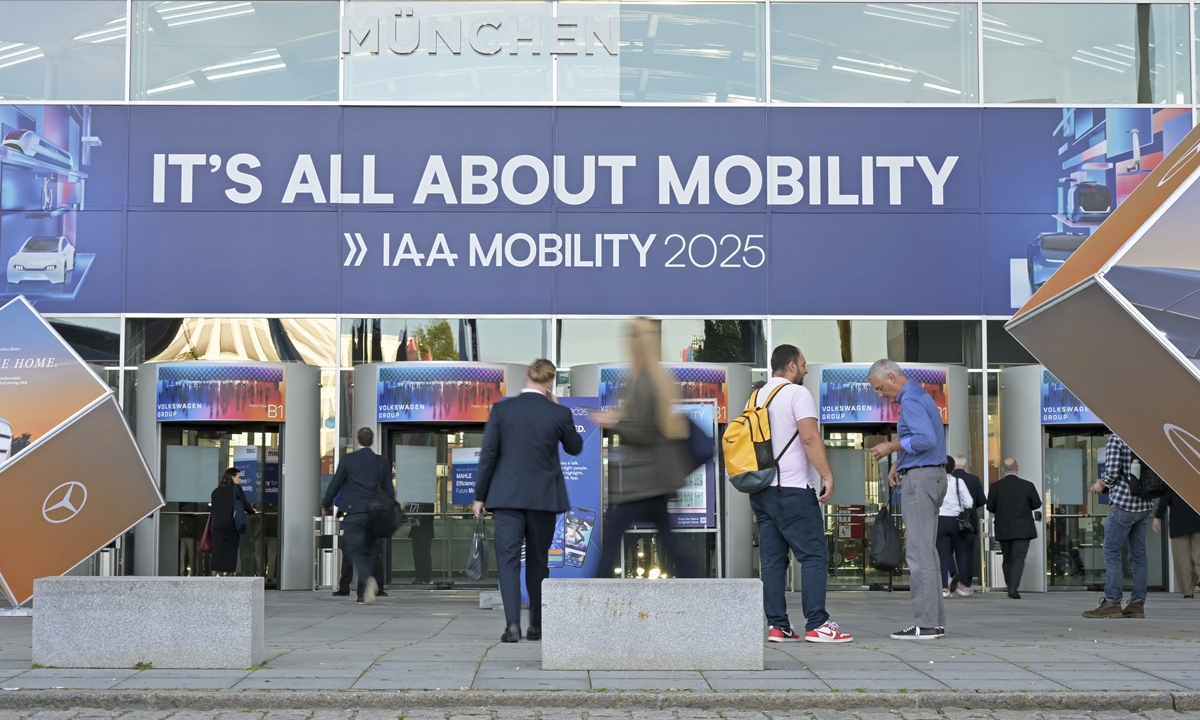
An entrance of the IAA MOBILITY 2025 held in Munich, Germany on September 8, 2025 Photo: VCG
The 2025 IAA Mobility, one of the world's largest mobility trade fairs, kicked off on Tuesday in Munich, Germany, where Chinese companies, backed by their persistent drive to expand in the European market, stood out as a major force. Experts said that despite some challenges in China-EU cooperation in electric vehicles (EVs), technological exchange remains a fundamental source of vitality for the global auto industry.
Of the 748 exhibitors, 116 are Chinese companies, setting a new record compared with 70 in 2023, according to China Media Group (CMG) on Tuesday. Their displays cover the entire industry chain, including new-energy vehicles, battery and electric drive systems, as well as intelligent automotive hardware and software.
At the exhibition, a senior executive of Guangzhou Automobile Group (GAC) said that the China-Europe auto industry is moving from "competition and cooperation" toward "integration." Looking ahead, both sides will join hands to bring innovative breakthroughs to global mobility, according to CMG.
Feng Xingya, chairman of GAC, was quoted by CMG as saying that China has the world's largest auto market and the broadest user base, which compels Chinese carmakers to focus on user demand and deliver high-value innovation to meet diversified needs. He noted that in areas such as new energy and intelligent connectivity, Chinese automakers have already established a globally leading competitive edge.
Meanwhile, international carmakers at the show also expressed strong interest in technological cooperation with China and their expectations for opportunities in the Chinese market.
"China is the decisive arena in the global auto technology race, where artificial intelligence has been widely adopted. We are co-developing with leading Chinese tech firms to seamlessly integrate cutting-edge innovations into the next generation of models designed exclusively for China," Audi global CEO Gernot Döllner said in a statement the company sent to the Global Times.
BMW China's R&D team has been deeply involved in the development of the new generation of locally produced models, seamlessly combining German engineering excellence with Chinese intelligent technology, the company told the Global Times in a statement.
Under this co-creation model, BMW's sixth-generation eDrive electric drive technology has enabled a driving range of up to 900 kilometers under CLTC conditions, easing consumers' concerns about battery range in pure electric vehicles, according to the statement.
At the exhibition, multiple Chinese battery producers showcased their latest breakthroughs, including lithium, sodium-ion, solid-state and large cylindrical batteries. More importantly, some Chinese companies have already established localized production capacity in Europe, according to CMG.
Wang Peng, associate research fellow at the Beijing Academy of Social Sciences, told the Global Times that Chinese firms' global expansion is fostering two-way technology exchange, advancing joint standards on charging interfaces and battery safety, offering a model for global new-energy governance.
Beyond the strong presence across the entire supply chain at the IAA Mobility, Chinese new-energy vehicle exports to Europe have also maintained positive momentum.
According to the latest data from European industry analytics firm Dataforce, Chinese EVs performed strongly in Europe this July, with hybrid market share climbing to a record 9.7 percent. Chinese brands accounted for 9.9 percent of Europe's EV market that month, while their overall share in the continent's car market exceeded 5 percent for the third straight month, Bloomberg reported.
Chinese companies are exploring diverse models to seek breakthroughs, moving beyond direct trade exports toward localized production and joint ventures in Europe, marking a shift from simply "going global" to truly establishing themselves in a particular market, a representative from the China Association of Automobile Manufacturers said, CMG reported.
Chinese EV companies, which cover the full industrial chain from new-energy vehicles to core components and intelligent hardware and software, are complementing European firms through technology exports, with both sides engaging in joint research on battery materials, manufacturing processes and vehicle connectivity, accelerating mutual recognition of technical standards, Wang said.
He added that China-Europe industrial cooperation projects can spur local infrastructure investment and create skilled jobs in Europe, helping the EU pursue economic growth and optimize employment structures.
RELATED ARTICLES