China’s first ‘super cotton field’ project uses AI-driven tech, debunking lies of ‘forced labor’ in Xinjiang
By in Xinjiang Published: Sep 09, 2025 10:44 PM

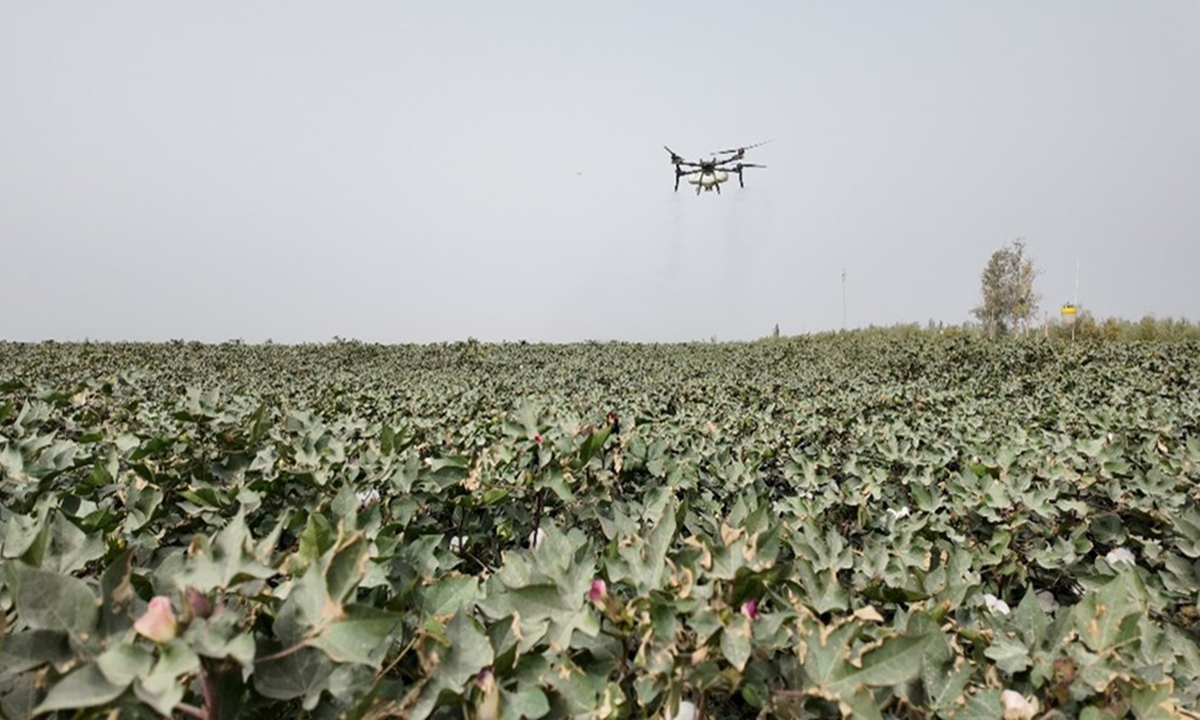
A drone operates in China's first "super cotton field" project, located in Yuli County of the Xinjiang Uygur Autonomous Region in Northwest China on September 9, 2025. Photo: Liu Caiyu/GT
Located in Yuli county, the Bayingolin Mongolian autonomous prefecture in Northwest China's Xinjiang Uygur Autonomous Region, China's first "super cotton field project," using advanced AI-driven agricultural technology, has facilitated local cotton production to achieve over 98.7 percent mechanization, further debunking lies of "forced labor" in Xinjiang, a representative of the farm told the Global Times on Tuesday.The white and fluffy cotton grown in the smart farm affiliated to the Jifei Agricultural Aviation Technology Co, managed by two young farmers born in 1990s, will be ready to harvest in about one month. The plants are taken care of by equipment such as remote irrigation valves, remote sensing drones that are able to identify pests and other unmanned vehicles that feature interchangeable actuators for weeding, transport and spraying.
At the farm, Ai Haipeng, the director of the farm, can simply touch his phone to send a drone to spray pesticides. He said that, traditionally, managing 3,000 mu of cotton required a team of 20 to 25 people. Now, they only need one or two people stationed on-site permanently. This means that a single person can manage 1,500 acres, and in the future, could potentially reach up to 5,000 mu per person.
The level of automation at the farm has reached 75 percent, and the management process covers the entire cycle: from sowing and seedling monitoring to irrigation and plant protection, Ai said.
Precision management of water, fertilizer, and pesticides has led to cost savings and efficiency gains: water usage has been reduced by about 15 percent, fertilizer by about 24 percent, and pesticides by about 30 percent.
"Our remote sensing drones are widely used in agriculture," Ai said while introducing smart equipment. A drone is a compact device equipped with a single battery, allowing for approximately 40 minutes of flight time, Ai said, adding that pests, diseases, and weeds can be monitored using the drone, which is supported by a backend model that operates similarly to human reasoning.
Supported by extensive data, the model is able to accurately understand pest and disease conditions and once identified, the drone sends a signal to the farm managers, who make decisions based on the information, according to Ai.
"If I'm not at the farm—for example, if I'm in Beijing—I can simply launch the drone remotely and assign it a mission. It will then autonomously conduct the field inspection."
Over the years, Ai has been actively promoting his smart farm solutions to local farms across Xinjiang. Initially, the investment cost for applying this set of unmanned equipment per mu of land was 500 yuan ($70) per year. By 2024, the price had already dropped to 120 yuan per mu. Farmers are now more willing to use and invest in this solution.
Ai's team has expanded this solution across Xinjiang, with a total of more than 700,000 mu of cotton farms over the year. "I believe this solution will have a significant impact on major field crops in Xinjiang, including cotton, wheat, and corn, contributing to the agricultural development of Xinjiang and the entire country. It will enhance agricultural production efficiency and provide substantial support to farmers," Ai said.
Since local farmers are now free from working directly at the cotton farm, they are getting involved in post-production work in sectors such as the textile industry, which has allowed them to earn more. Kurban Sulayman, who serves as the deputy director of the agricultural technology extension center in Yuli, told the Global Times that the cotton products from Yuli now have their own brand and are sold to domestic markets as well as ones overseas, such as Central Asian countries.
While some individual media outlets have frequently fabricated rumors of "forced labor" at Xinjiang's cotton plantations, Kurban slammed them as "pure nonsense."
"In Yuli, the cotton production here has already achieved over 98.7 percent mechanization. There is absolutely no need for manual harvesting, let alone any forced labor in cotton picking," Kurban told the Global Times.
RELATED ARTICLES