Liiustration: Liu Rui/GT
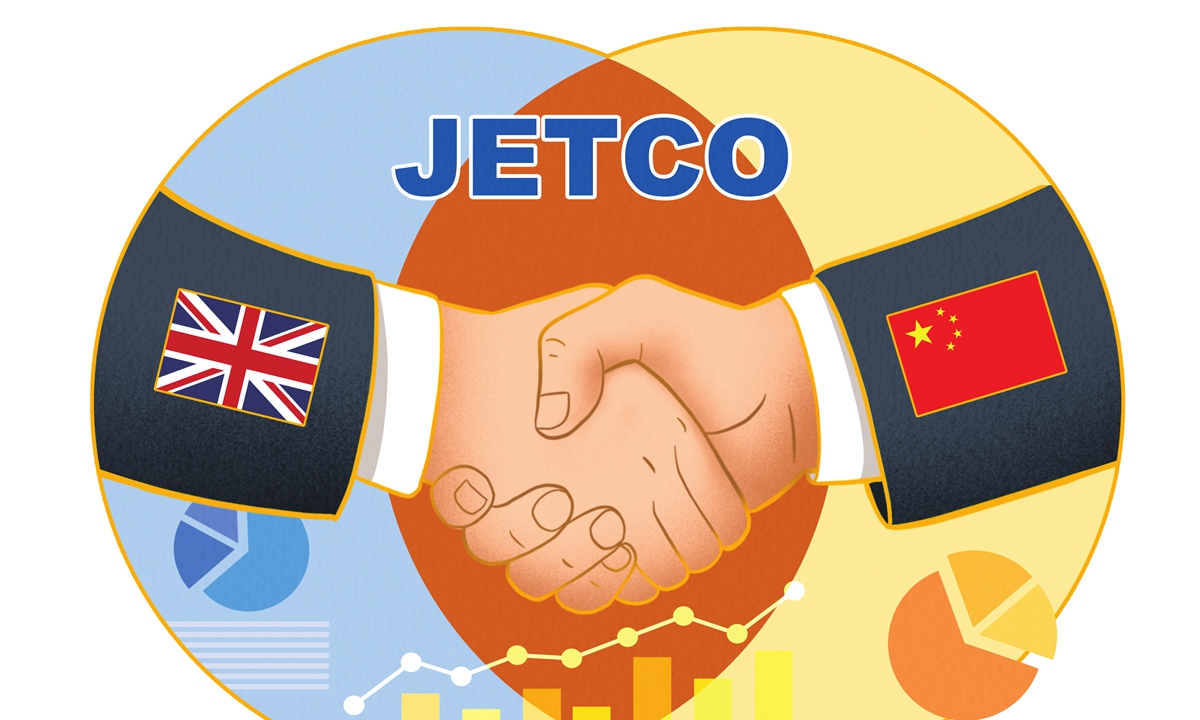
According to The Guardian, the UK's new business secretary, Peter Kyle, will visit China on Wednesday to attend the China-UK Joint Economic and Trade Commission (JETCO) in Beijing. The resumption of this high-level dialogue mechanism marks a long-awaited restart of bilateral economic talks, which is particularly significant amid the sluggish global economic recovery and complex geopolitical dynamics.This is the first JETCO meeting to be held after a seven-year hiatus. Its revival reflects the UK government's strategic intention to boost economic growth by strengthening economic cooperation with China under the dual pressures of a weak global economy and sluggish domestic growth. However, the depth and breadth of cooperation will not only depend on the willingness of both sides but also on whether the UK can demonstrate strategic autonomy, sincerity, and consistency in its actions.
The Guardian noted that this is part of British Prime Minister Keir Starmer's "continuing efforts to revitalize the UK's trade relationship with China and provide growth to the British economy." Since Labour took office last year, senior cabinet members have frequently visited China, including the chancellor, Rachel Reeves, in January and the new deputy prime minister, David Lammy, last October, who also visited in his previous role as foreign secretary.
The UK business community has long called for stronger engagement with China. In May, the British Chamber of Commerce in China stated in a report that high-level dialogues such as JETCO were "much needed" forums for spurring bilateral trade and investment.
The challenges the UK faces in cooperating with China cannot be ignored. With major power competition intensifying globally, the UK must choose between accommodating US pressure and pursuing pragmatic cooperation with China. Domestically, anti-China forces within the Conservative Party and pressure from Parliament further complicate the government's approach. "Some in the UK remain trapped in a Cold War mindset on fundamental strategic issues, preventing the full potential of China-UK economic ties from being realized," said Dong Yifan, an associate research fellow at the Belt and Road Academy of Beijing Language and Culture University.
While the resumption of JETCO carries symbolic meaning, real achievements will require deeper cooperation in concrete areas. China has always maintained an open attitude, but cooperation must be a two-way effort. We expect the UK to demonstrate genuine pragmatism and push forward business cooperation, rather than merely engaging in symbolic exchanges. London needs to clearly assess who can contribute to Britain's own development and to global peace and stability, and therefore make its foreign strategy based on that judgment.
The resumption of this meeting is not merely a formality of high-level contact; it could provide both sides with a long-term and stable platform for cooperation. "If the dialogue is successfully held, it will mark the start of a new stage in bilateral economic engagement. Against the backdrop of a US-driven global trade war, the UK moving closer to China and promoting bilateral trade through dialogue sends a positive and constructive signal - not only for China-UK economic ties but also for global economic development," Gao Jian, director of the Center for British Studies at Shanghai International Studies University, told the Global Times.
If China and the UK can achieve tangible commercial outcomes under conditions of consistency in policy stability and strategic autonomy, it will inject new momentum into bilateral relations. Whether the UK government can demonstrate sincerity through consistency of words and deeds and truly exercise strategic autonomy will be the key factor determining how far this dialogue can go.
RELATED ARTICLES