What’s wrong with US attempt to counter China with alliances?
By Published: Sep 10, 2025 10:07 PM

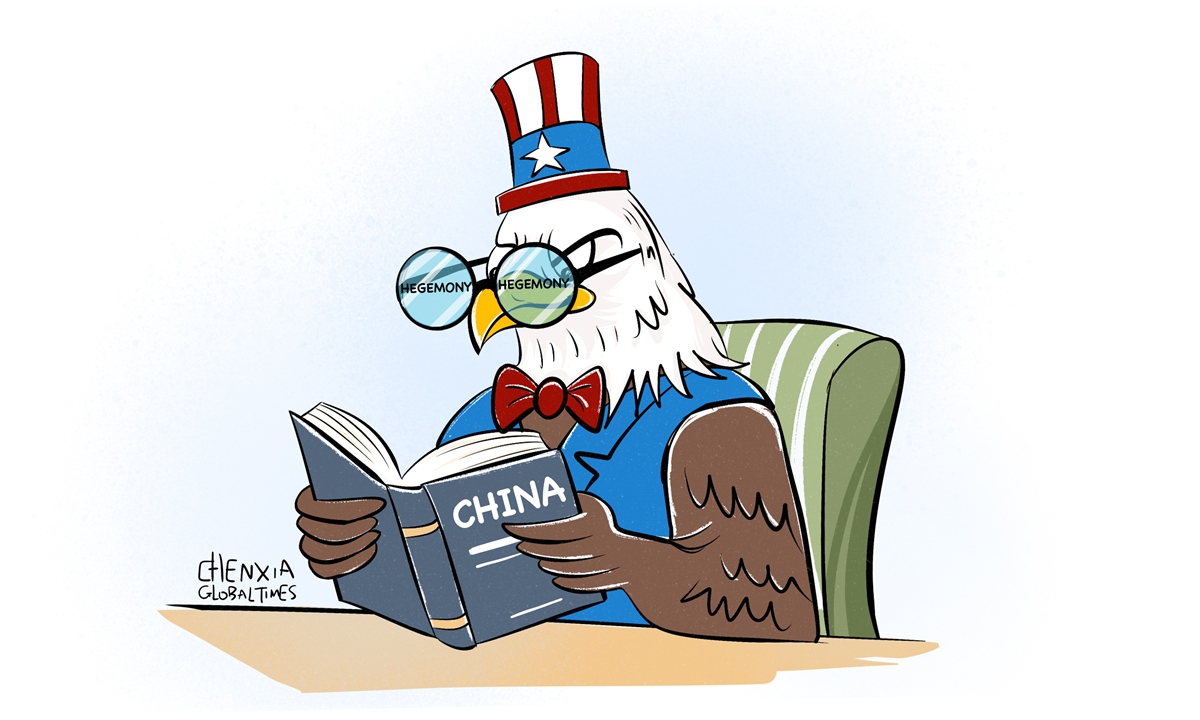
Illustration: Chen Xia/GT
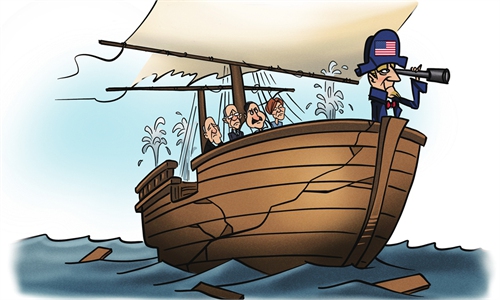
Of late, Washington has acquired a new favorite refrain: If America hopes to counter China, it must rally its allies. This chorus has grown ever louder since the spectacle of dozens of world leaders convening in Beijing to watch a military parade - an unsubtle backdrop underscoring China's growing magnetism on the international stage.Recently, The New York Times set out the argument plainly, "America Alone Can't Match China. But With Our Allies, It's No Contest," by Kurt Campbell and Rush Doshi. The logic is seductive: It presents itself as pragmatic and sober, sensitive to allied feelings, and reaffirming of America's global leadership all at once.
In reality, this argument is targeting Trump administration's unvarnished unilateralism - those tariffs that drove off "quasi-allies" like India. The new chorus calls for a return to Biden administration principles: rebuild alliances, form a united front and counter China by sheer scale, while, ideally, cutting China out of global supply chains.
But a closer look reveals a structure built not on bedrock but on sand. The problem isn't just in execution; it's in the premise itself, which is fundamentally flawed.
These strategists, for all their new packaging, are walking a familiar Cold War beat, convinced that America's interests and power can still carve up the globe into neat camps, one "us" and one "them."
But let's return to practicalities for a moment. What does America hope to accomplish by "uniting" its allies?
Its main objective is to constrain China's manufacturing ambitions and keep Beijing's global influence in check.
However, the root of this predicament is simple: America's chosen "allies" are now deeply entwined with China, not only as competitors, but as partners and stakeholders in the same intricate web of commerce.
Take India, not so long ago billed as the great hope to "counterbalance" China. Yet India's booming textile sector runs on Chinese machinery. Could India export more and cheaper apparel to the US without Chinese spinning frames? Not unless the US is willing to resurrect its own textile machinery industry and peddle equipment to India at Chinese price points.
The irony thickens. The American architects of "joint alliance building" are now championing a template they themselves have never truly applied. The New York Times piece declares that "America's best hope for matching [China] lies in maximizing its own strength through alliances. That means no longer treating US allies as dependents under our protection, but as partners in building power jointly by pooling markets, technology, military capability and industrial capacity."
It seems that Washington's luminaries have finally discovered "win-win cooperation" - or at least, the rhetoric of it - while attempting to lure China's partners into a counter-Beijing camp.
However, the suggested strategy mismatch here is fundamental: trying to use the language and instruments of "cooperation" in the service of a zero-sum contest. The chemistry is all wrong. You cannot ask honeybees to make venom. Tools of shared progress cannot deliver the fruits of zero-sum rivalry.
Consider, too, the calculus of "allied loyalty." Much is made of unity, but the very flexibility prized in these capitals is telling: This "double dipping" is not a diplomatic sin - it is a feature of interdependence, not a bug. The so-called coalition has no chance to truly align as long as the benefits of economic deepening with China remain this compelling. Moreover, solving today's global problems, even some local ones, is inseparable from China.
Another inconvenient truth: What is America even offering? The US can provide access to a vast consumer market, but it cannot supply its allies with the range of affordable manufactured goods and technologies on which they now rely on China.
In the end, these alliance schemes, forged in the spirit of Cold War nostalgia, will remain safely quarantined within think tank white papers and the hallowed echo chambers of DC conference rooms. In the real world, the tide of economic globalization defies borders, and the fusion of global interests cannot be unwound by fiat. Any serious attempt to force today's exquisitely tangled web of interdependence back into boxes labeled "friend" and "foe" is bound to meet reality head-on and rebound.
The author is a senior editor with the People's Daily and currently a senior fellow with the Chongyang Institute for Financial Studies at the Renmin University of China. dinggang@globaltimes.com.cn. Follow him on X @dinggangchina
RELATED ARTICLES