Impact of S.Korean President Lee Jae-myung’s foreign policies on Northeast Asia remains uncertain after 100 days in office: expert
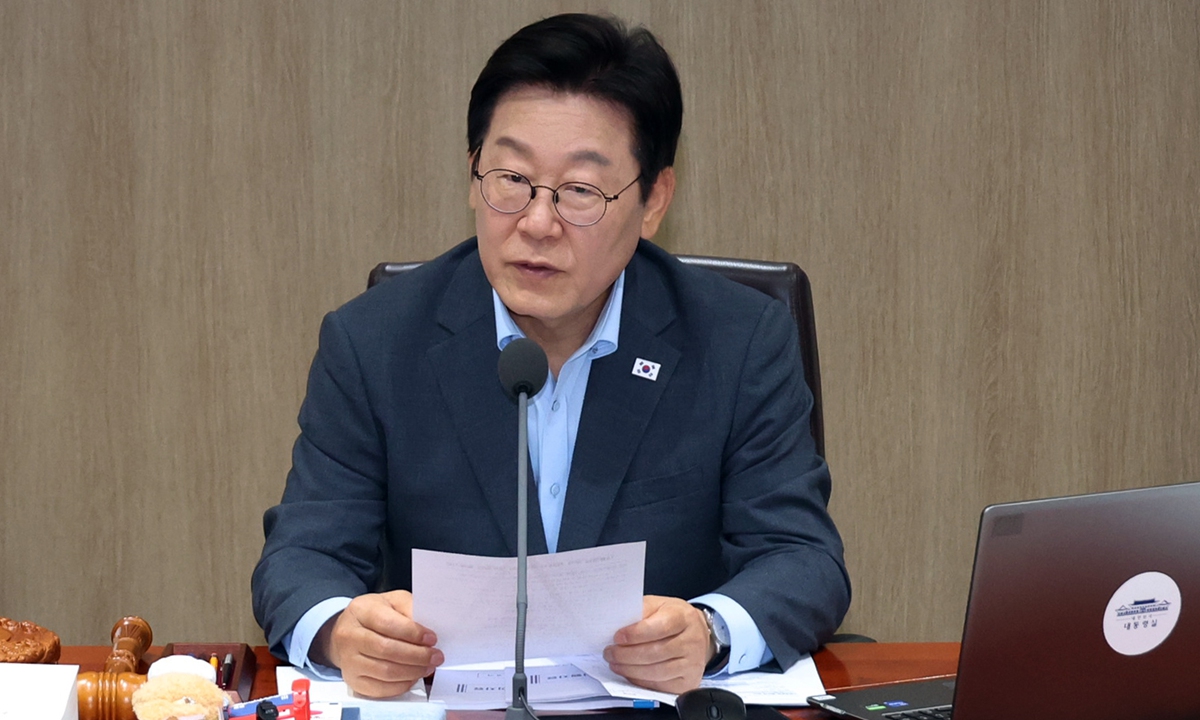
South Korean President Lee Jae-myung presides over a cabinet meeting on August 12, 2025. Photo: VCG
South Korean President Lee Jae-myung has reached the key milestone of his first 100 days in office, amid the detention of over 300 South Koreans by US immigration authorities. Chinese experts told the Global Times that although Lee has had an "efficient start", his policies, especially in foreign affairs, remain controversial and their impact on Northeast Asia remains uncertain.
Before being elected president, Lee pledged to pursue a "pragmatic diplomacy" policy. At his 100-day press conference, he reiterated his commitment. However, Chinese analysts said the actual direction of Seoul's diplomacy shows a complex deviation from this original intent, with "pragmatic diplomacy" facing multiple challenges.
In late July, US President Donald Trump announced that Washington had reached a trade deal with Seoul, and said that South Korea had agreed to invest $350 billion dollars in projects owned and controlled by the US, according to Xinhua.
According to a CNN report on August 26, South Korean businesses are expected to invest a total of $150 billion in the US, according to President Lee's office. Trump met Lee at the White House in Washington, on August 25, according to the media reports.
However, the olive branch extended by Lee to the US did not receive a reciprocal response. US immigration authorities and Homeland Security Investigations (HSI), among others, conducted a large-scale "illegal immigration crackdown" at the construction site of Hyundai Motor and LG Energy Solution's joint battery factory in Georgia, arresting 475 individuals, according to The Chosun Daily on September 6. Most of those arrested were Korean employees, with around 300 reportedly detained for holding visas that did not align with their purpose of stay, said the report.
The NBC News also cited The Chosun Daily, saying it framed the arrests as a betrayal and a harsh blow to South Korea.
Zhan Debin, director and professor of the Center for Korean Peninsula Studies at the Shanghai University of International Business and Economics, told the Global Times that the current South Korea-US relationship is progressing largely according to the expectations set by the Lee administration.
However, due to issues such as tariffs, the South Korean government has made greater concessions in its relationship with the US, which is partly to address the challenging issues of defense cost-sharing, the modernization of the South Korea-US alliance, and increasing defense budgets under US pressure, said Zhan, adding that, on the other hand, it also demonstrates that the Lee administration continues to prioritize its relationship with the US.
However, Zhan said that the "detention incident" has made South Korean society more acutely aware of the unreliability of the US as an ally. Despite South Korea making concessions on trade and other issues, the US still imposes strict standards on South Korean companies and citizens regarding investment, employment, and legal compliance, Zhan said. It's believed that South Korea has realized that being "unconditionally pro-US" is not a viable path, Zhan noted.
In terms of China-South Korea relations, South Korean president on Tuesday condemned recent rallies and demonstrations targeting tourists from China, describing them as "not freedom of expression, but disturbance," Yonhap News Agency reported.
Zhan noted that while the development of China-South Korea relations has not yet reached the desired level, South Korean society has returned to a more rational mainstream. Regarding the future of China-South Korea relations, he said that taking a positive stance is crucial, but it must be followed up with practical initiatives.
In the long term, the foreign policy orientation of the Lee administration presents uncertainties for South Korea's political ecology and the geopolitical landscape of Northeast Asia. According to Zhan, this is primarily due to the discrepancies between Lee's pre-election statements and his policies after taking office. It is currently difficult to determine which approach will become the long-term policy, Zhan said.
Zhan said that if South Korea can genuinely implement a "pragmatic diplomacy based on national interests" free from ideological constraints or pressure from the US and maintain diplomatic flexibility, it will have a positive impact on the Northeast Asian landscape. However, if it veers toward opportunistic diplomacy, it may exacerbate policy instability and lead to fluctuations in the regional situation.
RELATED ARTICLES