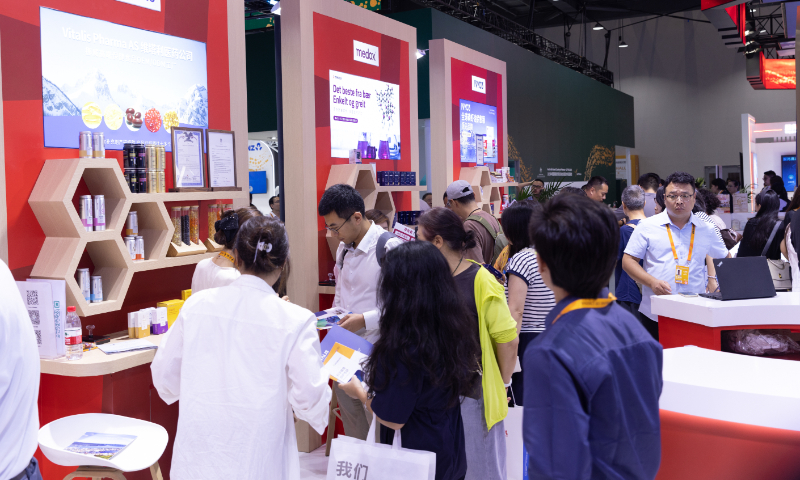
Consumers consult at the Norway pavilion about products brought by Norwegian companies on September 12, 2025, during CIFTIS 2025. Photo: Courtesy of Embassy of Norway in China
International trade companies have acclaimed the openness and trade freedom of the Chinese market during the China International Fair for Trade in Services (CIFTIS). Provided China's strict quality requirements are met, they said, competitiveness speaks for itself, and there are no discriminatory barriers or trade prejudice.
At the fair, many international firms showcased signature products from their home countries. Even on the third day of the event, booths were packed with visitors. From Iranian hand-woven carpets, Norwegian premium health supplements, Georgian fine wines and Japanese outdoor gear, products from various industries were on offer, hoping to share the opportunities of China's huge consumer market.
"The Chinese market maintains a high level of freedom for us and encourages us to expand our business. We have not faced restrictions, and the market environment keeps very favorable," Li Xi, marketing manager at Vitalis Pharma AS, a Norway-based health supplement company, told Global Times on Friday.
Li enthusiastically introduced the company's Norwegian specialty seal oil at the fair. "Only Norway and Canada are permitted to harvest seals, under government quotas. Bringing the product into China allows us to share one of Norway's best products here. As a cross-border brand, we have received strong support in China."
China has adopted an open approach, combined with strict oversight, Li noted. While import qualifications are tightly regulated, once those requirements are met, the market remains highly open. Li also highlighted the vast potential of the Chinese market.
At Georgia's pavilion, premium wines were introduced to Chinese consumers, with steep discounts available. The booth was packed with visitors, with many lining up to sample the wines on display, Global Times observed.
"Many Chinese consumers are immediately drawn to our products after just one taste, with no further explanation needed," said Levan Tavadze, CEO of Satavado (Beijing) International Trade Co, a Georgia-based wine exporter.
"Georgia is the cradle of wine. Out of more than 5,000 grape varieties in the world, 525 grow in Georgia, and these native varieties cannot be found elsewhere," Tavadze said.
As long as a product is good enough, it can find a place in the Chinese market, Tavadze noted. "Because there are no barriers, everyone wants to enter such a vast market, and competition is fierce," he said.
Tavadze said that trade barriers imposed by certain countries on China only serve to make Chinese companies stronger, as they are charting the right path by diversifying their global markets.
Yuan Wei, CEO of Fengxun Ireland (Spirits & Drinks) Ltd, an Ireland-based cocktail trading company, told Global Times that after more than 30 years in the export business, it sees the Chinese market as fully inclusive.
"I will continue to bring other Irish companies to China to take part in the Consumer Products Expo and the China International Import Expo, both of which have been very well received," Yuan said.
In recent years, China has actively led efforts to expand openness. From the Belt and Road Initiative (BRI) to the implementation of the Regional Comprehensive Economic Partnership (RCEP), experts said China is committed to strengthening the stability and connectivity of regional industrial and supply chains, helping boost trade and investment opportunities in the region.
Noting the importance of the BRI in particular, representatives from participating countries told Global Times at CIFTIS that China's dynamic market has provided partner countries with stable confidence for cooperation, not only in consumer goods but also in building service supply chains.
In the context of the BRI, Hamid Adeli, commercial counselor of the Embassy of Iran in China, told the Global Times that expanding services trade among partner countries, in areas like tourism, green energy, and digital infrastructure, can generate greater value than traditional goods trade.
This shift not only boosts economic resilience and innovation but also fosters deeper interdependence, cultural exchange, and long-term peace and stability across the world, said Adeli.
China's leadership in renewable energy can significantly boost cooperation with Iran in solar and wind projects, helping Iran diversify its energy mix, Adeli noted.
This year's CIFTIS includes participants from across five continents, with the scale of exhibitors expanding further from last year. Nearly 2,000 companies are taking part on-site, according to the event organizers.
RELATED ARTICLES