China’s supersize market, investment hub role highlighted during 14th five-year plan period
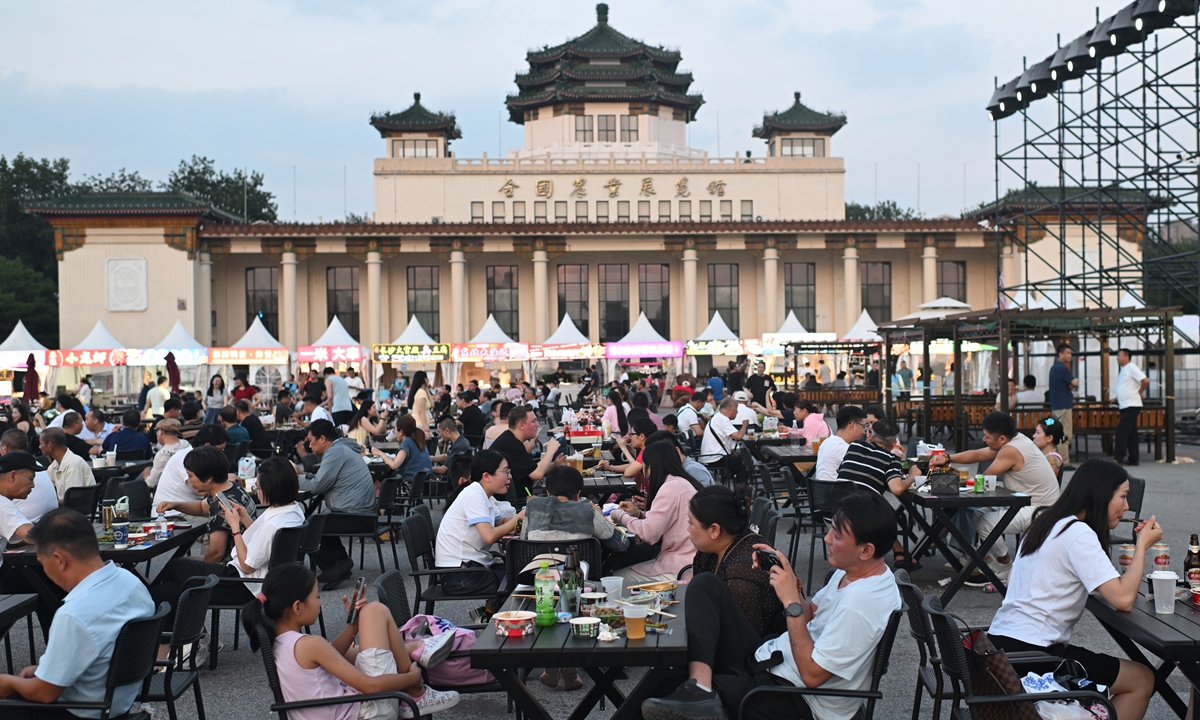
People eat dinner and snacks in the square in front of the China Agricultural Exhibition Center in the evening on July 18, 2025. In recent years, the "night economy" in China has been booming. Photo: cnsphoto
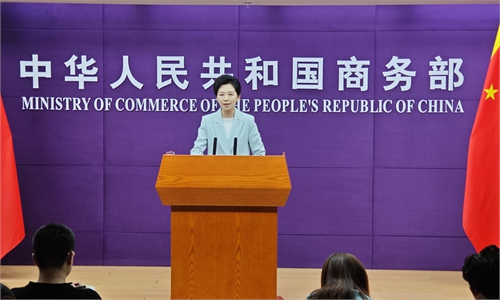
China's commerce has withstood wave after wave of challenges, passing the test of history over the 14th Five-Year Plan period (2021-25), as key targets in areas such as consumption, foreign trade, foreign investment, and outbound investment cooperation have progressed as expected, major tasks have been advanced smoothly, and significant progress has been made in the high-quality development of commerce, Minister of Commerce Wang Wentao said at a press conference when summarizing the achievements during the period on Friday in Beijing.
From consumption vitality to trade resilience, multiple sets of data unveiled at the press conference showcased the country's strength in domestic market advantage and the significantly enhanced resilience and shock resistance of foreign trade.
Vast market potential
Speaking about the domestic market, Wang highlighted the strengthened role of consumption as a primary engine and stabilizer, with China's robust domestic market showing clear advantages.
China's supersized consumption market has expanded during the 14th Five-Year Plan period, reinforcing the nation's position as the second-largest consumer market globally, Wang said.
As the world's second-largest consumer market, China's retail sales have grown 5.5 percent annually over the past four years, and are set to surpass 50 trillion yuan ($6.96 trillion) in 2025. He specifically emphasized the rapid growth of service consumption, pointing out that residents service spending increased by 3.5 percentage points to 46.1 percent, and residents service consumption expenditure grew at an average annual rate of 9.6 percent from 2020 to 2024.
China's total retail sales are about 80 percent of the US' in absolute terms. However, in terms of actual purchasing power, based on World Bank data and calculations, China's retail sales have reached 1.6 times that of the US, according to Wang.
Hu Qimu, deputy secretary-general of Forum 50 for Digital-Real Economies Integration, emphasized that the dual-circulation development pattern and accelerated construction of unified domestic market drove consumption growth during the period.
He noted that productive services aid industrial transformation, research and development, and technology transfer, while improved infrastructure, such as networks and logistics, supports innovative models like live-streaming e-commerce, fostering long-term development.
The thriving domestic consumption is also a vivid demonstration of China's vast market potential. From 2021 to 2024, China imported consumer goods worth a total of 7.4 trillion yuan, with its vast market contributing significantly to global development, Wang noted.
China's massive market and immense consumption capacity offer significant opportunities for foreign goods. Its market scale shows to the world that major economies like the US are not the only big consumers, as China's consumption potential is comparable, with a gap that is far smaller than commonly perceived, Li Changan, a professor at the Academy of China Open Economy Studies at the University of International Business and Economics, told the Global Times on Friday.
Global contribution
Foreign trade has withstood pressure and demonstrated resilience, with total goods trade maintaining its position as the world's largest. The international market shares for exports and imports have remained stable at over 14 percent and 10 percent, respectively. Services trade continues to rank second globally in scale, exceeding $1 trillion for the first time last year, according to Wang.
Against the backdrop of a complex external environment and challenges, China's foreign trade has shown strong resilience and new vitality. Wang stressed that the country's scale advantage and comprehensive system advantage benefit trading partners, while sharing its vast market opportunities globally.
Commenting on the trade highlights over the past five years, Huo Jianguo, a vice chairman of the China Society for World Trade Organization Studies in Beijing, highlighted the continuous optimized structure along with upgrading technologies, while electronics and machinery and equipment have become the pillars of China's exports, reflecting the country's advancement in technology.
As a key trading partner for over 150 countries and regions, China supplies quality products and services, bolsters global supply chain stability, and promotes trade liberalization. Meanwhile, the Chinese mainland and the Hong Kong Special Administrative Region accounted for about 13.3 percent of global imports in 2024, per WTO data. Compared to 13.6 percent for the US, the figure makes China the world's second-largest import market, behind the US by just 0.3 percentage points, Wang noted.
Also speaking on China-US trade frictions, Wang said that China-US economic and trade relations have experienced both ups and downs, but the two sides continue to be important economic and trade partners. The relationship is, at its core, mutually beneficial; cooperation represents the only correct path forward. While differences and frictions are inevitable in bilateral economic and trade cooperation, dialogue and consultation remain the best means to resolve them, he said.
At the ongoing third China International Supply Chain Expo (CISCE), participants also stressed the significance of being involved in the Chinese market through sustainable deployment.
"China is not only a market. China is also a big producer. The China market is attractive to countries and entrepreneurs. It's a huge market," Jürgen Ritter, Managing Director and Team Leader of Sino-Germany Agricultural Centre, told the Global Times at the sidelines of the expo.
Arkadiusz Filipowski, CEO of Polish logistics firm Fulfilio Sp. z o.o., told the Global Times that the company sees great potential in working more closely with Chinese partners. "It's important for us to understand how Chinese companies do business and what they value in international cooperation. We are committed to building long-term relationships in this market."
In terms of attracting foreign investment, since the 14th Five-Year Plan period, cumulative foreign investment absorbed has exceeded the target of $700 billion. A total of 229,000 foreign-funded enterprises have been established, 25,000 more than during the 13th Five-Year Plan period (2016-20). As for outbound investment, the investment has consistently ranked among the world's top three, with an average annual growth rate exceeding 5 percent.
During the 14th Five-Year Plan period, China intensified efforts to attract high-quality foreign investment and enhance openness amid a challenging external environment, which not only shared its advantages worldwide but has also spurred foreign investment and technology inflow, fostering China's industrial upgrade and deeper integration with the global supply chain, Hu told the Global Times.
In addition to offering Chinese dividends globally, Huo said that China has played an active role in the WTO by upholding the rules-based system, especially demonstrating leadership in promoting investment facilitation amid the 14th Five-Year Plan period.
Shifting into the next five-year plan period, Wang noted that China will advance higher quality trade in the 15th Five-Year Plan period, amplifying innovation momentum - not only boosting exports but expanding imports - while strengthening global cooperation and trade resilience to foster an open, cooperative, and mutually beneficial global trade landscape.
Looking ahead, the fundamental positive outlook of China's economy remains unchanged, with the consumer market still characterized by its vast potential, strong resilience, and abundant vitality. Given the severe and complex challenges, including unstable and uncertain international situations, the ministry will introduce timely and targeted new policies while the toolbox is well-equipped, Wang said.
RELATED ARTICLES