US House passes bill including ‘aid’ to Taiwan region; move only to serve Washington’s own interests: expert

A view of the Taiwan Straits is seen from Xiamen port, in East China's Fujian Province. Photo: IC
The US House of Representatives has reportedly passed its version of the National Defense Authorization Act (NDAA) for fiscal year 2026, which includes new aid to Taiwan region. A Chinese expert on Friday slammed new US aid under the NDAA to the island of Taiwan as a self-serving scheme ultimately aimed at securing a larger share of arms sales, particularly by pushing Taiwan authorities to purchase US second-hand or obsolete weapons.
The US House of Representatives approved annual defense bill on Wednesday local time. Among the key components of the NDAA is $1 billion for the so-called Taiwan Security Cooperation Initiative to strengthen the island's military capabilities, according to US military news outlet Stars and Stripes.
A report by RFI noted that the bill passed this time increases the funding for the so-called Taiwan Security Cooperation Initiative to $1 billion, more than tripling the $300 million allocated for 2025. Additionally, the scope of funding has been expanded to include projects such as combat casualty care and medical equipment support. RFI also noted that among the 10 provisions in the bill concerning the so-called Indo-Pacific region, five are directly related to the Taiwan region.
The US House bill authorizes nearly $900 billion in military spending, and the US Senate is considering its version of the bill, which authorizes $32 billion more spending than the House measure. When that passes, the House and Senate Armed Services committees will reach a compromise that must pass both chambers before it can be sent to the White House for US President Donald Trump to sign into law or veto, according to Reuters.
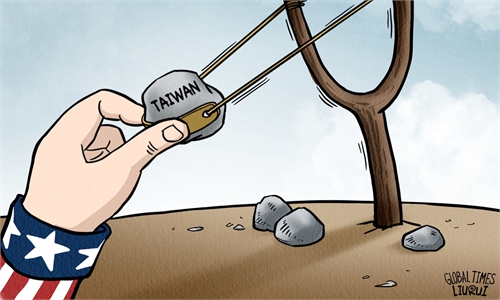
The US uses so-called aid to secure a larger share of arms sales to Taiwan region, forcing it to foot the bill for upgrades and purchases of US second-hand or obsolete weapons, Zheng Jian, a professor at the Taiwan Research Institute of Xiamen University, told the Global Times on Friday.
"The real purpose behind aid is profit-making, not substantive support," Zheng said, adding that the aid also allows the US to use it as leverage in trade negotiations with Taiwan authorities, thereby serving its own interests. "Think about it, how can the Taiwan authorities confidently make demands in the negotiations in the tariff war?"
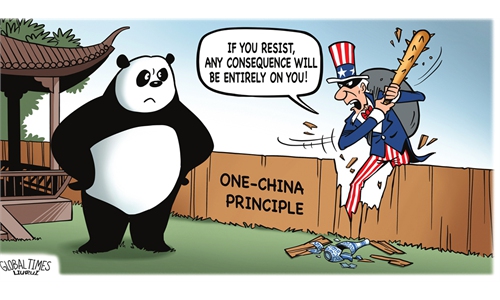
Moreover, the US move seriously violates the one-China principle and the spirit of three China-US joint communiqués, and the so-called aid appears to be expanding support but is actually a means of manipulation, the expert pointed out, adding that the island of Taiwan should not naively trust the surface-level assistance and must discern the intentions behind it.
Chinese officials have repeatedly voiced firm opposition to the US' so-called military aid to the island of Taiwan. In June, when asked to comment on the US House Appropriations Committee's passing of the Department of Defense Appropriations Act 2026, which includes $500 million for Taiwan, Senior Colonel Zhang Xiaogang, a spokesperson for the Ministry of National Defense, said that "we firmly oppose any form of military collusion between the US and the Taiwan region of China."
Whether through military aid, arms sales, or any other pretext, the US aims to bring the flames of war to the Taiwan region, intending to destroy and harm Taiwan - its motives are extremely sinister. "We urge the US to abide by the one-China principle and the provisions of the three China-US joint communiqués, and to cease sending erroneous signals to the 'Taiwan independence' separatist forces," Zhang said.
"We solemnly warn the DPP authorities that 'relying on the US to plot independence' is doomed to fail, and that 'using military force to resist reunification' is a dead-end path," the spokesperson added.
RELATED ARTICLES