Diplomats, UN representatives praise China’s desertification efforts
By in Dengkou Published: Sep 14, 2025 11:37 PM

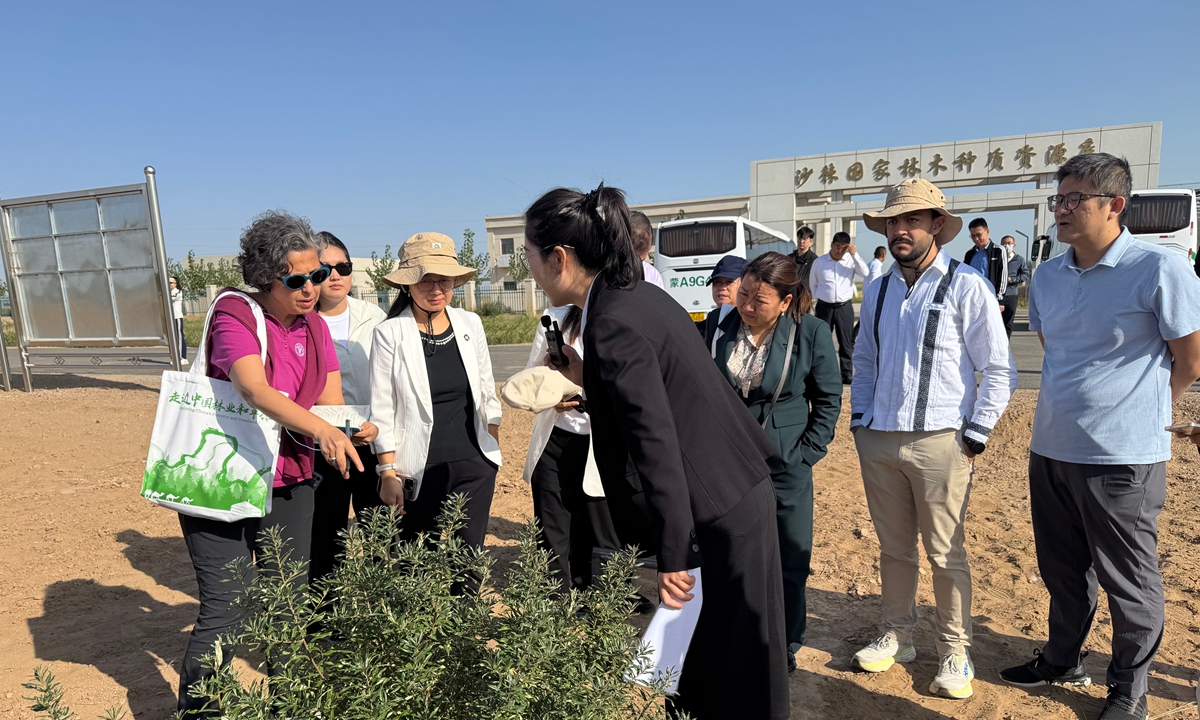
Diplomats from several countries and representatives of the United Nations visit a forest tree Germplasm bank in Bayannur, North China's Inner Mongolia Autonomous Region on September 14, 2025. Photo: Zhao Yusha/GT
Diplomats from several countries and representatives of the United Nations visited key desertification control projects on Sunday in Bayannur, North China's Inner Mongolia Autonomous Region — a main front line in the country's vast Three-North Shelterbelt Forest Program. After witnessing the efforts firsthand, they commended China's persistence and innovation in tackling desertification, as well as its openness to global cooperation.
China's National Forestry and Grassland Administration organized an event titled "exploring China's Forestry and Grassland" from Saturday to Monday, and invited diplomats and representatives from countries such as Kazakhstan, Iran, Iraq, Mongolia, Mexico, Brazil, as well as the Food and Agriculture Organization of the United Nations (FAO) and the United Nations Environment Programme (UNEP), to witness China's desertification-control efforts andecological changes firsthand.
On Sunday, the delegation visited a sand forest center, an oasis shelterbelt construction demonstration zone; the joint sand-control demonstration area along the Yellow River shoreline, a State-owned forest farm and a photovoltaic desert-control power station.
Following the visit, participants gained a deeper understanding of China's achievements in soil and water conservation, rural revitalization, and promoting ecological prosperity.
"Each part, each area we visited has been really amazing and eye opening, for example, where we are here, which is how it is called the Mengneng 850 megawatt photovoltaic base. It's really impressive because not only the government and the company have been really integrating or developing this, for both like power, energy, production but it has also integrated ecological, protection and stabilization of the sandy area," Nora Berrahmouni, a deputy director of the FAO Land and Water Division, told the Global Times.
"My only message is to ensure that China continues to support and promote and propagate. It's species, it's about diversity within China and share the knowledge how other countries could also use their species there about diversity in a way that can be really more strong and plant and support combating desertification, supporting livelihoods and supporting biodiversity and the economy," said Berrahmouni.
"The most interesting thing we have seen is how China has developed some research and experimental projects to find out how to control the desertification, how to improve the crop systems in more eroded areas," said Antonio Portilla Montemayor, second secretary of Mexican embassy in China.
He pointed out that those experiences are very important for other countries like Mexico. "Because we also have in Mexico [the desert]. So learning about the experience of China will give us more ideas of how to develop the environment and protect our environments and also to brings more development to the regions where the desert is founded."
Kalamkas Duzbayeva, counselor at the Kazakstan embassy in China, told the Global Times that "China's experience in combating desertification is very interesting. The projects we saw today in Inner Mongolia demonstrate sound scientific solutions and methods. The project with trees and their irrigation impressed us the most. There are arid regions in Kazakhstan, and I believe these projects could be applied there. In the future, cooperation between our countries in forestry and desertification control will become more active."
With desertification devouring land equal to four football fields every second globally, this is a fight for humanity's shared future. China, a major contributor to global greening and a model in desert control, actively promotes cooperation, per Xinhua News Agency.
China attaches great importance to international cooperation in desertification control. It has established the China-Mongolia Desertification Prevention and Control Cooperation Center, the China-Arab International Research Center for Drought, Desertification, and Land Degradation, and the China-Central Asia Desertification Prevention and Control Cooperation Center, providing Chinese solutions and expertise to the global fight against desertification, according to China's National Forestry and Grassland Administration.
For example, hundreds of wells drilled by Chinese teams have turned sandy areas into farmland in Egypt, supporting desert reclamation. China has supplied drought-resistant saplings to Mongolia's "Billion Trees" campaign. Africa's own "Great Green Wall" plan inspired by the China's National Forestry and Grassland Administration also gained support from China, Xinhua reported in June.
China has offered a "beacon of hope" and a "roadmap" for success against desertification, said World Bank official Valerie Hickey.
RELATED ARTICLES