Chinese FM spokesperson refutes US envoy's Russia-Ukraine conflict claim, says trade with Russia normal
By Published: Sep 15, 2025 06:05 PM

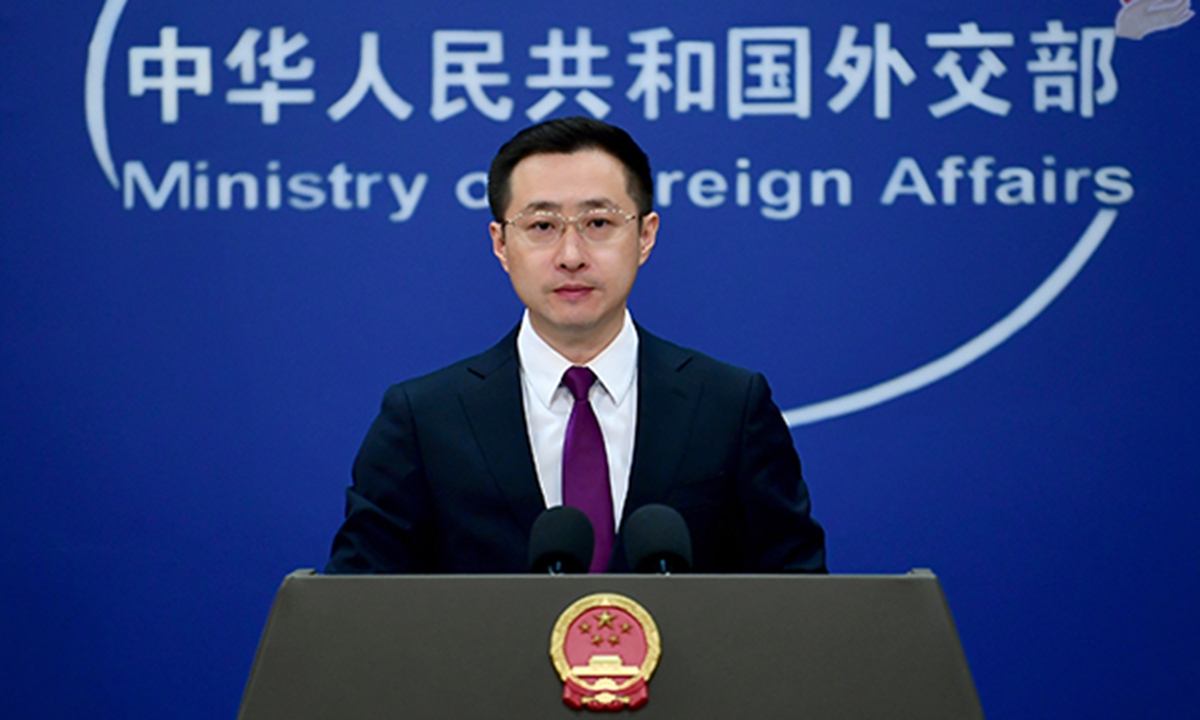
Chinese Foreign Ministry Spokesperson Lin Jian
In response to a question regarding US President's Special Envoy for Ukraine General Keith Kellogg, who at a security forum in Kyiv last Saturday said that if China stopped supporting Russia, first of all economically, it would lead to a very quick end to Russian aggressive war against Ukraine, Chinese Foreign Ministry spokesperson Lin Jian said on Monday that on the Ukraine crisis, China holds an objective and just position, and has worked actively to promote peace talks.
"Most countries, including the US and those in Europe, continue to trade with Russia. The normal exchange and cooperation between Chinese and Russian companies are in line with WTO rules and market principles. They don't target any third party and should not be interfered or affected," Lin said.
Speaking at the Yalta European Strategy (YES) Conference on Saturday, Kellogg accused China by claiming that "if China cut off assistance to Russia, the war would end tomorrow." A Chinese expert said this is an attempt to shirk responsibility by groundlessly blaming China.
Ukrainian media outlets including RBC-Ukraine and Rubryka have covered the remarks by Kellogg. According to RBC-Ukraine on Saturday, Kellogg claimed that in the China-Russia relationship, Russia is the "junior partner," with China holding the advantage. He noted that China possesses economic strength, military power, and historical leverage. Kellogg claimed that without Chinese support, Russia would not be able to continue the war, RBC-Ukraine reported.
Cui Hongjian, a professor at the Academy of Regional and Global Governance at Beijing Foreign Studies University, refuted Kellogg's remarks, saying that the US politician was trying to shift contradictions outward and evade responsibility.
"The fact that the Russia-Ukraine conflict has escalated to such a severe state today is undeniably the responsibility of the US. Throughout this process, they failed to adhere to—or, from the outset, prioritize—a political resolution, instead opting for an approach that supports confrontation," Cui told the Global Times on Monday.
The expert said that the US is currently adjusting its strategy regarding the Ukraine issue. On one hand, the US is unwilling to advance the political resolution process; on the other hand, it is reluctant to fully commit, fearing potential losses while continuously seeking to gain benefits throughout the process, Cui analyzed.
According to the expert, the US is employing two main strategies: First, it is shifting major issues to Europe, such as the matter of sanctions; The second strategy involves increasing pressure and testing the waters with China.
The remarks made by Kellogg are essentially a continuation or reflection of the current US strategy, Cui pointed out.
But no matter how they try to shift the blame, China's stance and actions have consistently aligned with its statements, the expert emphasized.
On January 16, Geng Shuang, China's deputy permanent representative to the United Nations (UN), made remarks at the UN Security Council Briefing on Ukraine. According to Geng, for some time now, and in fact today, the US has been peddling false narrative to discredit and smear China at the council's meetings on the Ukraine issue. "This is completely unacceptable," Geng stated. "It has mainly three points. First, China provides military supplies to Russia. Second, China provides political cover for Russia. Third, if China had not supported Russia, the war would have ended long ago. These three points are all lies through and through," Geng said.
The Chinese envoy emphasized that "First, if China had really provided military supplies to Russia, the situation on the battleground would not have been where it is now. Second, if China had provided political cover for Russia, we would not have repeatedly emphasized in public the respect for the sovereignty and territorial integrity of all countries and the adherence to the purposes and principles of the UN Charter. Third, if China really did not want an early end to the war, we would not have sent our special envoys on multiple shuttle diplomacy missions, nor would we have worked with the Global South countries to establish the Group of Friends for Peace on the Ukraine crisis."
RELATED ARTICLES