Illustration: Liu Rui/GT
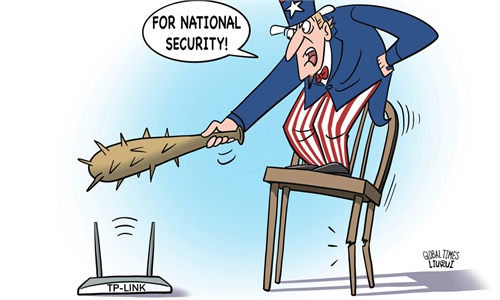
Recently, Washington's coercive rhetoric and actions regarding the Russia-Ukraine conflict have once again laid bare its hegemonic logic of interfering in other countries' independent decision-making. Not only does it attempt to shift the responsibility for the Ukraine crisis onto third-party countries, politicize their normal economic and diplomatic activities, but it also pressures its allies into imposing sanctions - all in pursuit of its own interests.
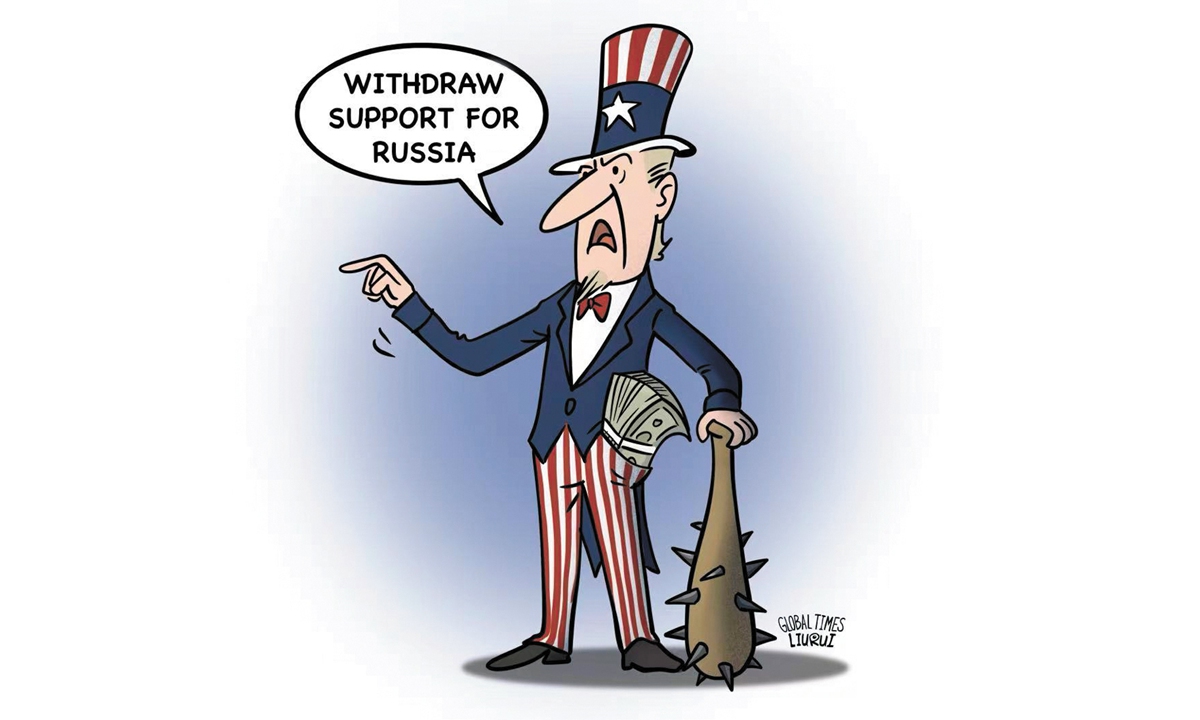
According to the Kyiv Independent on Sunday local time, Keith Kellogg, US Special Envoy for Ukraine, again hyped up the conflict and slandered China at the Yalta European Strategy conference. "I think that if China cut off their support for Russia today, the war would be over tomorrow," he claimed.
"Washington has repeatedly tried to offload responsibility for the Ukraine crisis and pressure third countries. The logic behind this is essentially to create a contradiction in order to cover up its own failures," Lü Xiang, a research fellow at the Chinese Academy of Social Sciences, told the Global Times.
In order to transfer pressure outward, Washington has not only wielded the tariff stick against third countries, but has also intensified the manipulation and coercion of its allies. On September 10, the Financial Times reported that the US was pushing the EU to impose tariffs on China and India. On September 12, the newspaper cited sources saying that Washington has pressured G7 members to hit China and India with tariffs of up to 100 percent for buying Russian oil in an attempt to force Moscow into peace talks with Ukraine.
In reality, many developing countries procure energy and conduct trade purely out of economic needs. Yet the US links such normal economic cooperation to "funding" Russia. The US' move is a typical act of unilateral bullying and economic coercion. Such behavior not only disregards the independent decision-making rights of third countries in development and cooperation, but also undermines trust and willingness for cooperation among the Global South. It seriously undermines international trade rules and threatens the security and stability of global industrial and supply chains.
Ironically, the US Secretary of Energy Chris Wright recently urged the EU to stop buying Russian oil and gas and switch to American energy products instead.
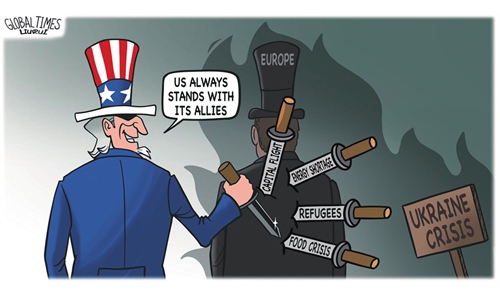
Moreover, Washington's strategy of outsourcing sanctions and making allies act as its agents has left them in a dilemma. "The US' unilateral coercion has forced the EU and G7 states into a situation where their policy autonomy is constrained and economic burdens are rising. At the same time, it exacerbates international contradictions and the complexity of the conflict," Lü said.
While hyping the so-called role of third countries, US politicians have dodged their responsibility that the US and its allies bear for the prolonged conflict. Since the outbreak of the conflict, Washington has provided military aid, from which US arms dealers have profited immensely. Even though a shift in Ukraine policy is seen in the current US administration, Washington still vows to provide Kiev with security assistance and has not ruled out other military options. Its policies bear undeniable responsibility for prolonging the conflict.
Since the very first day of the crisis, China has been taking an objective and impartial stance, insisting on promoting peace talks. China's Deputy Permanent Representative to the UN, Geng Shuang, stated clearly at a Security Council meeting earlier this year: "If China had really provided military supplies to Russia, the situation on the battleground would not have been where it is now." These remarks make it clear that China has not taken part in the fighting and refute any accusations that China has "prolonged the war."
When it comes to resolving the Ukraine conflict, if the US and certain European countries genuinely seek peace, the most effective approach is not to ramp up sanctions, provide more weapons, or pressure other countries, but to put forward practical diplomatic solutions while respecting the sovereignty and independent choices of all nations. Only by relying on multilateral consultation and political settlement can there be a sustainable path toward regional peace and global stability.