CCG takes regulatory measures as Philippine govt ships intrude Huangyan Dao waters
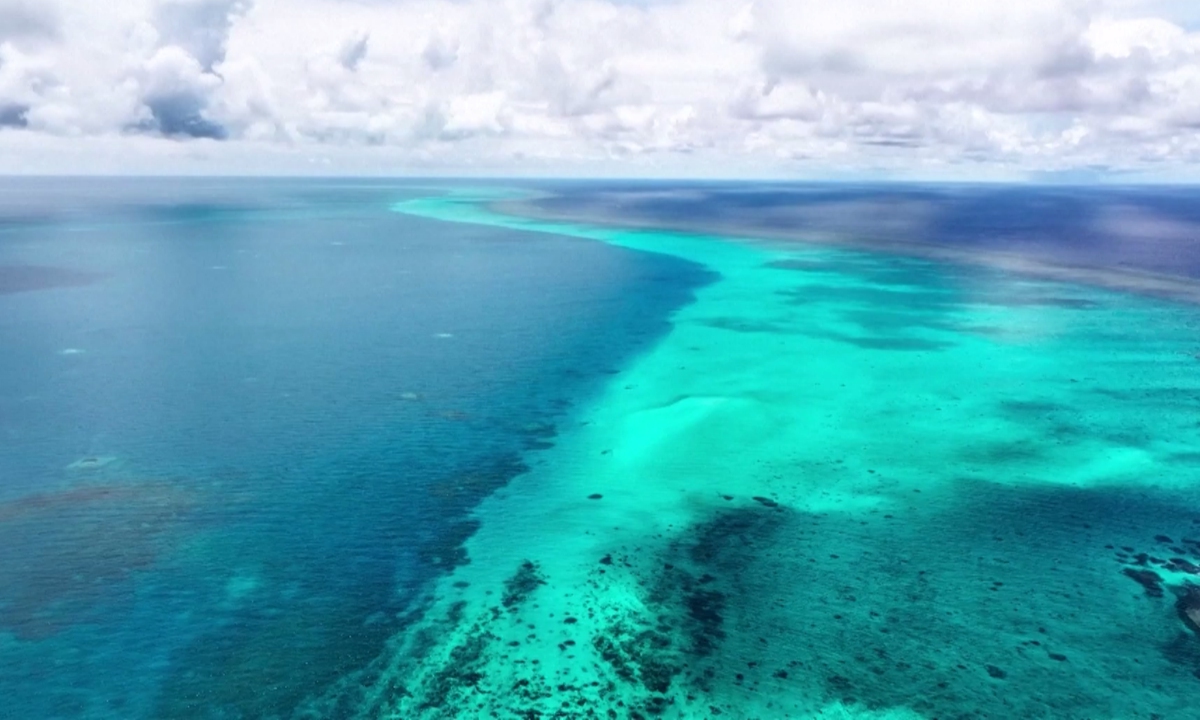
An aerial drone photo shows the scenery of China's Huangyan Dao in the South China Sea. Photo: VCG
The China Coast Guard (CCG) on Tuesday took regulatory measures in accordance with the law against multiple Philippine government ships that conducted illegal activities in the territorial waters of China's Huangyan Dao in the South China Sea, according to the CCG.
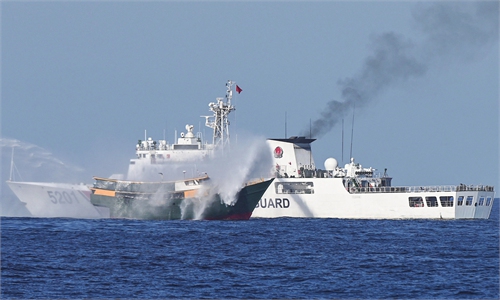
CCG spokesperson Gan Yu said the Philippines organized over 10 government ships to illegally intrude into the territorial waters of China's Huangyan Dao from multiple directions. In accordance with the law, the CCG took regulatory measures against the Philippine ships, including issuing warnings via loudspeaker, conducting route control and using water cannons. Gan noted the CCG operation on site was professional and standardized, legitimate and law-abiding.
At around 10 am, Philippine government ship No. 3014, disregarding China's repeated solemn warnings, intentionally rammed into a CCG ship that was performing regular law enforcement duties, in an unprofessional and dangerous manner. The Philippines' deliberate illegal and provocative acts are of an egregious nature, and the full responsibility for the collision rests entirely with the Philippines.
Video clips obtained by Global Times show that Philippines' ship No.3014 deliberately rammed into CCG vessel, and the Chinese vessel fired water cannons as a countermeasure.
Ding Duo, director of the Research Center for International and Regional Studies at the National Institute for South China Sea Studies, said the Philippines' provocations are within expectations and China's responses at sea are well prepared, citing the background that China has announced the establishment of Huangyan Dao national nature reserve.
The Armed Forces of the Philippines (AFP) will not allow China to build such a nature reserve, Philippine Navy spokesperson Roy Vincent Trindidad said at a press briefing on Tuesday. Trinidad said the AFP knows what to do but he refused to share specific details, Philippine news outlet GMA Network reported.
Ding told the Global Times the Philippines' purposes are multilayered: by organizing a large-scale intrusion, Manila is attempting to make up for "losses" both on site and in public opinion after China announced the nature reserve. It also wants to test whether there are changes in scale and intensity of China's rights protection and control measures at sea, Ding said.
The provocation is also a stunt for domestic audience to divert attention and pressure from the Marcos Jr. administration and play victim in front of the US and some external countries to demonstrate the Philippines' value as "chess piece" and win external support, Ding said.
Ding said that in order to safeguard China's territorial sovereignty, uphold the authority of a national-level nature reserve and protect the coral reef ecosystem of Huangyan Dao, China will further enhance targeted, effective and diverse responses and countermeasures.
The Philippines will not achieve its goals and it should be able to perceive China's unwavering determination to safeguard its territorial sovereignty and maintain stability at sea, the expert said.
Commenting on the Tuesday incident, Chinese Foreign Ministry spokesperson Lin Jian said that what happened proved once again that the Philippines' deliberate infringement and provocations at sea are the root cause of the tensions. The Philippines needs to stop these activities at once and must not challenge China's firm resolve to safeguard our lawful rights and interests.
Ding added that the Philippines could have perceived China's establishment of a nature reserve differently, as it opens a window for cooperation in low-sensitivity areas, particularly maritime eco-protection. In the future when conditions are ripe, Chinese and foreign scientists, research institutes and even governments could cooperate.
RELATED ARTICLES