Building walls and barriers will eventually box oneself in: Chinese FM on The Economist's article on China's thriving trade despite US attacks
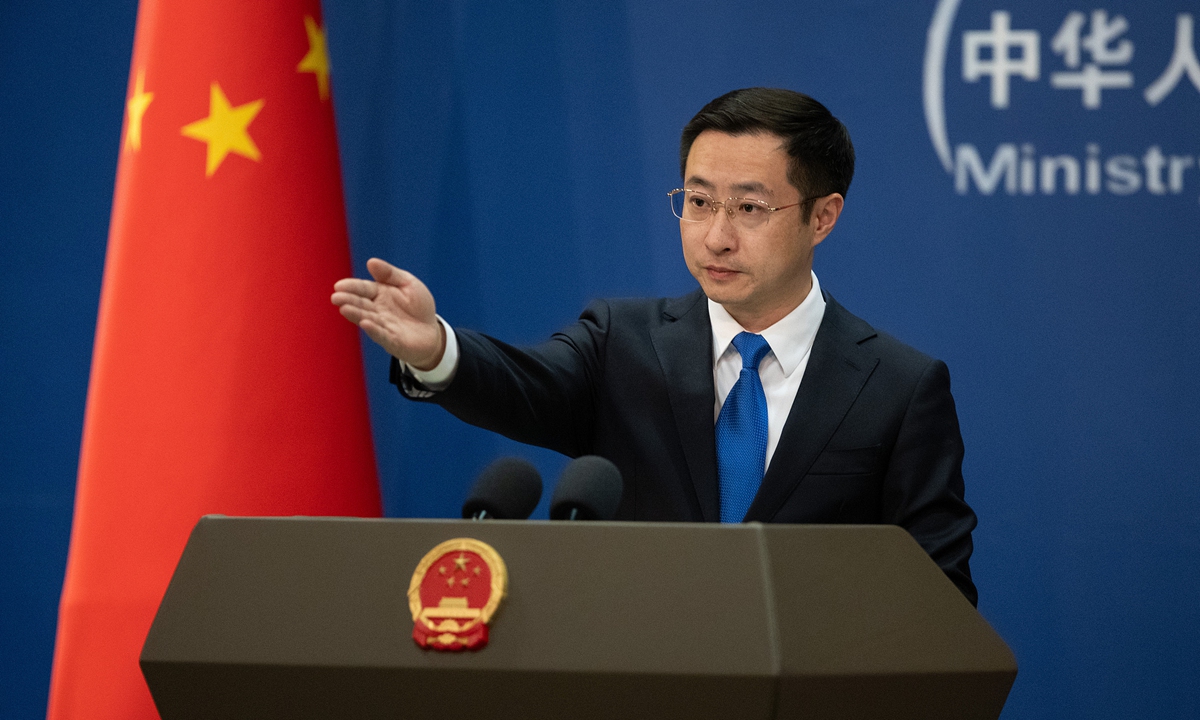
Photo: China's Foreign Ministry spokesperson Lin Jian
Building walls and barriers will eventually box oneself in, and trade war cannot shake the comparative advantages of Chinese manufacturing industry, a Chinese Foreign Ministry (FM) spokesperson said on Wednesday.
The comments came to respond media inquiries about a recent article published in The Economist - entitled "China's trade is thriving despite America's attacks" - noting that China is cementing its role in supply chains and the world is snapping up more Chinese goods than ever before. The trade war and tariff war posed little influence on China.
Despite the complex and fluid external environment, China's foreign trade has maintained steady growth with stronger resilience and vitality, FM spokesperson Lin Jian said during a regular press briefing.
Lin noted that in the first eight months of this year, China's total trade in goods went up by 3.5 percent year-on-year. ASEAN and the EU have become China's top two trading partners. China's total imports and exports with BRI partner countries grew by 5.4 percent.
"Building walls and barriers will eventually box oneself in. Removing them and clearing paths leads to win-win," Lin said, noting that what has happened shows that tariff war and trade war do not change China's comparative advantages long acquired by its manufacturing sector, nor do they change the global popularity of China's high-quality goods or reverse the trend of countries supporting trade liberalization and facilitation.
"Together with the world, China will stay committed to open development, promote an open world economy, reject all forms of protectionism, and share opportunities and thrive together through high-standard opening-up," the spokesperson added.
The article published in the latest issue of The Economist on September 9 noted that the US government's "grander ambition - to hurt China's trade machine - has been unsuccessful." It further noted the US' push for the creation of a "Fortress North America," and said that "fortresses are rarely signs of confidence."
The world beyond America is snapping up more Chinese goods than ever before, the article in The Economist said, pointing to a trend particularly evident in the Global South, where the BRI has deepened trade ties.
"Despite US tariff pressures, China's economy remains resilient, backed by its globally competitive manufacturing chains and ongoing institutional opening-up," Dong Shaopeng, a senior research fellow at the Chongyang Institute for Financial Studies at Renmin University of China, told the Global Times on Wednesday.
Rather than retreating from globalization, China is deepening reform by optimizing its business environment, expanding free trade zones, and strengthening ties with global partners, efforts that also help to stabilize global trade and the global economy, Dong said, expecting further enhanced financial, industrial, and trade policies that will help deepen ties with other trade partners in Europe, Southeast Asia, and beyond.
The diversity in China's foreign trade has not only effectively alleviated the impact brought by the volatility of the external trade environment and promoted the stability and improvement of global industrial and supply chains, but also delivered tangible benefits to both domestic and international consumers as well as companies from all countries operating in China, Lin said at a previous press briefing.
"We believe that as we continue to see the effect of the full range of policies China has adopted, the Chinese economy will continue to unleash more vitality and potential and continue to inject precious certainty into global economic growth," Lin added.
Global Times
RELATED ARTICLES