Illustration: Liu Rui/GT
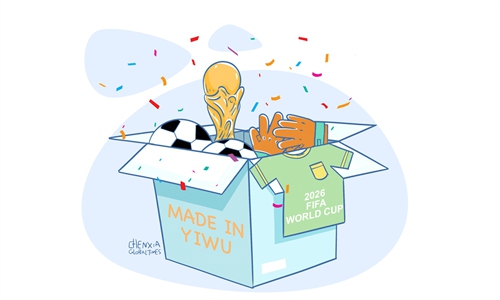
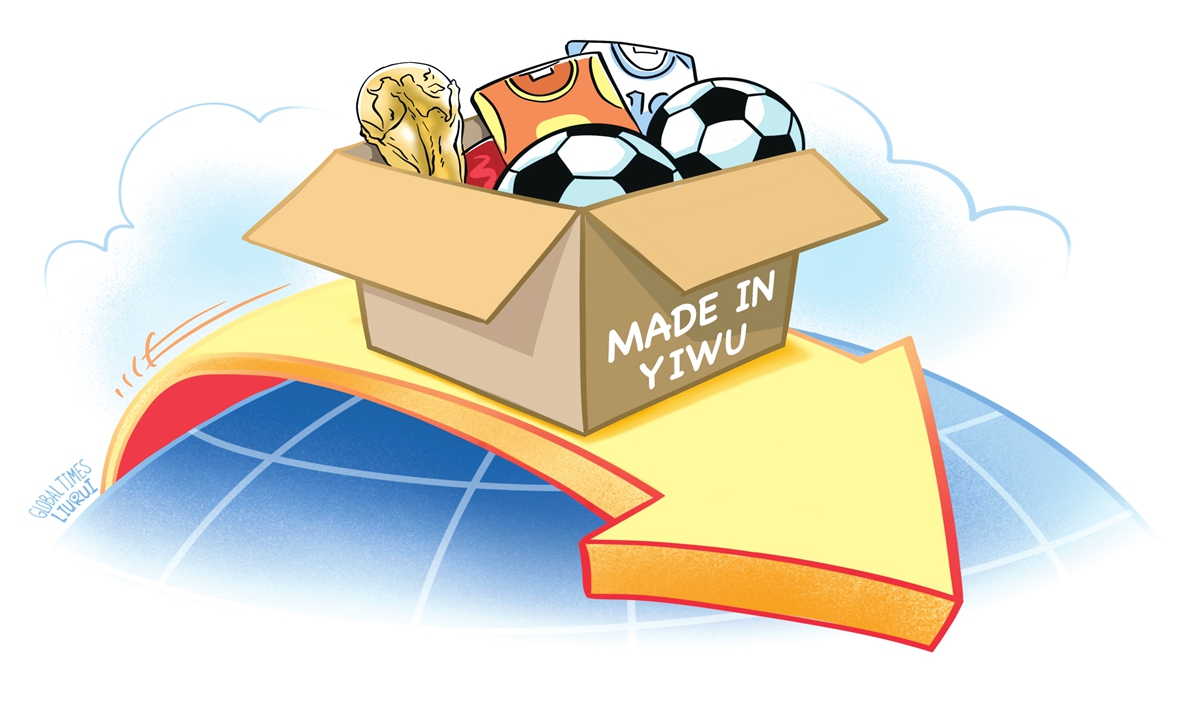
With just nine months to go before the 2026 FIFA World Cup to be held in the US, Canada and Mexico, Yiwu, the small commodities capital in East China's Zhejiang Province, has entered the fast lane of the World Cup economy. Local merchants are reporting a steady rise in orders for sports goods, with a peak expected between late September and early October, CCTV News reported on Sunday.Besides the established advantages of a diversified market presence and rapid response capability, Yiwu merchants' efforts to pursue opportunities in international markets are also marked by new trends: Strengthening product design and quality to meet the specific demands of target markets, offering personalized customization and placing a strong emphasis on intellectual property protection.
In the first seven months of the year, sports goods shipments from Yiwu reached 6.78 billion yuan ($950 million), up 16.8 percent year-on-year. Sales to the three World Cup host countries alone hit 1.88 billion yuan, up 10 percent year-on-year, according to Yiwu Fabu, the city's official social media account, citing data from Yiwu customs. For Yiwu, it is proof that its business model - flexible, innovative and globally connected - continues to deliver resilience in an uncertain global economy.
Yiwu's strength is not just scale; it is speed. The city has built an industrial chain that can integrate and adapt at remarkable pace. In this system lies a vast mold manufacturing cluster, producing more than 3,000 molds for new products every year. About 30 percent serve Yiwu's own companies, another 30 percent supply businesses in Zhejiang and neighboring provinces, and 40 percent are exported to Southeast Asia, Africa and South America, according to the Xinhua News Agency.
This capacity to churn out new molds at scale gives Yiwu traders the ability to diversify products swiftly, tailor supplies to market shifts and deliver faster than competitors. In global trade, that agility is a strong competitive edge, allowing the city to respond quickly to changing demand and capitalize on emerging opportunities.
Yet, agility alone would not explain Yiwu's resilience. The city's merchants are also deeply attuned to global consumer trends. Instead of recycling the same low-cost models, they actively study customer demand across different countries and regions. They tweak product designs, expand categories and invest in intellectual property protection. This strategic shift has allowed them to grab first-mover advantages in global events like the World Cup, where differentiation and speed matter as much as price.
Just as important is Yiwu's steady progress in climbing the value chain. Now, the city's merchants are steadily building self-owned brands that resonate abroad. This branding push is more than cosmetic: It secures higher margins, strengthens competitiveness and reduces dependence on overseas distributors.
At the same time, the rise of customization and the boom in cross-border e-commerce are reshaping Yiwu's business model. By reaching consumers directly through digital platforms, traders can deliver more value-added services, strengthening both supply chains and customer loyalty.
The resilience of Yiwu is especially inspiring against the backdrop of a turbulent international economy. Global trade is grappling with resurgent protectionism, supply chain fragmentation and heightened geopolitical risks. For many exporters, these headwinds spell trouble. For Yiwu, they have been an impetus to adapt faster, innovate harder and spread risk wider. The result is a city that continues to post solid growth.
Beyond the World Cup, merchants in Yiwu are not just producing soccer balls, jerseys and fan gear. They are showcasing an economic model built on speed, adaptability and foresight. When the world tunes in to other events or festivals, the city can quickly adapt to seize new opportunities.
Yiwu has shown that success in global trade is no longer about volume alone - it is about the ability to innovate, diversify and climb the value chain. In a world where turbulence and uncertainty in the international trade landscape and global supply chain cooperation is disrupting trade, Yiwu's shift will shape the sustainability of its next stage of growth.
The author is a reporter with the Global Times. bizopinion@globaltimes.com.cn
RELATED ARTICLES