Illustration: Chen Xia/Global Times
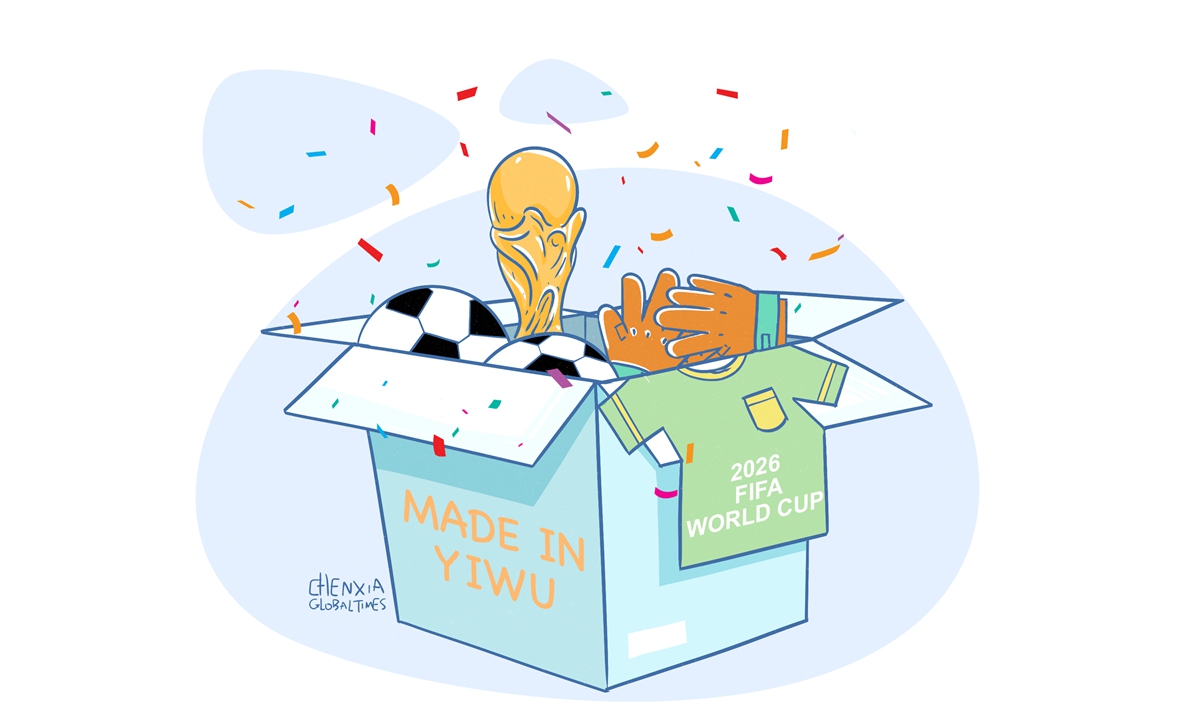
With the 2026 FIFA World Cup nearly a year away, Yiwu, dubbed the "world's capital of small commodities" or the "world's supermarket," has already begun to rev up its commercial machinery. A Sunday report from the Xinhua News Agency, referencing Yiwu customs data, showed that from January to May, the city's exports of sports goods and equipment surged to 4.79 billion yuan ($668.5 million), up by 16.6 percent. The report further noted that Yiwu's manufacturing sector is swiftly responding across the entire supply chain, seizing the initial wave of opportunities presented by this football event.Over the years, Yiwu, East China's Zhejiang Province, has consistently demonstrated its capacity to swiftly adapt to the requirements of international sporting events, thereby establishing itself as an important supplier of related merchandise. This range includes a variety of soccer balls and an extensive array of sports apparel, among other items.
This trend is poised to continue, as indicated by a report from Yiwu Fabu, the city's official social media account, which said that businesses in the city have already started receiving orders for products related to the 2026 FIFA World Cup that will be hosted by Canada, Mexico and the US next year. This early involvement highlights Yiwu's readiness and efficiency in meeting the demands of major international events.
What underpins the "business stickiness" between Yiwu and the World Cup? First, Yiwu is home to a well-established sports goods industry cluster. Having evolved over more than four decades, this sector has become one of the pillars of the city's economy. It offers a diverse range of products and strong production capabilities, enabling rapid response to the needs of international sporting events like the World Cup.
Second, how does Yiwu quickly adapt to the needs of the international market? A report from Hangzhou.com can provide us with some insights. According to the report, as early as the latter half of last year, some Yiwu merchants had already begun to seize opportunities related to the 2026 World Cup. They recognize that preferences for sports merchandise, such as functionality, design, and color, can differ greatly among countries. This insight, gained from experience at various sporting events, allows these businesspeople to strategically prepare for the market, ensuring they are well-prepared to meet the upcoming spike in demand.
Before the final lineup of teams was even announced, some merchants in Yiwu had already begun the proactive design of fan gear for various national teams. According to Yiwu Fabu, one business owner said that the company started to file for design patents for these supporter outfits as early as the beginning of last year. To date, it has secured 20 design patents, with more than 10 additional patents in the application process.
Third, Yiwu's robust logistics network ensures relatively quick delivery times for products. Yiwu boasts strong infrastructure in terms of transportation, logistics, and communication, facilitating smooth trade operations. Yiwu has established a global logistics network. Domestically, its logistics routes cover cities and regions across China, enabling rapid distribution of goods. Internationally, Yiwu exports products to more than 200 countries and regions worldwide through various transportation modes, including sea, air, and rail.
Attributing Yiwu's export and manufacturing prowess solely to a low-cost model oversimplifies its success. In reality, its strength is the result of a comprehensive strategy that encompasses robust supply chains, sharp market insight and adaptability, along with a sophisticated logistics network. This strategic blend enables Yiwu to efficiently satisfy global demand.
Yiwu's well-established industrial chains and advanced logistics network enable manufacturers to respond rapidly to changes in global demand. For major sporting events like the World Cup, this means that products can be designed, produced, and shipped on tight timelines. Yiwu not only supplies merchandise - it helps fuel the festive atmosphere of international events, while also driving local economic growth. This is win-win cooperation.
This mutually advantageous collaboration further underscores the impracticality of decoupling within the trade sector. Amid escalating global economic uncertainties, the World Cup-related merchandise provided by Yiwu serves as a testament to the city's expertise and its products' positive impact on the global economy.
The author is a reporter with the Global Times. bizopinion@globaltimes.com.cn
RELATED ARTICLES