Foreign experts endorse the significance of China’s V-day military parade at Beijing Xiangshan Forum
By Ma Ruiqian and Published: Sep 17, 2025 07:42 PM

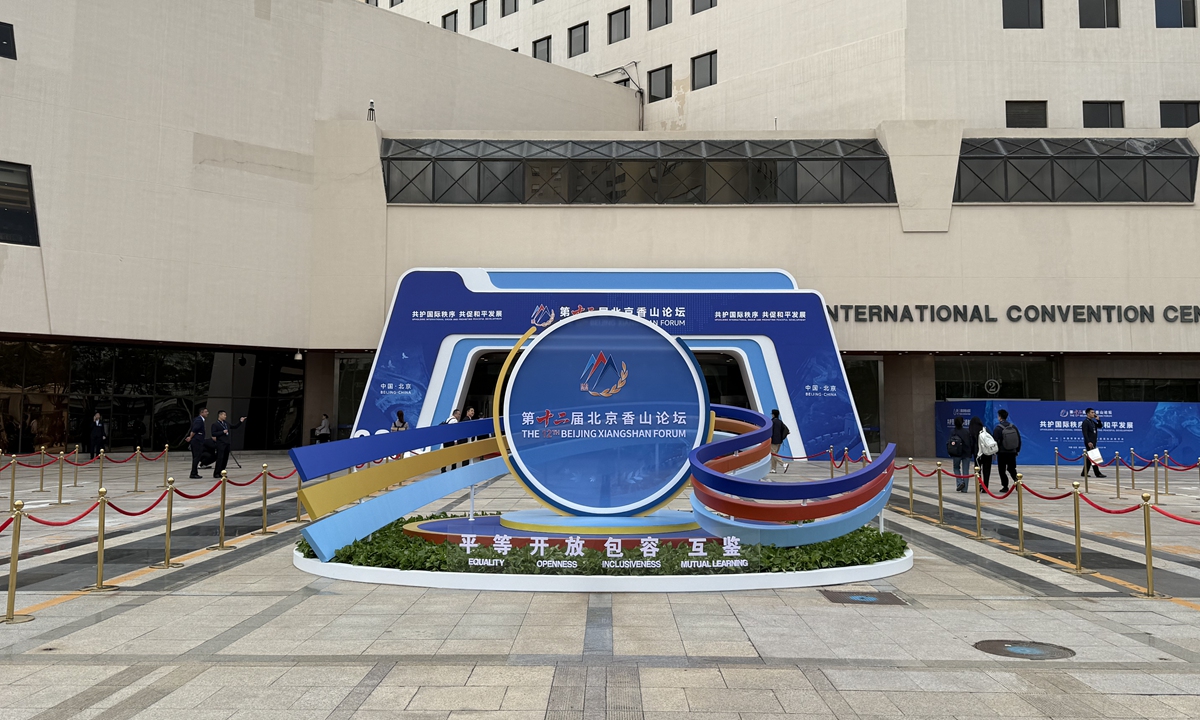
The 12th Beijing Xiangshan Forum opens on September 17 in Beijing. Photo: Ma Ruiqian/GT
Foreign experts attending the Beijing Xiangshan Forum have widely praised the significance of China's military parade in central Beijing on September 3 to mark the 80th anniversary of its victory in World War II, highlighting its impressive display of capabilities, technological advancements, and contributions to global peace.
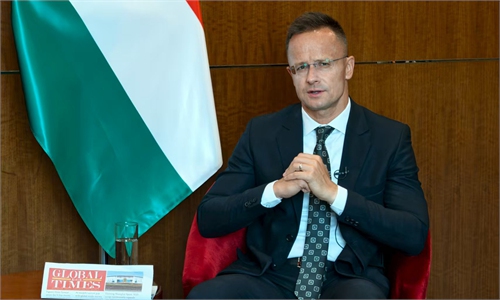
"The parade was very impressive," Attila Demko, a professor at the Hungarian Administrative University and former director of Hungary's Defense Policy Bureau, told the Global Times on the sidelines of the forum on Wednesday. He noted that the parade commemorated an important point in history — the end of the World War II.
"Unfortunately, we still need militaries and a balance of military power to prevent new wars," said Demko. He highlighted China's rapid military modernization: "30 years ago, from a Western perspective, the Chinese military was not very modern. Today, however, it is highly capable and technologically advanced." "We also have to take into account that it has strong leadership," Demko emphasized.
Demko highlighted China's military development for its contributions to peace: "The Chinese military is one of the largest in the world. China has already contributed significantly to international peacekeeping, and it may be able to do even more in the future."
Dmitrii Stefanovich, a research fellow with the Primakov National Research Institute of World Economy and International Relations, Russian Academy of Sciences, told the Global Times on Wednesday that he was impressed China's demonstration not only of selected weapons but also of a variety of systems.
"The way China demonstrated its military capability basically underlines that the development of the Chinese military is being done in a very credible and scientific manner," said Stefanovich.
Siswanto Rusdi, director of the National Maritime Institute of Indonesia, expressed his gratitude to China, saying, "With China's grand commemoration of the 80th anniversary of victory in the Chinese People's War of Resistance against Japanese Aggression and the World Anti-Fascist War, I feel China represents us - countries like Indonesia and Malaysia."
"We were victims of fascism in the 1940s, especially Japanese fascism, and long before that we also suffered under Dutch colonialism. So we understand both fascism and anti-fascism," said Rusdi.
"China voices our interests and concerns. Without this, the anti-fascist war and our suffering would be easily forgotten. But your government remembers all of us and keeps that memory alive. I think that's why Prime Minister Anwar Ibrahim joined the parade," Rusdi told the Global Times.
"Every country has a right to develop," VADM (Ret.) Ahmed Saeed, president of the National Institute of Maritime Affairs of Pakistan, said in response to the Global Times' question about foreign media questioning China's military development.
Commenting on the high-tech military capabilities displayed in China's V-Day parade, Saeed noted, "China's development cannot be seen in isolation. China's military strategy, which is based on active defense, has a basic character that is not aggressive. It is defensive and respects other countries' sovereignty."
"The rise of China is more of a stabilizer than a disruptor of peace," said Saeed.
RELATED ARTICLES