Hong Kong chief executive delivers policy address, focuses on livelihood, economy
City to boost development of border tech hub, enhance AI efficiency
By Published: Sep 17, 2025 09:48 PM

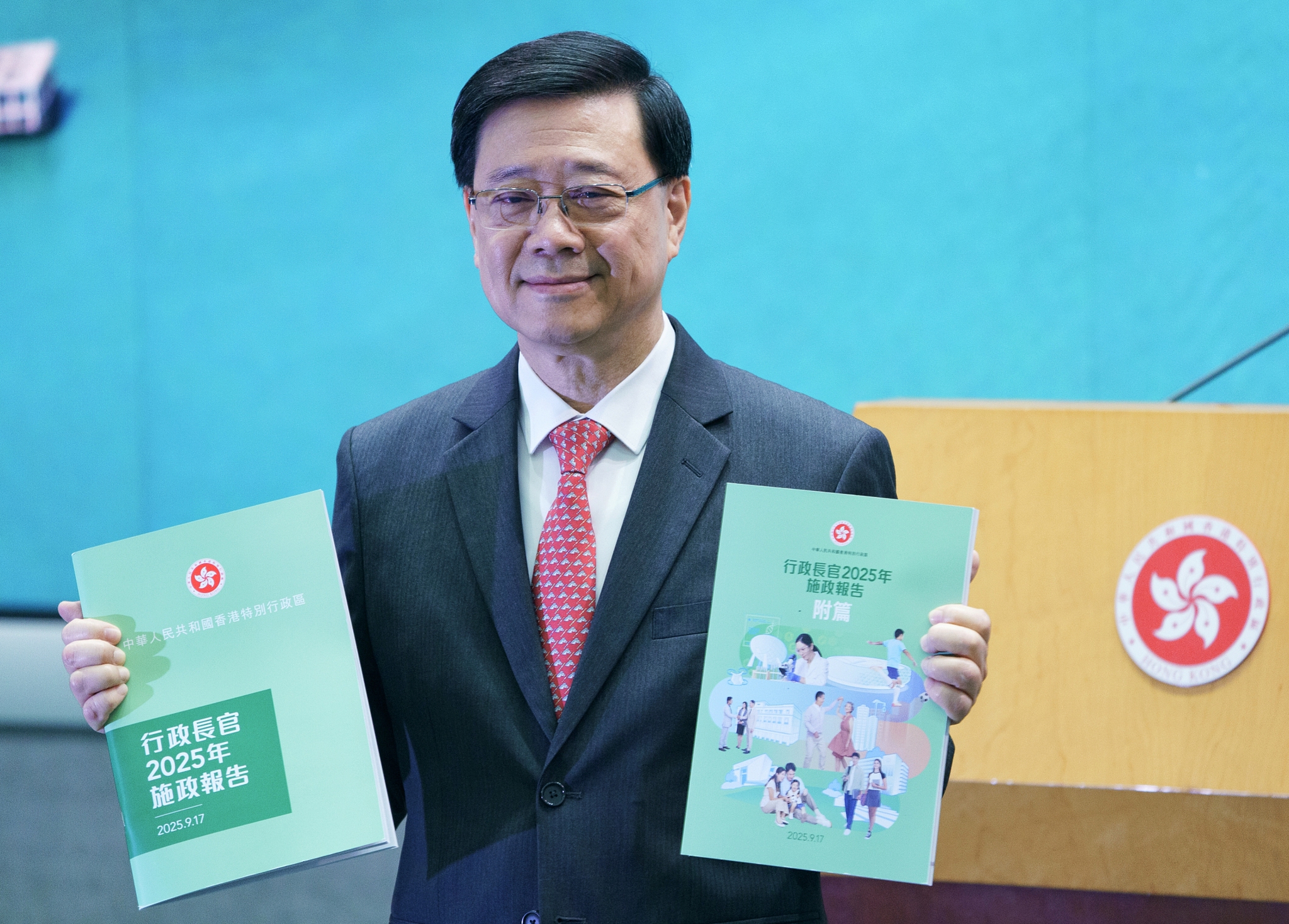
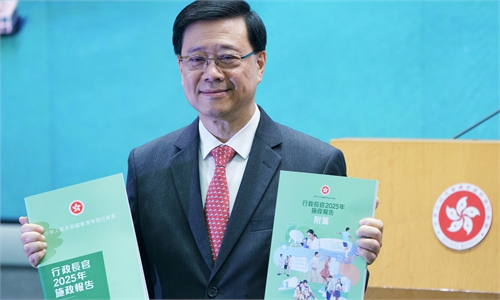
Hong Kong Chief Executive John Lee Ka-chiu presents his fourth Policy Address to press on September 16, 2025. Photo: VCG
Hong Kong Chief Executive John Lee Ka-chiu delivered his annual Policy Address on Wednesday, outlining measures aimed at improving livelihoods and strengthening the economy. The plan includes accelerating development of the Northern Metropolis, a major project near the border with Chinese mainland, and creating a task force to enhance the city's efficiency in AI.
Lee called the Northern Metropolis "is the new engine for Hong Kong's economic development and holds immense potential." He vowed to accelerate its development and set up the Committee on Development of the Northern Metropolis, according to a readout of his speech published on the website of HKSAR government.
The Northern Metropolis is close to Shenzhen's metropolitan core and the base of innovation and technology industry with the greatest development momentum, and having seven land-based boundary control points, forging an essential platform for Hong Kong's cooperation with other Greater Bay Area cities, according to Hong Kong government introduction.
The chief executive also announced the establishment of "AI Efficacy Enhancement Team," which aims to drive technological reform, coordinating and steering government departments in the effective use of AI, and in the re-engineering of outdated workflows.
Meanwhile, the Hong Kong government will promote the development of AI plus with strong emphasis on safety risk prevention, and implement AI government services and facilitate the wide-scale application and development of AI across different sectors in the society to boost overall efficiency, said Lee.
The accelerated development of the Northern Metropolis is not only vital for helping Hong Kong integrate into the Greater Bay Area's technology development, but also for enabling mainland Chinese tech companies to expand abroad by leveraging Hong Kong's international status, mature financing channels, and well-established intellectual property (IP) registration system, Lawrence Tang Fei, a member of the Hong Kong Legislative Council and vice president of the Hong Kong Federation of Education Workers, told the Global Times.
The same advantages also apply to Hong Kong's development of AI, Tang said, noting that amid complex geopolitical factors, the city can serve as an important bridge between the Chinese mainland and the global academic and technology communities, particularly in attracting talent and enhancing communication.
Lee vowed to consolidate Hong Kong's overseas offices, including the Hong Kong Trade Development Council, and the city's mainland offices, into a one-stop platform to help mainland companies go abroad.
The chief executive said the task force will actively encourage mainland companies to use Hong Kong as a springboard for their overseas expansion.
The chief executive said the city's economy is expected to grow by 2 to 3 percent this year, according to Now TV.
This year's Policy Address places particular emphasis on economic development and highlights the city's broad strategy for industries such as high-end manufacturing, financial innovation and the green economy, Liang Haiming, dean of the Belt and Road Research Institute at Hainan University, told the Global Times.
Liang added that this policy direction will further enable Hong Kong to contribute to the country's overall development while enhancing the city's international competitiveness.
This year marks the 80th anniversary of the victory in its war of resistance against Japanese aggression and the World Anti-Fascist War. Lee said the HKSAR government will host a series of large-scale events, including working with Shenzhen to launch a new red culture-themed experiential study tour route, according to media reports.
The initiative aims to deepen public and tourist understanding of Hong Kong's wartime history, while comprehensively cataloguing, restoring, and protecting local sites related to the Communist Party of China's resistance efforts, integrating them into educational tours and activities.
The HKSAR government will also promote patriotic education facilities on the Chinese mainland, incorporating them into Hong Kong's patriotic education bases to encourage more students and young people to participate in visits, said Lee.
Hong Kong's Education Bureau will continue to integrate patriotic education into daily teaching and learning, while strengthening programs such as the training scheme for student ambassadors on the Constitution and the Basic Law.
RELATED ARTICLES