IN-DEPTH / IN-DEPTH
Desert yields seafood and crops, witnessing southern Xinjiang’s tech-driven granary
Hope grows in soil
By in Xinjiang Published: Sep 17, 2025 10:38 PM

Editor's Note:
China's human rights stories are unfolding in a new era of comprehensive deepening reform and historic changes. It is a key component of China's poverty alleviation and whole-process people's democracy, a thorough reformation in judicial, medical insurance, and other key sectors related to the national economy and people's livelihoods, as well as a combination of numerous impressive and inspiring individual stories.
To be nurtured in youth, educated, secure gainful employment, receive medical care when ill, cared for in old age, have a place to live, and supported when weak... these are the concrete embodiments of human rights, demonstratinachievements of China's human rights development. But what is revealed in the daily lives of the Chinese people speaks to the most basic truth: Rights to survival and development are fundamental human rights.
The Global Times is launching a series of articles, telling vivid stories about upholding human rights in the new era. We expect the series to become a window through which more foreign readers will understand how Chinese people recognize human rights and what efforts they have made to fight for and fully enjoy human rights in their daily lives.
"Nine out of 10 years see poor harvests, and chaff and wild vegetables make up half the annual food supply." This was the collective memory of Xinjiang Uygur Autonomous Region's elderly farmers and the childhood recollection of Maimaiti Aili.
Back then, when looking down at Xinjiang region from an airplane, even in the middle of summer, a vast expanse of white could still be seen across many areas - not snow, but salt and alkali that deterred the growth of crops. More than one-third of Xinjiang's arable land suffered from salinization to varying degrees: In mild cases, it led to low crop yields, and in severe cases, not a single blade of grass could grow.
"In the past, if you grabbed a handful of this soil and rubbed it, half a handful of salt would come out. Not to mention growing crops - even grass refused to grow here. The maximum yield for rice was no more than 300 kilograms per mu (0.067 hectares)," Maimaiti, a graduate born in Kashi, located in southwestern Xinjiang, recalled. "I loved my hometown, but with this saline land, what was the way forward?"
This question haunted countless young people like Maimaiti in Xinjiang, a bittersweet "homesickness."
In 2018, Yang Jigun, head of the seawater rice project at the Agricultural Genomics Institute at Shenzhen under the Chinese Academy of Agricultural Sciences flew 5,500 kilometers from Shenzhen, South China's Guangdong Province, to Kashi. This agricultural scientist, long accustomed to battling saline soils, has since then devoted himself into transforming the desolate land.
Turning saline lands into granaries
Utilizing saline-alkali land is a global challenge. In spring 2018, Yang arrived in Kashi confronted by a bleak sight: The vast, barren land grew no grass, and soil tests revealed a salinity of 39‰, 9.7‰higher than seawater. Locals gathered around, skeptical: "Our ancestors couldn't grow crops here. Can you really do it?" Clutching the test report, Yang recalled that he responded firmly, "This isn't 'wasteland' - it's untapped treasure. With the right approach, it will yield crops!"
In the farmland, Yang's team repeatedly tested the soil salinity and finally confirmed that the salt content of this land was 39.7‰. Generally, good soil has a salt content below 1‰, Yang explained. "The salinization is so severe that the soil is even tinged with black alkali - how can this be land for growing crops?" Gazing at the white-tinged farmland, Yang sighed. "The utilization of saline-alkali land is a problem worldwide. China has 1.8 billion mu of arable land, plus 1.5 billion mu of unused saline land. If we can blaze a trail in Xinjiang, its value will be enormous."
Seawater rice is the key to solving this problem. Commonly known as salt-tolerant rice, it does not grow in seawater but is a rare and unique germplasm resource in China. "The seawater rice we have developed is a vivid name for salt-tolerant rice. It can survive in saline-alkali land with a salt content of 10‰," Yang explained.
As project leader and founder of Zhongnong Haidao (Shenzhen) Biotechnology Co, Ltd, Yang saw this technology as the "golden key" to transforming saline land. His team selected two test fields: One with a pH of 10.5 (heavily saline) and another in Pahtakla township (lightly saline) in Kashi, planting seeds and hope.
Seawater rice, a rare and specialized variety, can grow in saline-alkali soil. Hailed by Yuan Longping, the renowned Chinese scientist known as the "father of hybrid rice," as a revolutionary leap in rice cultivation, it represents a major scientific breakthrough following hybrid rice, Yang told the Global Times.
In Pahtakla township, Yang's team faced relentless challenges. The desert sun scorched, with daytime temperatures hitting 40C as they measured data and adjusted water and fertilizer, sweat crystallizing into salt on their clothes. Sandstorms filled their makeshift shelters with dust, tainting even their drinking water.
Worse still, locals were unconvinced. Chang Guangwei, an early team member, told the Global Times that Rehan Guli Tumier, a Pahtakla township villager, said bluntly, "We've farmed this land for generations, barely getting any yield. If your experiment fails, we lose even that. What then?" Chang recalled a veteran farmer's scorn: "I was planting rice before you were born. What does a college graduate know?"
Instead of arguing with them, Yang's team visited households, offering reassurance. "Farmers fear losing their harvest, so we gave them a 'guarantee,'" Yang said. "We promised 2,000 yuan ($28.1) per mu in rent, success or failure, ensuring their income." Through persistent outreach and explanations, Rehan Guli Tumier agreed to lease one mu for a year, becoming the first participant in Pahtakla township.
In this test plot, Yang's team planted six seawater rice varieties. But challenges persisted: Their rice tolerated up to 12‰ of salinity, while Pahtakla township soil's salinity was as high as 39‰. "The sunlight here is intense; midday water temperatures hit over 40C, spiking salt solubility. Many sprouting seedlings got 'burned,'" Chang recalled. The team watched wilting seedlings with heavy hearts, and Yang, sleepless, checked fields by flashlight at night.
On the sixth morning, he spotted green shoots and even tadpoles swimming - a breakthrough! "We passed the first hurdle!" he shouted, rousing the team. They gathered around the tiny seedlings, some eyes brimming with tears, Yang recounted.
"When we started promoting seawater rice, many didn't see its value. It's not just about grain - it's a pioneer for saline land restoration," Yang told the Global Times. "Plant it for two to three years, and the soil salinity drops significantly, allowing the cultivation of corn, cotton, or soybeans, transforming 'wasteland' into treasure."
"According to the yield measurement conducted by local agricultural bureau in 2024, the maximum per mu yield of our crop reached 853.2 kilograms, with an average per-mu yield of 670 kilograms. This is nearly double the yield of the local salt-tolerant varieties used previously," the agriculturalist noted.
The 'chips' of agriculture held in hands
As seawater rice scaled from test plots to large fields, researchers in Shenzhen accelerated efforts to tailor "custom seeds" for Xinjiang. "Test success is just the start. To root seawater rice in Xinjiang, we must adapt seeds to the land," Yang told Global Times. "We take Xinjiang's high-yield varieties to Shenzhen, grow them in winter, and screen them annually, selecting the best to create varieties suited for Xinjiang's saline soils. Seeds are agriculture's 'chips' - strong seeds ensure stable yields."
In the lab, Yang's team meticulously tested harvested seeds, measuring grain size, weighing thousand-grain weights, and checking disease resistance, storing high-yield seeds in a germplasm bank.
In the fields in Kashi, the Global Times reporter saw robust rice roots gripping the saline soil, drawing nutrients. "Growing such strong roots in saline land is incredible," Yang said.
On the field's edge, a unique livestream was underway. Maimaiti, holding golden rice, beamed to online viewers: "Look, this is our desert-grown seawater rice - fragrant when cooked." Four years ago, he worried about his saline land's future; now, skilled in soil monitoring and drone seeding, he's a local "new farmer" social media influencer. His smile, free of past uncertainties, radiates pride in his homeland, turning "homesickness" into hope for prosperity.
"Seawater rice has grown from a saline-land solution to a driver of income. We aim to spread this success further," Yang said. "China's rice bowl must stay in our hands, filled with our own healthy grain."
Beyond Kashi, Xinjiang's deserts are turning green. In Hotan's Cele county, deep in the Taklamakan desert, sprinkler systems grow lush corn. Center-pivot irrigation saves 30-50 percent more water than flood irrigation, cutting costs by thousands per 100 mu, painting green "circles" of hope in the sand. Diverse crops - vegetables, fruits, flowers, and herbs - are making Xinjiang's land vibrant.
Seafood in desert brings vitality
"Xinjiang's agricultural history is a saga of battling saline land," some villagers of Pahtakla township told the Global Times. Now, these lands yield not only high-yield rice and corn, but also "seafood."
In southern Xinjiang's Hotan and Kashi, transformed saline water supports South American white shrimp, crabs, and golden pomfret. Aquaculture bases along the Taklamakan's edge are taking shape.
In 2024, Hotan's aquatic output reached 12,000 tons, valued at 380 million yuan, bringing fresh seafood to inland tables and jobs with monthly wages at over 3,600 yuan. At the fresh base in Qiemo county, situated at the heart of the Taklimakan Desert in Xinjiang, 20 mu host golden pomfret and grouper with over 99 percent survival rates, plus successful trials of pearl oysters and clams. An eco-smart, constant-temperature system ensures "zero antibiotics, zero emissions, and zero pollution," forming a "blue pasture" in the desert, according to reports by CCTV News.
This year marks the 70th Anniversary of the Founding of Xinjiang Uygur Autonomous Region. From "nine years no harvest" to "desert granaries," Xinjiang's agricultural landscape has transformed. Modern facilities in deserts now produce grains, fruits, and the "world's farthest seafood from the ocean." These achievements highlight governance and human progress.
At dusk in Kashi's fields, Yang watches villagers harvest. Maimaiti livestreams, and Rehan clutches fresh rice, beaming. The breeze carried rice blossom scents and the distant desert glows golden.
Six years ago, Yang faced white saline land and skeptical gazes. Now, bountiful fields and laughter surround him. "We said we'd make saline land yield crops. People called it a fantasy. Look now - it's real," Yang said.
This land, once driving youth like Maimaiti away, now holds them with golden fields, fresh seafood, and stable incomes. The desert hasn't changed; what has changed is the wisdom and courage to transform it. The land hasn't changed; what has changed is the hope and future growing upon it.
China's human rights stories are unfolding in a new era of comprehensive deepening reform and historic changes. It is a key component of China's poverty alleviation and whole-process people's democracy, a thorough reformation in judicial, medical insurance, and other key sectors related to the national economy and people's livelihoods, as well as a combination of numerous impressive and inspiring individual stories.
To be nurtured in youth, educated, secure gainful employment, receive medical care when ill, cared for in old age, have a place to live, and supported when weak... these are the concrete embodiments of human rights, demonstratinachievements of China's human rights development. But what is revealed in the daily lives of the Chinese people speaks to the most basic truth: Rights to survival and development are fundamental human rights.
The Global Times is launching a series of articles, telling vivid stories about upholding human rights in the new era. We expect the series to become a window through which more foreign readers will understand how Chinese people recognize human rights and what efforts they have made to fight for and fully enjoy human rights in their daily lives.
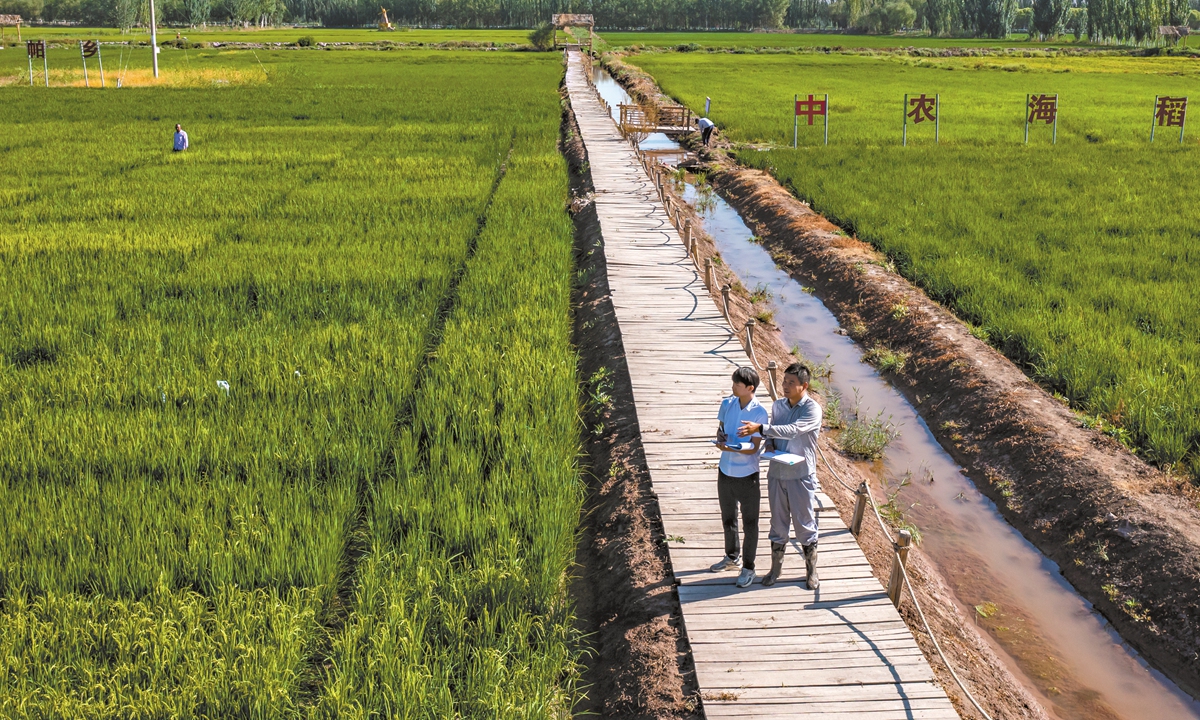
The research team evaluates the growth of seawater rice in Pahtakla township, Xinjiang, in July 2024. Photo: Courtesy of Zhongnong Haidao (Shenzhen) Biotechnology Co
"Nine out of 10 years see poor harvests, and chaff and wild vegetables make up half the annual food supply." This was the collective memory of Xinjiang Uygur Autonomous Region's elderly farmers and the childhood recollection of Maimaiti Aili.
Back then, when looking down at Xinjiang region from an airplane, even in the middle of summer, a vast expanse of white could still be seen across many areas - not snow, but salt and alkali that deterred the growth of crops. More than one-third of Xinjiang's arable land suffered from salinization to varying degrees: In mild cases, it led to low crop yields, and in severe cases, not a single blade of grass could grow.
"In the past, if you grabbed a handful of this soil and rubbed it, half a handful of salt would come out. Not to mention growing crops - even grass refused to grow here. The maximum yield for rice was no more than 300 kilograms per mu (0.067 hectares)," Maimaiti, a graduate born in Kashi, located in southwestern Xinjiang, recalled. "I loved my hometown, but with this saline land, what was the way forward?"
This question haunted countless young people like Maimaiti in Xinjiang, a bittersweet "homesickness."
In 2018, Yang Jigun, head of the seawater rice project at the Agricultural Genomics Institute at Shenzhen under the Chinese Academy of Agricultural Sciences flew 5,500 kilometers from Shenzhen, South China's Guangdong Province, to Kashi. This agricultural scientist, long accustomed to battling saline soils, has since then devoted himself into transforming the desolate land.
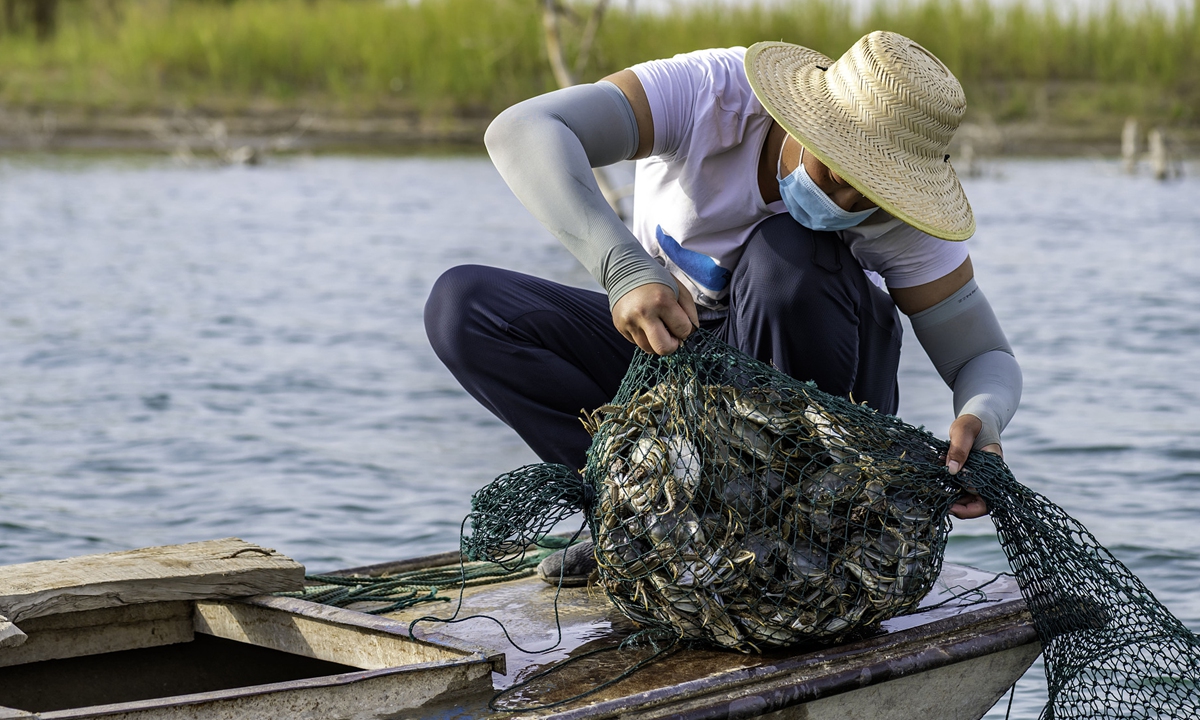
A local fisherman sails fishing boats to harvest crabs in Weili county, Northwest China's Xinjiang Uygur Autonomous Region. Photo: VCG
Turning saline lands into granaries
Utilizing saline-alkali land is a global challenge. In spring 2018, Yang arrived in Kashi confronted by a bleak sight: The vast, barren land grew no grass, and soil tests revealed a salinity of 39‰, 9.7‰higher than seawater. Locals gathered around, skeptical: "Our ancestors couldn't grow crops here. Can you really do it?" Clutching the test report, Yang recalled that he responded firmly, "This isn't 'wasteland' - it's untapped treasure. With the right approach, it will yield crops!"
In the farmland, Yang's team repeatedly tested the soil salinity and finally confirmed that the salt content of this land was 39.7‰. Generally, good soil has a salt content below 1‰, Yang explained. "The salinization is so severe that the soil is even tinged with black alkali - how can this be land for growing crops?" Gazing at the white-tinged farmland, Yang sighed. "The utilization of saline-alkali land is a problem worldwide. China has 1.8 billion mu of arable land, plus 1.5 billion mu of unused saline land. If we can blaze a trail in Xinjiang, its value will be enormous."
Seawater rice is the key to solving this problem. Commonly known as salt-tolerant rice, it does not grow in seawater but is a rare and unique germplasm resource in China. "The seawater rice we have developed is a vivid name for salt-tolerant rice. It can survive in saline-alkali land with a salt content of 10‰," Yang explained.
As project leader and founder of Zhongnong Haidao (Shenzhen) Biotechnology Co, Ltd, Yang saw this technology as the "golden key" to transforming saline land. His team selected two test fields: One with a pH of 10.5 (heavily saline) and another in Pahtakla township (lightly saline) in Kashi, planting seeds and hope.
Seawater rice, a rare and specialized variety, can grow in saline-alkali soil. Hailed by Yuan Longping, the renowned Chinese scientist known as the "father of hybrid rice," as a revolutionary leap in rice cultivation, it represents a major scientific breakthrough following hybrid rice, Yang told the Global Times.
In Pahtakla township, Yang's team faced relentless challenges. The desert sun scorched, with daytime temperatures hitting 40C as they measured data and adjusted water and fertilizer, sweat crystallizing into salt on their clothes. Sandstorms filled their makeshift shelters with dust, tainting even their drinking water.
Worse still, locals were unconvinced. Chang Guangwei, an early team member, told the Global Times that Rehan Guli Tumier, a Pahtakla township villager, said bluntly, "We've farmed this land for generations, barely getting any yield. If your experiment fails, we lose even that. What then?" Chang recalled a veteran farmer's scorn: "I was planting rice before you were born. What does a college graduate know?"
Instead of arguing with them, Yang's team visited households, offering reassurance. "Farmers fear losing their harvest, so we gave them a 'guarantee,'" Yang said. "We promised 2,000 yuan ($28.1) per mu in rent, success or failure, ensuring their income." Through persistent outreach and explanations, Rehan Guli Tumier agreed to lease one mu for a year, becoming the first participant in Pahtakla township.
In this test plot, Yang's team planted six seawater rice varieties. But challenges persisted: Their rice tolerated up to 12‰ of salinity, while Pahtakla township soil's salinity was as high as 39‰. "The sunlight here is intense; midday water temperatures hit over 40C, spiking salt solubility. Many sprouting seedlings got 'burned,'" Chang recalled. The team watched wilting seedlings with heavy hearts, and Yang, sleepless, checked fields by flashlight at night.
On the sixth morning, he spotted green shoots and even tadpoles swimming - a breakthrough! "We passed the first hurdle!" he shouted, rousing the team. They gathered around the tiny seedlings, some eyes brimming with tears, Yang recounted.
"When we started promoting seawater rice, many didn't see its value. It's not just about grain - it's a pioneer for saline land restoration," Yang told the Global Times. "Plant it for two to three years, and the soil salinity drops significantly, allowing the cultivation of corn, cotton, or soybeans, transforming 'wasteland' into treasure."
"According to the yield measurement conducted by local agricultural bureau in 2024, the maximum per mu yield of our crop reached 853.2 kilograms, with an average per-mu yield of 670 kilograms. This is nearly double the yield of the local salt-tolerant varieties used previously," the agriculturalist noted.
The 'chips' of agriculture held in hands
As seawater rice scaled from test plots to large fields, researchers in Shenzhen accelerated efforts to tailor "custom seeds" for Xinjiang. "Test success is just the start. To root seawater rice in Xinjiang, we must adapt seeds to the land," Yang told Global Times. "We take Xinjiang's high-yield varieties to Shenzhen, grow them in winter, and screen them annually, selecting the best to create varieties suited for Xinjiang's saline soils. Seeds are agriculture's 'chips' - strong seeds ensure stable yields."
In the lab, Yang's team meticulously tested harvested seeds, measuring grain size, weighing thousand-grain weights, and checking disease resistance, storing high-yield seeds in a germplasm bank.
In the fields in Kashi, the Global Times reporter saw robust rice roots gripping the saline soil, drawing nutrients. "Growing such strong roots in saline land is incredible," Yang said.
On the field's edge, a unique livestream was underway. Maimaiti, holding golden rice, beamed to online viewers: "Look, this is our desert-grown seawater rice - fragrant when cooked." Four years ago, he worried about his saline land's future; now, skilled in soil monitoring and drone seeding, he's a local "new farmer" social media influencer. His smile, free of past uncertainties, radiates pride in his homeland, turning "homesickness" into hope for prosperity.
"Seawater rice has grown from a saline-land solution to a driver of income. We aim to spread this success further," Yang said. "China's rice bowl must stay in our hands, filled with our own healthy grain."
Beyond Kashi, Xinjiang's deserts are turning green. In Hotan's Cele county, deep in the Taklamakan desert, sprinkler systems grow lush corn. Center-pivot irrigation saves 30-50 percent more water than flood irrigation, cutting costs by thousands per 100 mu, painting green "circles" of hope in the sand. Diverse crops - vegetables, fruits, flowers, and herbs - are making Xinjiang's land vibrant.
Seafood in desert brings vitality
"Xinjiang's agricultural history is a saga of battling saline land," some villagers of Pahtakla township told the Global Times. Now, these lands yield not only high-yield rice and corn, but also "seafood."
In southern Xinjiang's Hotan and Kashi, transformed saline water supports South American white shrimp, crabs, and golden pomfret. Aquaculture bases along the Taklamakan's edge are taking shape.
In 2024, Hotan's aquatic output reached 12,000 tons, valued at 380 million yuan, bringing fresh seafood to inland tables and jobs with monthly wages at over 3,600 yuan. At the fresh base in Qiemo county, situated at the heart of the Taklimakan Desert in Xinjiang, 20 mu host golden pomfret and grouper with over 99 percent survival rates, plus successful trials of pearl oysters and clams. An eco-smart, constant-temperature system ensures "zero antibiotics, zero emissions, and zero pollution," forming a "blue pasture" in the desert, according to reports by CCTV News.
This year marks the 70th Anniversary of the Founding of Xinjiang Uygur Autonomous Region. From "nine years no harvest" to "desert granaries," Xinjiang's agricultural landscape has transformed. Modern facilities in deserts now produce grains, fruits, and the "world's farthest seafood from the ocean." These achievements highlight governance and human progress.
At dusk in Kashi's fields, Yang watches villagers harvest. Maimaiti livestreams, and Rehan clutches fresh rice, beaming. The breeze carried rice blossom scents and the distant desert glows golden.
Six years ago, Yang faced white saline land and skeptical gazes. Now, bountiful fields and laughter surround him. "We said we'd make saline land yield crops. People called it a fantasy. Look now - it's real," Yang said.
This land, once driving youth like Maimaiti away, now holds them with golden fields, fresh seafood, and stable incomes. The desert hasn't changed; what has changed is the wisdom and courage to transform it. The land hasn't changed; what has changed is the hope and future growing upon it.
RELATED ARTICLES