ARTS / FILM
Film ‘Evil Unbound’ goes on global release Thursday, detailing Japanese germ-warfare Unit 731’s atrocities
Opening the wound for healing


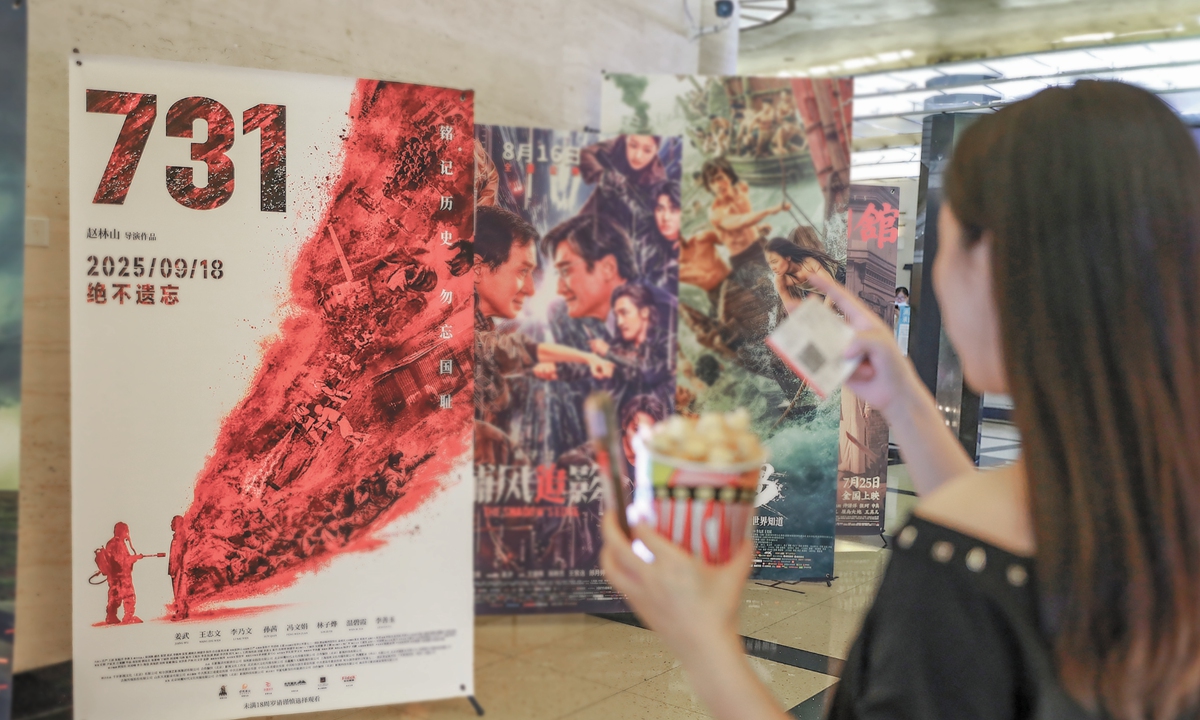
A viewer stands in front of the poster of the Chinese film 'Evil Unbound' Photo: VCG
The highly-anticipated film Evil Unbound themed on Unit 731, a notorious Japanese germ-warfare unit created during World War II (WWII), hits Chinese cinemas on Thursday.According to ticketing platform Maoyan, the film has grossed over 100 million yuan ($14.06 million) in presale box office revenue and topped the most-anticipated movies list, with over 4 million people expressing interest in watching it. Many Chinese netizens have taken to social media, stating that they wish to become "witnesses to the atrocities committed by the Japanese army in WWII."
Multiple ticketing platforms show that the first screening schedule of the film across Chinese cinemas is set for 9.18 am on Thursday, September 18, echoing the September 18 Incident in 1931 which marks the start of Japanese military's invasion of China.
Directed by Zhao Linshan, the movie highlights the atrocities suffered by the "Maruta" (the human experimentation subject as called by the Japanese army) from the perspective of civilians. The scenes put on full display the crimes against humanity committed by the Japanese Kwantung Army's Unit 731.
Unit 731 was the codename for a covert Japanese military medical unit from 1932 to 1945, responsible for bacterial warfare and human experiments that killed over 3,000 Chinese, Korean, Soviet, and Western prisoners of war in brutal tests. The Japanese militarists secretly designated an area of 6.1 square kilometers in the Pingfang district of Harbin, in Northeast China's Heilongjiang, in 1936, establishing the world's largest biological warfare base, according to the Xinhua News Agency.
In an exclusive interview with the Global Times, Zhao revealed that his mission went far beyond filmmaking. It was, he said, "an attempt to save history from oblivion" and "open the wound for healing."
'A race against time'
To ensure the film's content remain as historically accurate as possible, the production team firstly embarked on what Zhao described as a "rescue-style evidence collection", spanning multiple countries.
Zhao recalled that when they located former Unit 731 Youth Corps members who once served as child soldiers at the unit, they were already in their twilight years. Each interview was "a race against time."
One of the most haunting moments during Zhao's research occurred at the grave of Shiro Ishii, the notorious commander of Unit 731, in Chiba Prefecture, Japan. A relative of Ishii asked, "Those who were beaten have already forgotten. Why should the one who beat them remember?" The implication was: If the victims have forgotten, must the perpetrators keep remembering?
This question, Zhao said, was "heart-wrenching," and also strengthened his will to make the film.
Zhao also expressed deep respect for the work of Jin Chengmin, director of the Exhibition Hall of Evidences of Crime Committed by Unit 731 of the Japanese Imperial Army, based in Harbin, who has dedicated 36 years to investigating the unit's atrocities.
"With almost no survivors, restoring the truth behind Unit 731's crimes relies heavily on perpetrators' accounts. They almost withdrew en masse, concealing crimes. We had to cross barriers to reach the truth, compelling perpetrators to testify for credible history," Jin told the Global Times, referring to his work as a "rescue mission" for history.
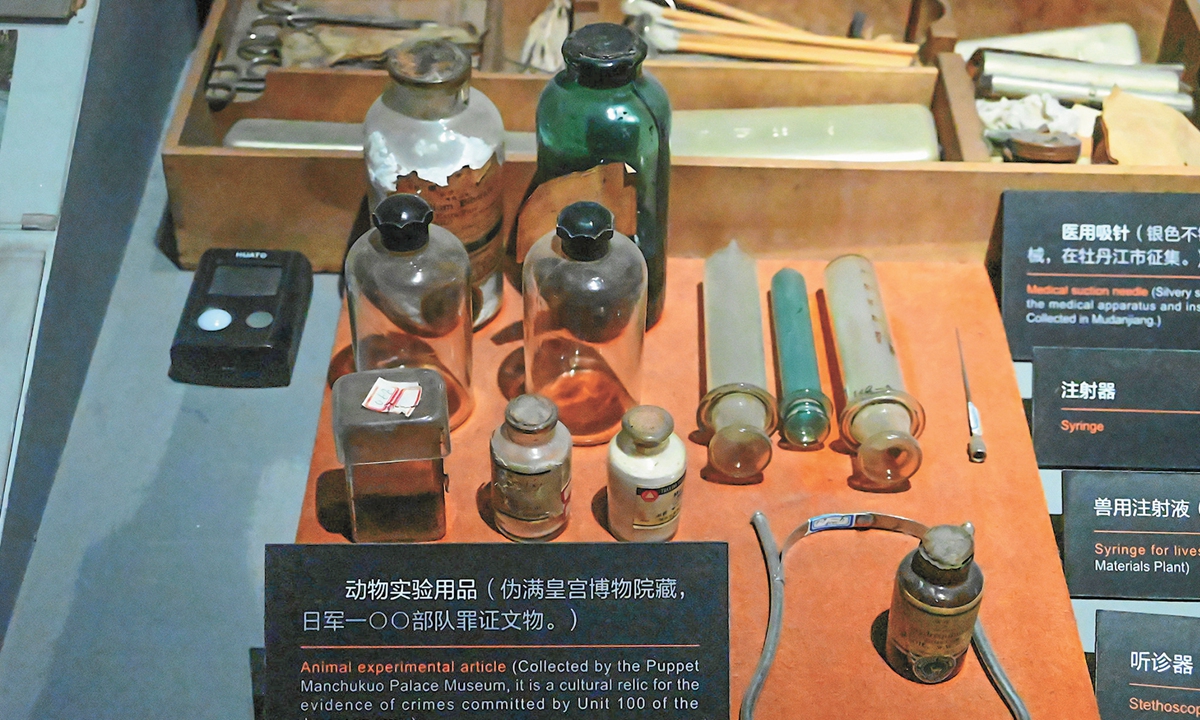
The exhibits at the Exhibition Hall of Evidence of Crimes committed by Unit 731 of the Japanese Imperial Army Photo: VCG
'Not exploiting pain'When asked to characterize Unit 731's crimes, Jin said: "Some call it a massacre, but that's imprecise. It was an unprecedented medical crime against humanity, using bacterial weapons, one of the three deadliest weapons alongside chemical and nuclear."
Facing the cruel crimes, the film Evil Unbound does not shy away from those grim details: Frostbite experiments, vivisection, and systemic biological warfare plans are depicted with unflinching clarity.
Zhao defended the approach: "I couldn't avoid showing some cruel scenes, scenes of experimentation, to everyone. I believe it's essential to expose this part of history, so we must tear open this wound."
He distanced the project from sensationalism, stressing that the aim was to promote reflection, not to exploit suffering.
"If we tear open this wound again and again only to show these scars, without a deeper insight, it might become merely an exploitation of suffering. So we should take advantage of this rare opportunity to look at this wound, to uncover the truth within it. I believe this to be meaningful for the future of humanity, for our entire history of development, war, and peace," Zhao said.
According to the film's official Sina Weibo account, Evil Unbound is set to also debut on Thursday in Australia and New Zealand. It will open in North America on Friday, followed by a number of other countries.
When asked what message he hopes overseas audiences will take away, Zhao said he believes the film will help global viewers understand that Unit 731's crimes are "not the private historical affair of one nation, but a lesson all humanity must learn."
Preserving the truth
Despite the Japanese government's long-standing position that no detailed records remain of Unit 731's activities, extensive evidence gathered by researchers and survivors tells a starkly different story.
As reported by the Xinhua News Agency, Japan has repeatedly claimed an absence of official data related to the notorious unit's operations. Yet, since 1998, Jin has preserved 423 hours of video testimony that systematically dismantle this narrative.
He once interviewed core military doctors, drivers, and youth corps members to refute claims that Unit 731 was the work of a few rogue scientists. "It was a top-down, organized, premeditated, large-scale state crime orchestrated by Japan's government, with no room for evasion," Jin said.
Echoing Jin, Wu Jianping, curator of the the Quzhou Exhibition Hall of the Japanese Invading Army's Bacteriological Warfare, provided further historical context.
He told the Global Times that the biological warfare waged by Japanese troops during their invasion of China spread across multiple provinces and regions in the country. Beyond Harbin, he added, the invading Japanese forces launched large-scale biological warfare attacks on Quzhou City in East China's Zhejiang Province on three separate occasions in 1940, 1942, and 1944.
Another branch, Unit 1644 in Nanjing, the capital of East China's Jiangsu Province, was also deeply implicated. "They participated in all three bacterial weapon attacks launched against Quzhou, and most core members were from Unit 731," Wu said.
The responsibility of preserving this painful history weighs heavily on those who continue to speak out. As a descendant of the victims, Wu vowed that "We cannot allow this history to be forgotten or diluted. As long as there are attempts to whitewash or conceal these war crimes, we must expose them, so that future generations will not forget."
RELATED ARTICLES