ARTS / CULTURE & LEISURE
Main structure of Palace Museum’s northern campus completed, set to boost relic conservation and exhibition capacity
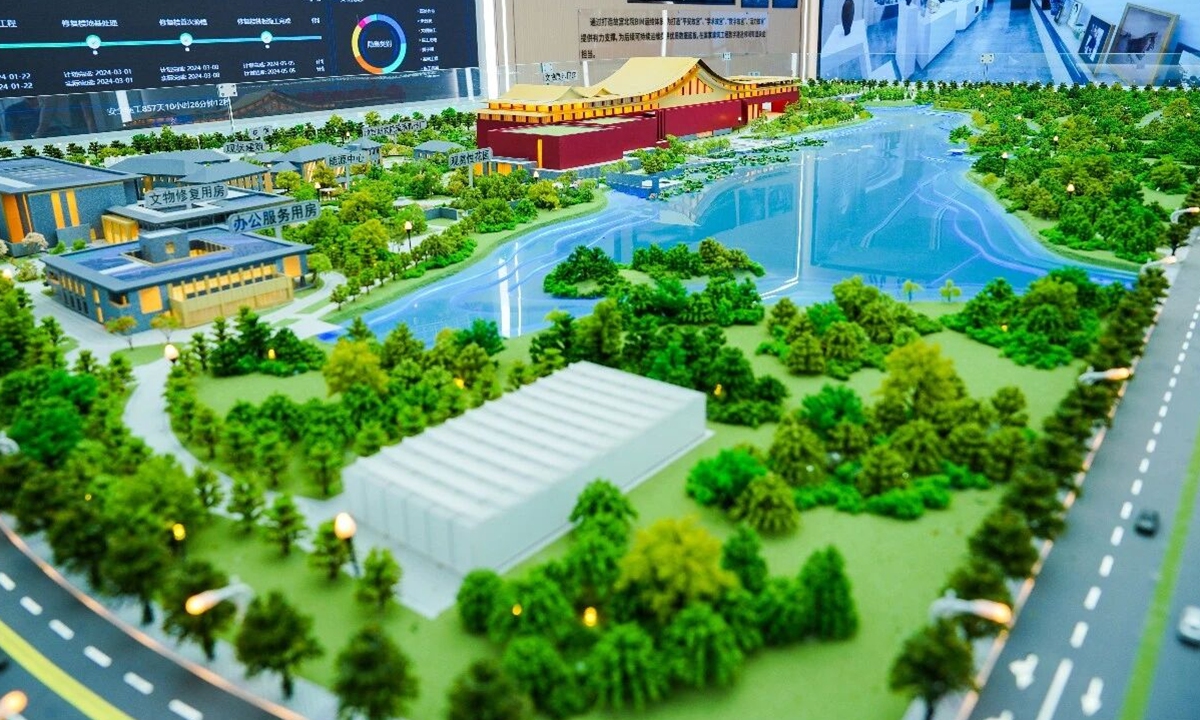
The main structure of the Palace Museum's northern campus has been fully completed Photo: Courtesy of the Haidian branch of the Beijing Municipal Commission of Planning and Natural Resources
The main structure of the Palace Museum's northern campus has been fully completed, and the project has officially moved into the interior decoration phase, the Global Times learned Thursday from the Haidian Branch of the Beijing Municipal Commission of Planning and Natural Resources. This major cultural facility, a key project under China's 14th Five-Year Plan, has made significant progress, marking its entry into the final stage of construction."As a vital bearer of China's 5,000-year-old civilization, the Palace Museum now houses more than 1.8 million cultural relics. With the completion of the museum's northern branch, more visitors will be able to appreciate its finest collections," Wang Xiaoming, director of the Haidian Branch of the Beijing Municipal Commission of Planning and Natural Resources, told the Global Times on Thursday.
"We are not just constructing a building, but using science and technology to safeguard the very roots of civilization," Zhao noted.
"The project is scheduled for completion in May 2026. Once completed, it will greatly enhance the museum's ability to conserve and showcase cultural relics," he noted.
Located in Shangzhuang town of Haidian district in Beijing, the northern campus covers a total floor area of 102,000 square meters and a land area of 115,500 square meters.
"The construction includes facilities for relic display, restoration, and office services. Upon completion, the site will serve as a modern museum complex integrating collection, exhibition, restoration, research, and education," a Palace Museum staff member told the Global Times on Thursday.
The interior work will focus on key areas, including exhibition hall layouts, restoration studio installations, and security system upgrades, ensuring that relic preservation and display environments meet world-class standards.
According to data shared by stuff member from the Beijing Municipal Commission of Planning and Natural Resources, the new campus is expected to enable the restoration of about a thousand of cultural relics annually, addressing challenges in repairing large and precious artifacts. It will also feature 12 state-of-the-art exhibition halls capable of displaying 20,000 to 30,000 items per year, three times the current exhibition volume of the Palace Museum, and it will incorporate digital technologies to enhance the visitors' experience.
According to Wang, as the project enters its interior decoration phase, the commission will continue to play a coordinating role to ensure the smooth advancement of this major cultural facility. Once completed, the northern campus will become a new cultural landmark in the capital, easing the burden on the Palace Museum's main site, advancing the protection and revitalization of cultural heritage, and injecting strong momentum into Beijing's development as a national cultural center.
During the construction process, the Haidian branch of the Beijing Municipal Commission of Planning and Natural Resources coordinated with relevant departments through the city-district planning platform to develop solutions that complied with regulations and addressed the project's practical requirements. By analyzing issues individually and handling specific problem areas separately, the commission ensured procedural compliance without affecting the construction schedule.
"We have installed 332 base isolators along with six different types of dampers, forming the most sophisticated seismic isolation system in China, capable of reducing 80 to 90 percent of earthquake energy," Zhao Canzhen, chief engineer of the project, told the Global Times. These "guardians" hidden beneath the building act as a solid shield to protect the cultural relics.
The exterior foam ceramic curtain walls and the foam glass insulation layer on the roof serve as an "energy-saving coat" for the building. The use of eco-friendly materials such as foam ceramics and foam glass makes this cultural landmark embody a "low-carbon spirit" inside and out.
"We are not just constructing a building, but using science and technology to safeguard the very roots of civilization," Zhao noted.
RELATED ARTICLES