Multiple places in China will implement spring and autumn breaks starting this semester

Children play at a park in Linyi, East China's Shandong Province on September 13, 2025. Photo: IC
Several regions in China will introduce spring and autumn breaks for primary and secondary schools starting this autumn in response to measures issued by the Ministry of Commerce (MOC) on Tuesday to boost service consumption, The Paper reported on Thursday.
Among the 19 measures across five key areas issued, the ministry encourages adjustments to the academic calendar and will introduce spring and autumn breaks in primary and secondary schools based on climate conditions with the precondition of the total number of vacation days and teaching hours remaining unchanged, according to The Paper.
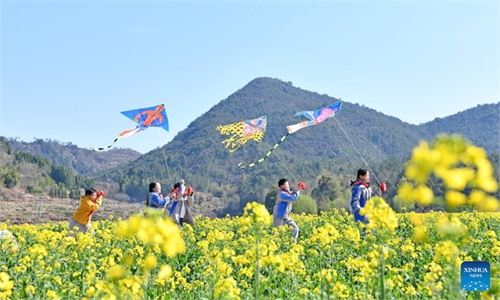
Spring and autumn breaks are short holidays added to the school year in addition to the traditional winter and summer vacations. They are typically scheduled around statutory holidays such as the May Day holidays and the National Day holidays to create longer continuous periods of rest, allowing students to relax, take part in practical activities or travel with their families.
As the National Day holidays are approaching, several areas including Enshi Tujia and Miao Autonomous Prefecture in Central China's Hubei Province and Foshan in South China's Guangdong Province have announced plans to introduce spring and autumn breaks.
On August 25, the local government in Enshi issued a notice, requiring all compulsory education schools to observe one spring break and one autumn break each semester, each lasting at least one week.
On August 11, the local education authority in Foshan announced the pilot program for spring and autumn breaks to be carried out in schools of compulsory education across the city during this coming academic year. The three-day autumn break is scheduled for November 12 to 14, while the two-day spring break will be arranged around the May Day holidays.
Since the beginning of 2025, provinces including Guizhou, Henan, Hainan and Jiangsu have issued implementation plans to explore the introduction of spring and autumn breaks.
On September 1, the Chengdu Education Bureau in Sichuan Province announced that the bureau supports schools in exploring the implementation of spring and autumn breaks by flexibly adjusting teaching plans, seeking parents' input and taking into account students' ages and stages of schooling.
According to Xiong Bingqi, director of the 21st Century Education Research Institute, practical resistance remains to spring and autumn breaks in primary and secondary schools. While some parents feel these breaks "take away" study time, believing students should focus on learning rather than leisure, other dual-income families worry about childcare during the breaks, as parents must work while their children are at home.
Xiong told the Global Times on Thursday that it requires coordinated action to overcome these challenges. Schools and community resources should offer activities for children without parental supervision during their breaks. Education authorities should work with labor and human resources departments to improve paid leave policies for employees.
The city of Hangzhou pioneered spring and autumn breaks in 2004. In recent years, spring breaks in the city are usually scheduled around May and autumn breaks around October. Notably, Hangzhou also provides free childcare services during these breaks for families in which both parents work to ease parents' concerns.
RELATED ARTICLES