China-proposed GGI is 'a very good solution': expert at the Beijing Xiangshan Forum
By Ma Ruiqian and Published: Sep 18, 2025 09:44 PM

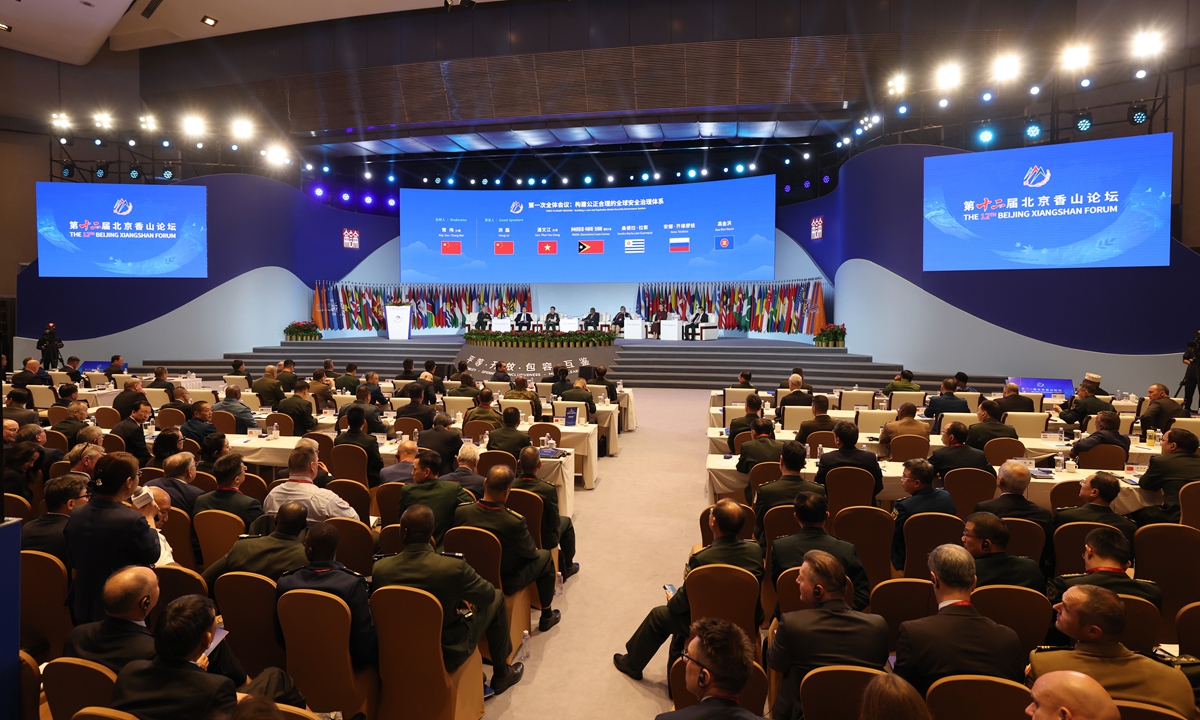
The 12th Beijing Xiangshan Forum opens on September 17 in Beijing. Photo: VCG
Foreign experts attending the Beijing Xiangshan Forum spoke highly of the China-proposed Global Governance Initiative (GGI) on Thursday, highlighting its emphasis on sovereignty, equality and multilateral cooperation.Pravin Sawhney, editor of FORCE magazine in India, told the Global Times that the GGI formalizes a new governance system recognized by Global South nations.
The GGI, proposed by Chinese President Xi Jinping on September 1 during the SCO Plus Meeting in North China's Tianjian, champions five principles - adhering to sovereign equality, abiding by international rule of law, practicing multilateralism, advocating the people-centered approach, and focusing on taking real actions.
Sawhney believes that the five principles of the GGI provide a foundation for Global South nations, whether big or small, to work together as equal partners. "It is about equality among nations, working under the United Nations, conducting multilateral trade under WTO rules, respecting national sovereignty and ensuring indivisible security. This represents an entirely different way of thinking from that of the US. And this is why most Global South nations have been drawn to this way of thinking," he said.
"It is about partnership, not dominance. When there is partnership, there will be peace. When there is peace, there will be stability, and then you can have development," Sawhney added.
Former Argentine Colonel Sergio Skobalski also highlighted the importance of the initiative for the Global South. "It is very important for Global South countries because, with China, which supports all the countries of the Global South, we have representation among the major powers," he said.
He further noted that the GGI and the Global Security Initiative complement each other, as both aim to promote peace, encourage cooperation among countries and respect sovereignty.
Facing growing turmoil, Ruhanas Binti Harun, a professor in the Department of International Relations, Security, and Law at the National Defense University of Malaysia, told the Global Times on the sidelines of the session themed "Asia-Pacific Security Cooperation" that the China-proposed GGI is "a very good solution."
"Geopolitics and geostrategic dynamics have evolved, and we need to improve the old structures to accommodate the new environment," she said.
"You need an initiative to address oppression, suffering and war," Harun added. "This initiative embodies the kind of governance we want, one that can distinguish right from wrong."
She also emphasized that it is important for a major country like China, with its huge influence and resources, to have such an important initiative.
Jean-Pierre Lacroix, Under-Secretary-General for Peace Operations at the United Nations, said the GGI emphasizes respect for sovereignty, as well as multilateralism and a collective responsibility to address today's challenges, particularly those related to peace and security.
"I think there is not only compatibility, but also convergence between the GGI and what the UN really stands for," Lacroix noted.
RELATED ARTICLES