Charlie Kirk assassination becomes a blame-shifting game masking US domestic problems
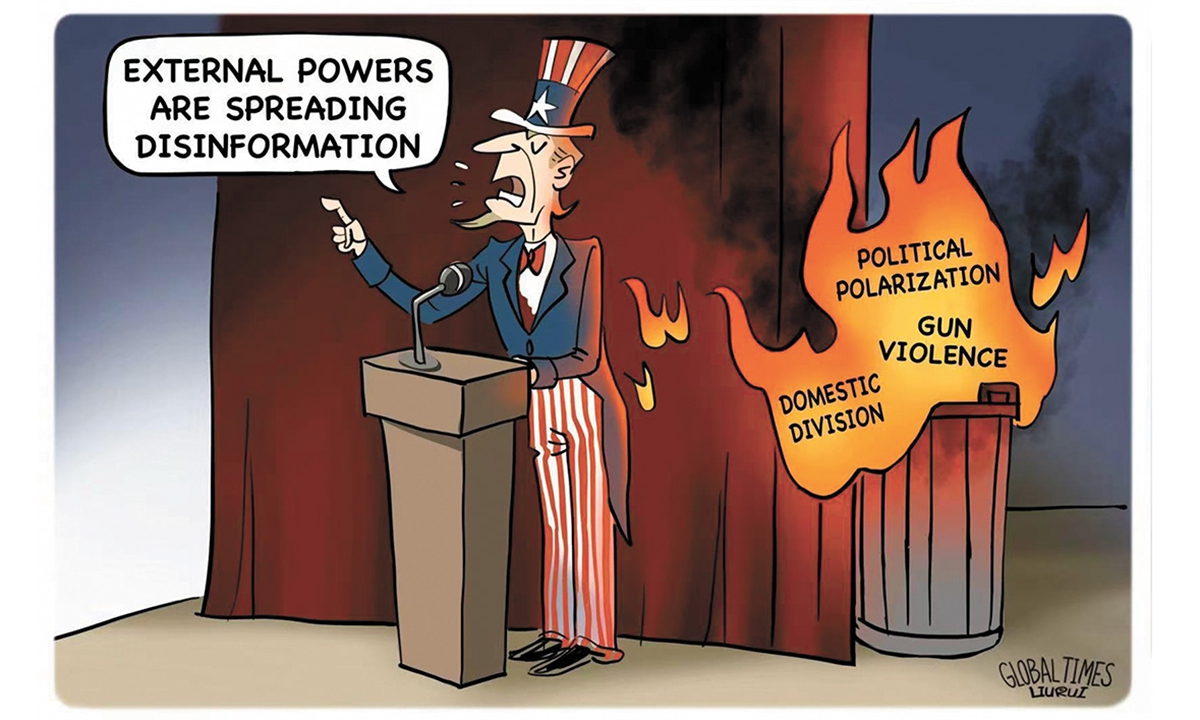
Illustration: Liu Rui/GT
In its Wednesday report, The New York Times framed the recent assassination of US politician Charlie Kirk within a familiar narrative: foreign countries seizing the opportunity to spread disinformation and sow division. But in reality, it merely attempts to distract attention from the country's own problems, evading the internal structural issues and political dysfunction within the US.The New York Times report is based on an analysis by NewsGuard, a company claiming to track online disinformation. The report said: "In the week since Charlie Kirk's assassination, Russia, Iran and China have spread thousands of false or incendiary claims about what happened to the conservative activist, in an effort to stoke political divisions or to portray the US as a dysfunctional country."
The NewsGuard's article highlighted remarks made by Utah Governor Spencer Cox following Kirk's shooting: "What we are seeing is our adversaries want violence."
The US "blame-shifting" script has long been well-established: When an incident occurs, external factors are identified and accused of amplifying the crisis, the issue is reframed as a matter of national security, and internal contradictions are ignored. The twisted coverage following Kirk's assassination is simply the latest episode in this series. In fact, these reports simply repeat a standardized, template-driven narrative.
So, what exactly is the source of the "violence" that this US official is referring to? The answer is the US itself.
According to Pew Research Center surveys released in 2025, the number of gun deaths in the US remains at high levels, "far higher" than those of other countries. Public concern about political division and violence has also continued to rise. Against this backdrop, blaming "foreign interference" is an evasion of the US' internal structural problems and political dysfunction.
"This has become a kind of inertia. Mainstream US media and political figures are accustomed to externalizing internal conflicts. This narrative could even be described as a policy to mislead their own citizens, ultimately deceiving even themselves," said Lü Xiang, a research fellow at the Chinese Academy of Social Sciences.
"Whenever problems arise domestically in the US, there are always those who habitually blame China, claiming that 'China is taking advantage of this situation.' In reality, these are events genuinely occurring within the US. Chinese reports merely reflect many public comments and reactions inside the country," Lü added.
Why do US media repeatedly play out this script? It serves as a political deflection. Kirk's assassination should have prompted reflection on the political polarization and culture of violence prevalent in the US. However, instead of paying more attention to engage with these critical issues, some media outlets and political leaders shifted the topic toward "foreign powers." Contentious issues such as gun control, law enforcement gaps, and political violence were downplayed or ignored altogether, while the media and politicians easily turn to ready-made "scapegoats" to divert attention from the real problems at hand.
However, these narratives targeting external powers cannot hide the truth: the root of the problem still lies within the US itself. Public concern over law and order, political polarization, and gun violence reflects a harsh reality that cannot be ignored. In contrast, media hype aimed at distracting attention toward external powers serves as little more than an ostrich burying its head in the sand - it cannot conceal the severity of domestic problems.
RELATED ARTICLES