China pledges greater efforts to safeguard peace at Beijing Xiangshan Forum; Heated discussions on security issues highlight importance of GGI
By and Ma Ruiqian Published: Sep 19, 2025 12:10 AM

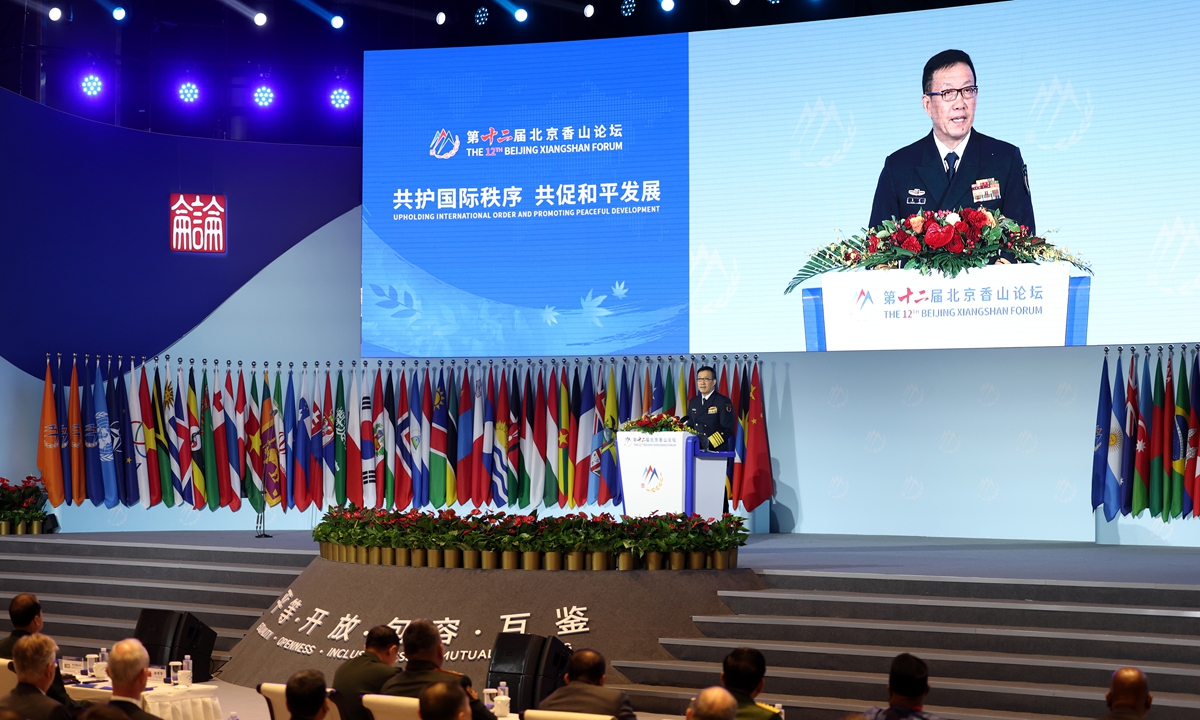
Chinese Defense Minister Dong Jun delivers a keynote speech at the opening ceremony of the 12th Beijing Xiangshan Forum on September 18, 2025. Photo: VCG
The 12th Beijing Xiangshan Forum entered its second day with an official opening ceremony highlighted by the keynote speech by the Chinese Defense Minister Dong Jun pledging greater efforts to safeguard world peace, as well as simultaneous sessions attended by representatives from various countries focusing on hotspot issues.
Despite a packed Thursday schedule, featuring the opening ceremony, two plenary sessions, and eight concurrent sessions covering diverse themes, the venue was consistently filled to capacity, with vibrant discussions and interactions both inside and outside the conference halls.
Reporters found that it was already hard to find a seat in some of the sessions ten minutes before the start. Delegates from different countries were also generous in their high praise for the forum, with many international participants sharing their excitement and satisfaction with reporters.
Analysts emphasized that in today's complex geopolitical landscape, the Beijing Xiangshan Forum stands as a rare and significant platform where nations of all sizes can engage on equal terms, and the Global South can also actively contribute its voice, underscoring its profound importance.
During the Thursday session themed "The Victory of the World Anti-Fascist War and the International Order," Jean Christophe Baron von Pfetten, Chairman of the Royal Institute for East West Strategic Studies in the UK, said in Chinese that "No other forum, [like the Beijing Xiangshan Forum], can bring together Ukrainians, NATO representatives, and Russian military leaders for a meeting. This makes it [the Beijing Xiangshan Forum] truly remarkable."
Commitment to peace
Addressing the opening ceremony of Beijing Xiangshan Forum on Thursday, Chinese Defense Minister Dong Jun pledged greater efforts to safeguard world peace, according to Xinhua News Agency.
He said that the Chinese military is willing to work with all parties to uphold security with concrete actions, enhance military mutual trust, step up multilateral coordination, and promote high-quality and efficient cooperation while improving related mechanisms, so as to make greater contributions to safeguarding world peace and building a community with a shared future for humanity.
Noting that this year marks the 80th anniversary of the victory in the Chinese People's War of Resistance against Japanese Aggression and the World Anti-Fascist War, Dong emphasized that the Chinese military stands ready to work with all parties to defend sovereign equality, uphold the post-war international order, bolster multilateralism, protect common interests, and jointly advance reforms to improve the global governance system, according to Xinhua.
Dong also spoke of the Taiwan question in his speech, emphasizing that the island's status as a part of China is a historical and legal fact that is beyond any doubt. The Chinese People's Liberation Army stands ready to defeat any secessionist plot of Taiwan separatist forces, and will foil any military interference from external forces, Dong added.
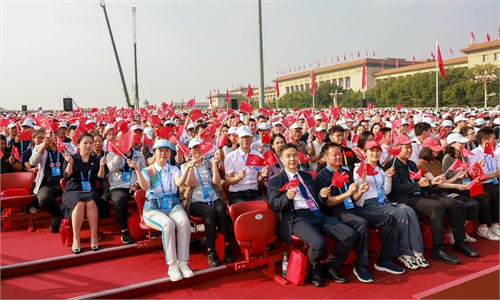
Zhang Weiwei, director of the China Institute of Fudan University, described Dong's speech as "very substantive," with both strategic thinking and specific suggestions for action, especially considering that China has just held a massive parade commemorating the 80th anniversary of victory in the Chinese People's War of Resistance against Japanese Aggression and the World Anti-Fascist War.
The expert told the Global Times that China is a civilized and rational nation, possessing not only a strong defense but also great wisdom.
He added that China's approach to comprehensive security is rooted in the pursuit of peace, rather than a zero-sum game or the elimination of adversaries, which markedly differs from some Western perspectives.
Seeking solutions
Following the opening ceremony, eight parallel sessions unfolded in the afternoon. While topics such as arms control, governance of emerging technologies, and the impact of evolving forms of warfare on international security attracted considerable interest. Sessions focusing on major-power relations, Asia-Pacific security cooperation, and the political settlement of regional conflicts were overflowing with attendees, underscoring the urgent need for solutions to the challenges facing the world today.
The second day of the forum coincided with the 94th anniversary of the September 18 Incident, which marked the start of China's war of resistance against Japanese aggression. During the session "Trends of Major-Country Relations," Masayuki Masuda, Head of China Division of National Institute for Defense Studies in Japan, was asked about his views on Japan's history of aggression.
His response, sidestepping personal views to highlight Japan's "peaceful path over the past 80 years," stirred controversy among attending experts. Even long after the session, Masuda was mobbed by reporters pressing for further comments.
Reporters observed in other sessions that delegates from various countries with differing stances and views engaged in heated discussions on topics such as the South China Sea issue, the Ukraine crisis, and the Israeli military operation in Gaza. However, when the sessions concluded, they warmly shook hands with each other and exchanged cards.
Ruhanas Binti Harun, a professor of Department of International Relations, Security and Law of the National Defense University of Malaysia, told the Global Times on the sidelines of the session themed "Asia-Pacific Security Cooperation" that in face of growing turmoil, China's recently proposed Global Governance Initiative (GGI) is "a very good solution."
During the session, the Malaysian expert described the US as a "big elephant" standing behind some regional countries, interfering in the Asia-Pacific region.
Geopolitics and geo-strategy have all evolved, and we need to improve the old structure to accommodate a new environment, she said. "We need an initiative to handle this oppression, suffering and war," said Harun, "The initiative has the kind of government we want, that can see between right and wrong."
The Global Governance Initiative is a very important initiative proposed by China. "Basically, what this initiative does is formalize a new governance system that has already been recognized by Global South nations," Pravin Sawhney, Editor of Force Magazine of India, told the Global Times on Thursday.
"It is about equality among nations…respecting national sovereignty, and ensuring indivisible security," Sawhney said, "It is about partnership, not dominance. When there is partnership, there will be peace. When there is peace, there will be stability, and then you can have development."
Commenting on China's GGI, Bernt Berger, Senior Researcher of the Center for Applied Research in Partnership with the Orient, Germany, told the Global Times that in the face of the forming new world order, China and Europe are "potential partners" to "pave the way forward," as some other major powers are subverting the existing order and rules, and care more about realizing their own interests.
RELATED ARTICLES