Xinjiang experiencing best period of development in history: white paper
White paper reveals Xinjiang's comprehensive achievements and vivid transformation: expert
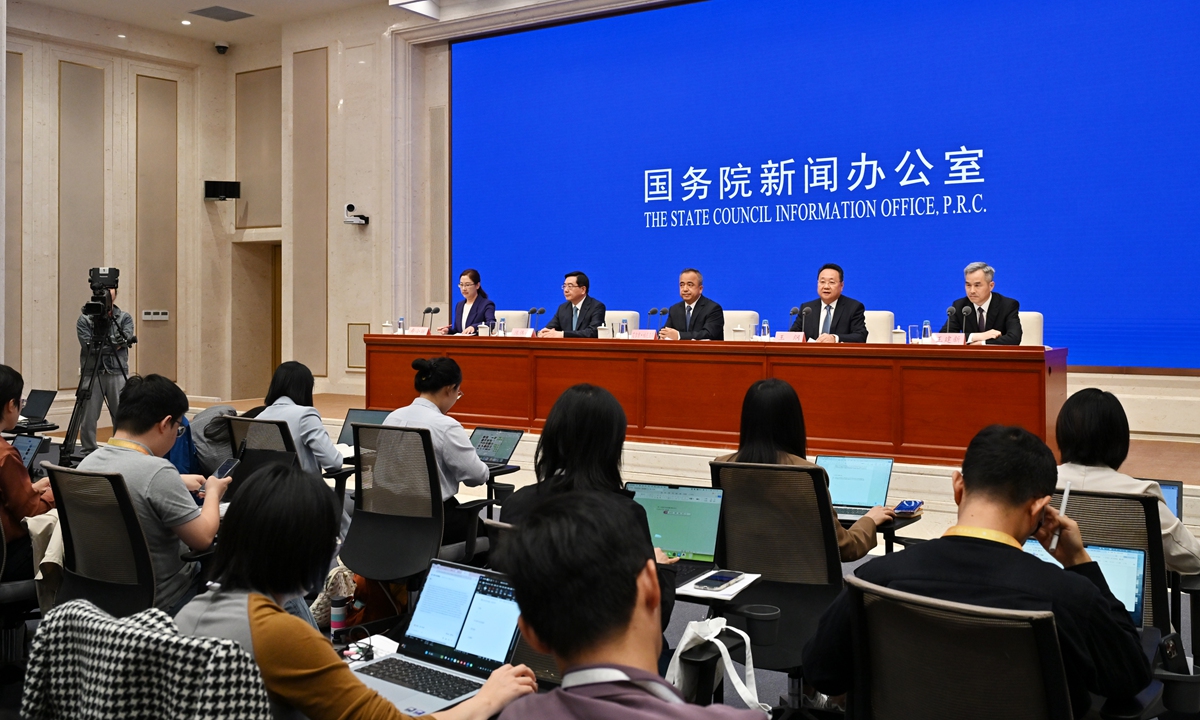
The State Council Information Office (SCIO) holds a press conference to release the white paper titled "CPC Guidelines for Governing Xinjiang in the New Era: Practice and Achievements" in Beijing, September. 19, 2025. Photo: cnsphoto
Today's Xinjiang is experiencing the best period of development in its history, according to a white paper issued by the Information Office of the State Council Friday.
This year marks the 70th anniversary of the Xinjiang Uygur Autonomous Region. The document said solid steps have been taken to govern Xinjiang in accordance with the law, maintain stability through ethnic unity, strengthen cultural identity and bonds, bring greater prosperity to the region and its people, and develop Xinjiang from a long-term perspective, the Xinhua News Agency reported.
"This has contributed to unprecedented economic and social development and significant improvement of people's wellbeing, and brought a greater sense of gain, happiness and security to the people," the paper noted, Xinhua reported.
The white paper titled "CPC Guidelines for Governing Xinjiang in the New Era: Practice and Achievements" is composed of a preface, main text, and conclusion, totaling about 21,000 Chinese characters, presenting the great achievements in reform, development, and stability in Xinjiang.
Stronger foundations for stability, peace and security have been built in Xinjiang, the document said, adding that a historic transformation from chaos to stability and from stability to good governance has been achieved in the region.
Experts noted the release of the paper was timely, offering detailed examples and data that present the region's transformation in a more comprehensive and vivid way.
The white paper is a record of the achievements of more than 26 million residents of Xinjiang, who have worked together under the strong leadership and care of the Communist Party of China (CPC) Central Committee, said Zhang Zheng, a professor at the School of Marxism at Xinjiang Normal University, who participated in the drafting of the document. "It showcases that Xinjiang has fully entered a new stage and a new era in its development," Zhang told the Global Times on Friday.
"In Xinjiang, you can see too many data to present, too many examples to make, too many people to introduce and too much progress to show, so we could only pick the most iconic and outstanding ones in the paper," Zhang said, adding that the paper contains the most comprehensive and vivid data and case studies to date.
Comprehensive achievements
The paper showcased Xinjiang's most complete and comprehensive achievements, including the region's economic progress, rising life expectancy, infrastructure improvements and industrial advances.
Xinjiang has seen comprehensive improvements in infrastructure, said the white paper, noting that the operating mileage of railways and the highway network totaled 9,202 km and 230,000 km, respectively, as of 2024, and the number of civil air routes reached 595, of which 25 are international routes.
Leveraging its natural resources and industrial capabilities, Xinjiang has accelerated efforts to develop a modern industrial system with its own unique advantages. The white paper mentioned that Xinjiang has been China's top cotton producer for 32 consecutive years, with the mechanization rate in plowing, planting, and harvesting reaching the 97 percent, according to white paper.
At the press conference where the white paper was released, a senior regional official said Xinjiang has made historic achievements in all undertakings over the past 70 years.
The region is experiencing its best period of development in its history, marked by the most profound changes and greatest benefits to date for people of all ethnic groups, said Erkin Tuniyaz, chairman of the regional government.
Multiple economic indicators in Xinjiang are among the fastest-rising nationwide. In 2024, the region recorded a 6.9 percent increase in fixed-asset investment, 8 percent growth in value-added industrial output from enterprises above designated size, and a 10.5 percent rise in general public budget revenue, said Chen Weijun, vice chairman of the regional government.
Xinjiang's grain output hit a record high of 23.3 million tons in 2024, while cotton output reached 5.68 million tons. In the first half of 2025, the region's retail sales of consumer goods reached 189.36 billion yuan, up 7.5 percent year-on-year, Chen said, "the growth rate ranked the third nationwide," he added.
The white paper also noted that the average life expectancy of residents in Xinjiang rose from 30 years in 1949 to 77 years in 2024.
It also highlighted progress in cultural heritage preservation, the strengthening of legal protections, and intensified efforts against desertification, with the Taklimakan Desert now surrounded by a 3,046-kilometer green belt - the world's longest, according to Xinhua.
Countering bias and smear campaigns
The white paper demonstrates not only Xinjiang's transformation and achievements, but also its advances in democracy, rule of law, regional ethnic autonomy, good governance, and human rights protection, Zhang said.
"In the white paper, facts and evidence are presented, with open data to show the building of our legal system, people's perceptions of judicial fairness, and guarantees of living, development, and security rights in Xinjiang," Zhang noted, "all aspects were detailed by examples in the white paper."
Xinjiang respects and protects ethnic minorities' right to learn and use their own spoken and written languages, the white paper said, adding that the region administers religious affairs in accordance with the law, allows religious groups to manage their own affairs independently, and guides religions to be compatible with socialist society, according to Xinhua.
"The development and changes in Xinjiang are tangible and visible. Having traveled across nearly every region of Xinjiang, I can say with confidence that the reality is entirely different from the smears spread by some foreign media. The region enjoys overall social stability, ethnic unity, religious harmony, and a happy life for its people," Yuan Jinhui, deputy head of the Xinjiang Administration Institute, told the Global Times on Friday.
From the north to the south of the Tianshan Mountains, there is a strong sense of peace, with residents expressing a profound feeling of gain, happiness, and security, Yuan said.
In response to a foreign media inquiry at the press conference regarding the impact on Xinjiang's economy and employment after the US in recent years placed over 140 Chinese companies on its entity list under the so-called US Xinjiang-related sanctions, Chen noted that the US' unreasonable sanctions, imposed under the pretext of "protecting human rights," violate the employment rights of Xinjiang workers. "If there is any coercion, it is the US that is engaging in it — coercing unemployment," Chen said.
Chen stressed that there is no form of so-called "forced labor" in Xinjiang. Workers of all ethnic groups seek a better life voluntarily and freely, and their labor rights and interests are fully protected, said Chen.
Chen noted that, in the short term, US sanctions may have some negative effects on Xinjiang's economic development, such as obstacles to product exports, losses for enterprises, a reduction in production capacity, and fewer employment opportunities for workers of all ethnic groups, including the Uygur people.
"We have the steadiness to withstand all winds and the courage to see clearly despite obstacles. US sanctions cannot stop Xinjiang's development, nor can they halt the growth and expansion of our enterprises or industries," Chen said.
RELATED ARTICLES