IN-DEPTH / IN-DEPTH
Africa Tech Challenge benefits African youth for over a decade, changes lives
Fishing for new skills
By Published: Sep 20, 2025 05:22 PM

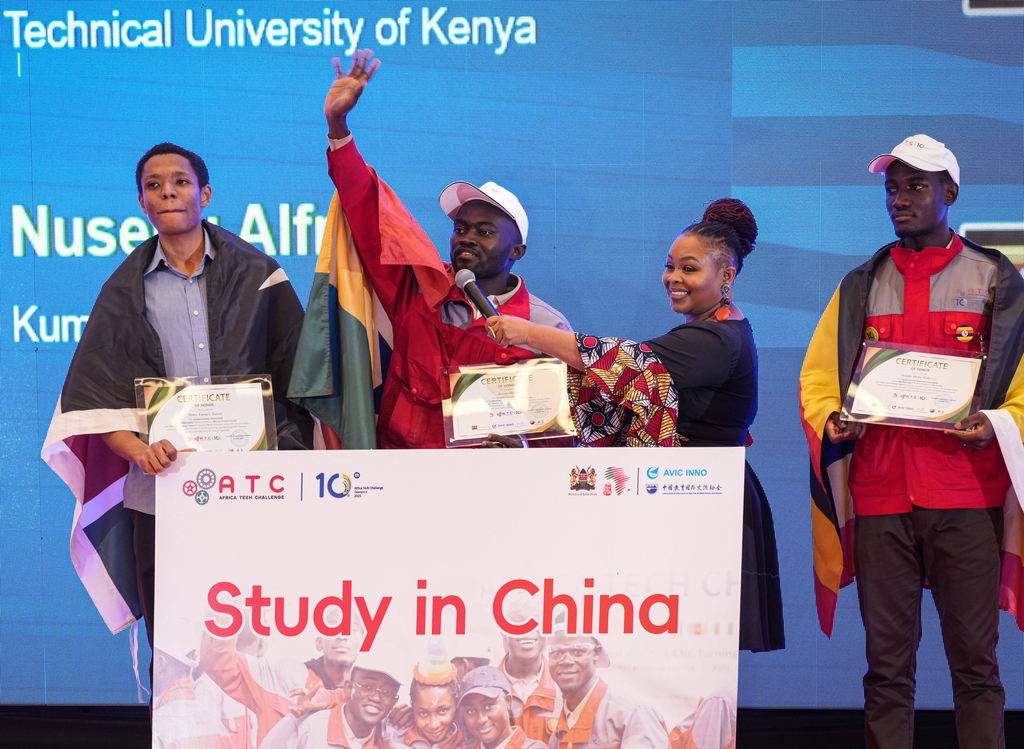
A winner of the 10th Africa Tech Challenge (ATC) Season waves at the competition’s closing ceremony held in Nairobi, Kenya, on September 1, 2025. Photo: VCG
At the CNC (computer numerical control) lathe processing competition area, the distinctive metallic scent of cutting fluid subtly permeates the air. Contestants focus intently on their machines, their fingers deftly navigating the control panels as they program, align tools, and conduct test cuts in a seamless flow of actions. As the machines hum to life, lines of cold code transform in their hands into precision parts that meet exacting standards.
This was the tense yet orderly scene judges observed during the finals of this year’s 10th Africa Tech Challenge (ATC) Season. In early September, at the closing ceremony of the ATC in Nairobi, Kenya, the final results were announced, and a new group of young faces earned ATC awards through their professionalism and skills. Awaiting them are more opportunities for further professional learning and development, as well as a brighter future.
Co-hosted by the Chinese firm AVIC INNO (AVIC Corporation Innovation Holding Limited), Kenya’s Ministry of Education, and the China Education Association for International Exchange, ATC has evolved over a decade into a vital platform for African youth pursuing their dreams, attracting nearly 2,000 participants from 14 African countries so far, including Kenya, Zambia, Uganda, Egypt, and Cote d'Ivoire. Young people from a number of nations gathered at this event, carrying their passion for skilled labor, and their aspirations for the future to exchange techniques and spark ideas.
Since its inception, ATC has been dedicated to enhancing the employ ability of African youth, systematically cultivating skilled talent that meets the needs of Africa’s industrialization and economic development, according to the ATC organizers. “The ancient Chinese wisdom of ‘teaching [people] how to fish’ reminds us that, instead of merely providing results to people, we should delve deeper into how to truly empower them with capabilities and wisdom. This is the essence of the ATC,” said Shi Yue, manager of vocational education department of AVIC INNO Project Engineering company.
‘Teach them how to fish’
There is an old Chinese saying: “To give people fish and you only provide them with one meal; to teach them how to fish and they can benefit throughout their lives.” This means that instead of providing direct material or short-term aid, the more valuable assistance comes from imparting knowledge, skills, and methods, enabling beneficiaries to solve problems and create value independently for long-term development.
Many cooperative projects between China and Africa are based on this “teaching [people] to fish” philosophy, with ATC serving as a prime example.
During operating TVET (Technical and vocational education and training) programs in Africa , we found that African countries, on one hand, are in urgent need of development and thus have a pressing demand for talents with both knowledge and skills; on the other hand, young people there generally lack employable skills, leading to persistently high unemployment rates, said Shi. Enhancing the employ ability of young people has become a topic of widespread concern among governments of African countries, Shi added.
Therefore, “based on in-depth research into local needs, our overseas team proposed the concept of ‘ATC’ when exploring public welfare cooperation models in Africa,” Shi told the Global Times. "We aim to help more African young people acquire practical skills, and ultimately achieve the goal of promoting education through competitions."
Over the past decade, as the Belt and Road Initiative (BRI) has deepened its reach across the Africa, the company has established or upgraded more than 180 TVET schools in various African countries, providing professional training for over 20,000 teachers and students each year. Drawing on years of rich experience in TVET sector, ATC has developed a model of “training, competition, study in China.” Each season of the competition has become a platform for deeply exploring and fully unleashing the skill potential of African youth.
No training fees are required for the registered teams of the ATC (including contestants and their instructors), Shi introduced. Furthermore, the competition itself is completely free of charge. And during the competition, expenses such as accommodation, meals, transportation (excluding costs for personal travel during rest periods) and equipment usage are covered by the Competition Organizing Committee and sometimes the involving Chinese colleges and universities, she added.
How can skills be better enhanced on the ATC platform? The ATC organizers explained that prior to the competition, they send experienced vocational skill instructors from China to conduct approximately four weeks of practical training tailored to the competition projects. These instructors generously share their expertise and hands-on techniques, guiding students through equipment operation and problem-solving. As a result, participants can largely improve their skill level in just a few weeks, laying a solid foundation for the upcoming competition.
At ATC, students can quickly apply the knowledge and skills they acquired during training to real-world scenarios. During the competition, they showcase their abilities, and have the opportunity to compete and exchange insights with peers from other African countries.
After the competition, outstanding winners are offered opportunities to further their studies in China. They can enter Chinese universities and enterprises, gaining exposure to advanced technologies and concepts, broadening their international perspectives, and accumulating more capital for their future careers, the Global Times learned from the ATC organizers.
In 2023, ATC was officially incorporated into the “Future Africa - China Africa TVET Cooperation Program.” This initiative is an important component of the capacity building category of the nine cooperation programs China announced during the Eighth Ministerial Conference of the Forum on China-Africa Cooperation (FOCAC) held in 2021, marking a big step in deepening cooperation between China and Africa. Since then, ATC has become a shining name card in the field of China-Africa vocational education cooperation, showing the achievements in talent cultivation and skills collaboration.
ATC has benefited many African youths. To date the competition has involved 1,933 participants, with 51 teams collectively earning 249 awards. Additionally, 30 participants have received opportunities to fly to China, making the dream of “Study in China” a reality, according to the competition organizers.
Mariam Saleh Ali Abdelhameed from Egypt is one such beneficiary. This fall, this former ATC contestant has started her academic journey in Beijing for her graduate studies.
Recalling her competition experience at ATC, Abdelhameed remains deeply moved. During the competition she faced not only technical challenges but also language barriers. Undeterred, she dedicated all her spare time to mastering her skills, seeking guidance from instructors and fellow contestants, and she ultimately achieved second place in the competition.
Abdelhameed is full of gratitude for the competition and the opportunities it provided. “ATC has given me not just a competition, but a new path in life,” she told the Global Times.
Illuminating the future
Like Abdelhameed, there are many African youths who have gained more learning and development opportunities, and even transformed their destinies through ATC.
Newton Milimu from Kenya, for instance, participated in the Fifth Season of ATC in 2018. To this day, he recalls that the competition boosted his confidence in his technical abilities, and allowed him to forge valuable connections with instructors and fellow contestants. “After all these years, I still vividly remember the intense focus and atmosphere of the competition,” Milimu shared with the Global Times. “But once the timer of the competition stopped, everything changed; we were no longer competitors but partners, laughing, sharing, and learning from each other.”
Thanks to his outstanding performance in the competition, Milimu was later offered a job opportunity with AVIC’s vocational education and training project in Kenya, becoming an assistant engineer in the mechanical engineering department.
Paul Muthungu, who participated in the First Season of ATC, experienced a complete transformation in his life trajectory due to the competition. Once a technician working on a tea farm, ATC opened new doors for him: through his participation, Muthungu earned a chance to study at Beihang University in Beijing, where he ultimately obtained a master’s degree after four years of study.
“Studying in China broadened my horizons and gave me a more international perspective,” Muthungu told the Global Times.
After participating in ATC, Apollo Godwin Maturo from Tanzania received an opportunity to study intelligent manufacturing engineering at a college in East China’s Zhejiang Province. “My goal is to deepen my professional knowledge, expand my global perspective, and continuously enhance my technical skills to solve more real-world problems,” said Maturo.
“Whatever kind of industrial skills Africa needs, we will train the corresponding talents,” said the ATC organizers. They added that since the first ATC was officially launched in Kenya in 2014, they have held the belief that using the spark of education to illuminate the path forward for African youth is essential. From focusing on mechanical processing in the first season of the competition, to incorporating mobile application development, and gradually expanding to CNC machining, mechatronics, mechanical engineering CAD (computer-aided design), ATC’s development track has always aligned with the pulse of Africa’s industrial growth.
For example, in 2017, in response to the rapid development of the African construction industry and the demand for skilled talent, ATC focused on the skills sector within construction and set up competition events for three specialties in civil engineering, concrete work, and rebar work. Contestants received on-site training at construction sites, which effectively enhanced their practical skills. After the competition, 25 outstanding participants were directly offered jobs in the construction of Nairobi’s iconic Global Trade Center, according to the ATC project team under AVIC INNO.
“This truly achieved a seamless connection between skills and employment, allowing participants to support their families and contribute to Kenya’s economic development,” said Shi.
On a larger scale, For years, ATC has been effectively helping participants enhance their technical capabilities in the short term, aligning with the demands of the job market, and further contributing to the industrialization process of their countries. “As a result, it has gained widespread recognition and support from the governments of involving African countries and societies,” Shi told the Global Times.
Shi shared that in the future, ATC will continue to introduce more competition events in cutting-edge fields, such as digitalization and green skills. The expansion into new fields will all be based on the skills that are most urgently needed in the local industrialization process, and have the greatest market potential there.
“Only in this way can we truly take root in the actual development needs of African countries, and effectively advance the in-depth and solid growth of China-Africa TVET cooperation,” she noted.
Shared development
The values of friendship and justice, which defines China-Africa relations, require us to facilitate Africa’s development endeavor with China’s development and ultimately deliver win-win progress and shared development through mutually beneficial cooperation, Chinese President Xi Jinping remarked in a speech he delivered at the opening ceremony of the Johannesburg Summit of FOCAC in December 2015.
In Africa, many infrastructure projects constructed or funded by Chinese enterprises are improving the lives of the people there. The completion of the light rail transit in Egypt’s 10th of Ramadan City has greatly improved local transportation, facilitating travel for the public.
Meanwhile, the opening of Angola’s Dr. Antonio Agostinho Neto International Airport has injected new vitality into local aviation development, strengthening Angola’s connections with the world. The upgrade of Mozambique’s Xai-Xai Chongoene Airport has enhanced local air transport capacity, providing strong support for regional economic development. The establishment of the Bobo-Dioulasso Hospital in Burkina Faso has provided higher-quality medical services to local residents, alleviating difficulties in accessing healthcare. The completion of the Mongu-Tabo Road project in Zambia has opened vital transportation routes, promoting economic exchange and cooperation between regions.
The organizers of ATC believe that, this competition serves as a bridge of skills, connecting the dreams and futures of many African youth while also fostering grassroots friendship between China and Africa. “This is a vivid practice of [implementing] the concept of building a community with a shared future for mankind,” they said.
RELATED ARTICLES