South Korean actress Jun Ji-hyun's new drama triggers controversy; advertising materials removed: media report
The character played by Jun Ji-hyun asks a senior expert, "Why does China have a preference for war?"in South Korean drama Tempest. Photo: Screenshot from Tempest
Starring actress Jun Ji-hyun, the South Korean drama Tempest has stirred a certain degree of controversy in China over specific lines and scenes — namely, the line asking "Why does China have a preference for war?", the misrepresentation of Dalian (a city in Northeast China) as an area of shabby shanties, and the frequent use of Chinese by villainous characters. These issues have sparked boycotts among some Chinese netizens, with her advertising materials removed, per media reports.
The Tempest is an original drama launched on Disney+ Korea starting September 10, 2025, produced by a South Korean team. Jun is well-known in China and previously gained popularity among Chinese audiences through hit Korean dramas such as My Love from the Star. The screenwriter of this drama also penned the South Korean film Decision to Leave, which starred Chinese actress Tang Wei.
Tempest follows a woman—a globally renowned UN ambassador played by Jun, who gets caught up in an assassination attempt sparked by the presidential election and a stunning conspiracy amid international power rivalry.
The controversy arose from a line in the 4th installment where Jun asks a senior expert, "Why does China have a preference for war?" Some netizens argued that it stigmatizes China's image and is inconsistent with reality.
Additionally, a scene in the drama featuring dilapidated shantytowns in Hong Kong, shot in dark tones, was labeled as Dalian, Northeast China's Liaoning Province. Some netizens noted that this depiction bears no resemblance to Dalian's actual image as a modern coastal city, and accused the production of showing disrespect to China. "Please respect the facts and stop deliberate smearing," netizens commented.
According to Dahe Daily on Saturday, luxury skincare brand La Mer has removed all content related to Jun from its official Weibo account. Meanwhile, PIAGET, the Swiss luxury watch and jewelry house for which Jun also serves as a brand ambassador, has taken down all its advertising materials featuring the star. Some netizens expressed their boycott in the comment section.
However, as of the time of press, there has been no extensive coverage of this incident in South Korea's major media outlets, and the level of attention it has garnered on South Korean social media platforms remains relatively low.
Recently, China and South Korea have had extensive interactions. On August 24, 2025, the 33rd anniversary of the establishment of diplomatic relations between the two nations, a special delegation led by former South Korean National Assembly Speaker Park Byeong-seok arrived in China for a visit. Subsequently, the Speaker of the National Assembly of South Korea Woo Won-shik arrived in Beijing to attend China's V-Day commemorations. South Korean Foreign Minister Cho Hyun is the third senior South Korean official to visit China within a month.
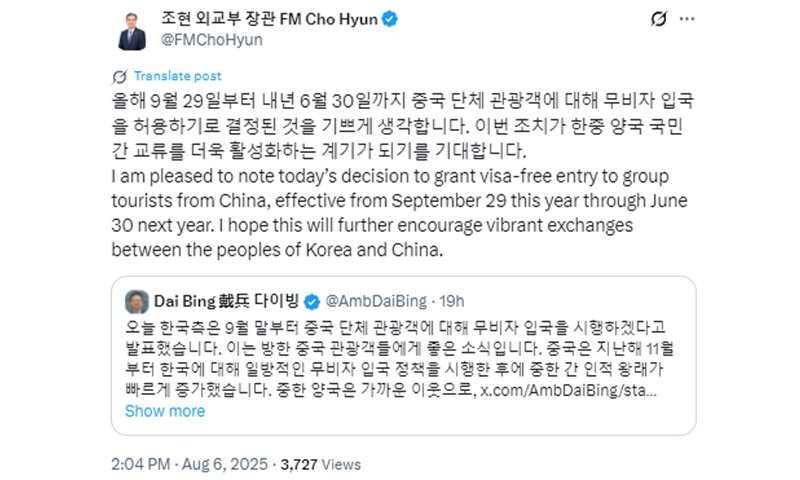
In terms of people-to-people exchanges, South Korea will implement a temporary visa-free policy for Chinese group tourists starting from September 29, and the policy will remain in effect until June next year, South Korean news agency Yonhap reported. In addition, South Korea's Coast Guard officer Lee Jae-suk, who died in the line of duty while rescuing a Chinese national, has received unanimous mourning and respect from both the official sectors and the public in China and South Korea.
Xiang Haoyu, a research fellow at the China Institute of International Studies, told the Global Times on Saturday that the lines and scenes smearing China in Tempest reflect certain South Korean creators' prejudices, misunderstandings toward China, and a narrow-minded nationalist sentiment. Some in South Korea still cling to outdated, rigid and biased stereotypes about China, and even distort China's image to satisfy some kind of self-gratification.
This may be an attempt to cater to certain conservative right-wing and anti-China forces, Xiang noted.
South Korean Prime Minister Kim Min-seok instructed the police on Friday to take "strong measures" when necessary against anti-China rallies taking place in Seoul, his office said, the Yonhap News Agency reported. Earlier on September 9, South Korean President Lee Jae-myung also condemned recent rallies and demonstrations targeting tourists from China, describing them as "not freedom of expression, but disturbance," per Yonhap.
In March of this year, a single line from a South Korean drama When Life Gives You Tangerines has once again brought Zhangjiajie in Central China's Hunan Province into the spotlight. In the final episode of the drama, which premiered on Netflix in March, the main characters promise to "go to Zhangjiajie to see the falling leaves next year."
Just as When Life Gives You Tangerines promoted non-governmental exchanges between the two countries, Xiang noted that entertainment products directly impact the mutual affection between the peoples of the two nations. Works with malicious smearing content like the Tempest hurt the feelings of the Chinese people, will only damage South Korea's image among the Chinese public, and further undermine the friendly relations between the two peoples.
Xiang stressed that South Korea should uphold the principles of objectivity, authenticity and respect in cultural and entertainment production, and avoid embedding unwarranted prejudices and discriminatory content.
As a key industry in South Korea, its entertainment sector should attach greater importance to social responsibility, take into account political and diplomatic impacts, and avoid hurting the feelings of people in other countries, Xiang added.
RELATED ARTICLES