China's monetary policy focuses on domestic imperatives, while balancing internal and external situations: central bank governor
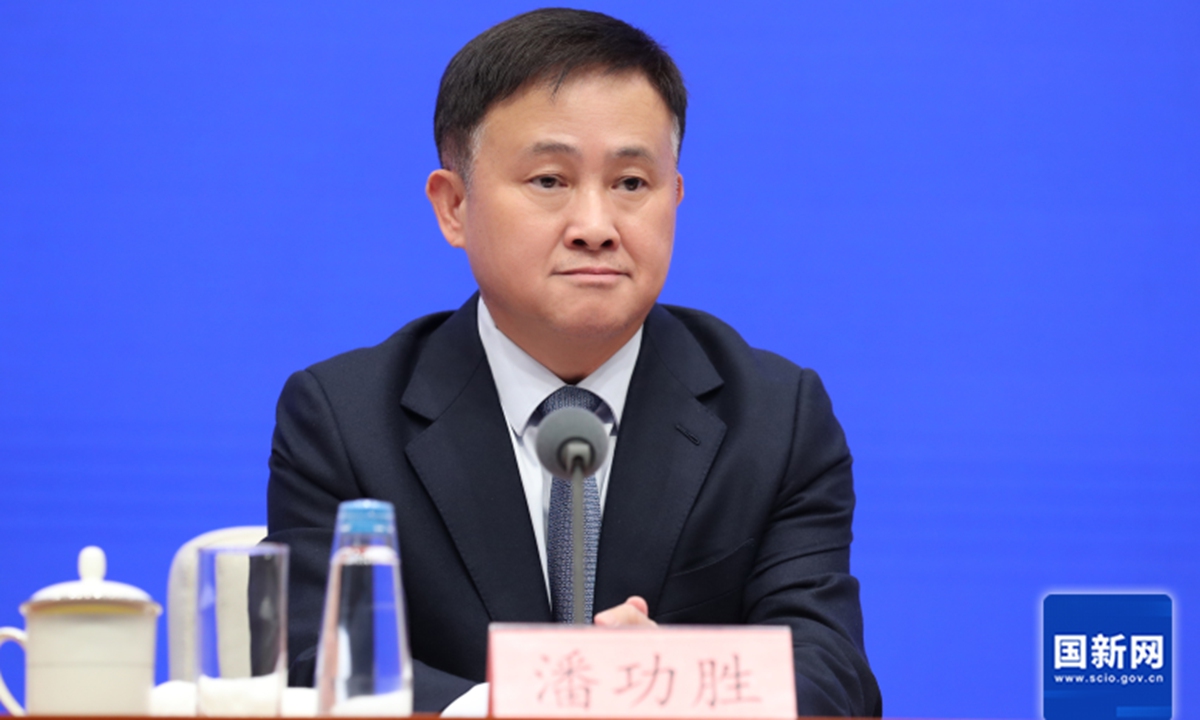
Central bank governor Pan Gongsheng Photo: Screenshot of scio.gov.cn
China's monetary policy is currently accommodative, with the emphasis placed on domestic imperatives while balancing both domestic and external situations, central bank governor Pan Gongsheng said on Monday in Beijing.
Pan made the remarks at a press conference held in the response to media questions about China's considerations for its next-phase monetary policy as the US Federal Reserve just decided to cut the country's benchmark interest rates by 25 basis points at its September meeting.
Pan said that a few days ago, the US central bank decided to lower the target range for the federal funds interest rate by 25 basis points, and the global financial markets fully anticipated this rate cut, and the market reaction was relatively stable.
The US dollar index has remained around 97, with international capital markets generally rising and commodity markets swinging downward, and China's major financial markets, including stocks, bonds, and foreign exchanges, has generally maintained stable operations, Pan said.
The People's Bank of China, the central bank, has clear macroeconomic principles in determining its monetary policy, and China's monetary policy adheres to the principle of focusing on supporting domestic imperatives while balancing both domestic and external situations, Pan noted.
"We have communicated with the market on multiple occasions regarding China's current monetary policy stance, and the market is very clear. China's current monetary policy stance is accommodative, following a moderately relaxed monetary policy. This policy stance has created a favorable monetary and financial environment for the continuous recovery of Chinese economy and the stable operation of the financial markets," Pan said.
"Looking forward, we will comprehensively utilize a variety of monetary policy tools based on macroeconomic conditions and evolving circumstances. This is also the fundamental methodology followed by major central banks internationally, including the US Federal Reserve, the European Central Bank, and the Bank of Japan, when determining specific monetary policy adjustments, meaning the policy is data-based," Pan noted.
Many central banks internationally share a common methodology, using macroeconomic data to determine whether monetary policy adjustments are necessary, he said.
China's central bank will do just the same, utilizing a comprehensive range of monetary policy tools based on macroeconomic conditions and evolving circumstances to ensure ample market liquidity, reduce overall financing costs, support consumption growth, expand effective investment, consolidate and strengthen the economic recovery, maintain the stable operation of financial markets, and maintain the basic stability of the RMB exchange rate at a reasonable and balanced level, said Pan.
Global Times
RELATED ARTICLES