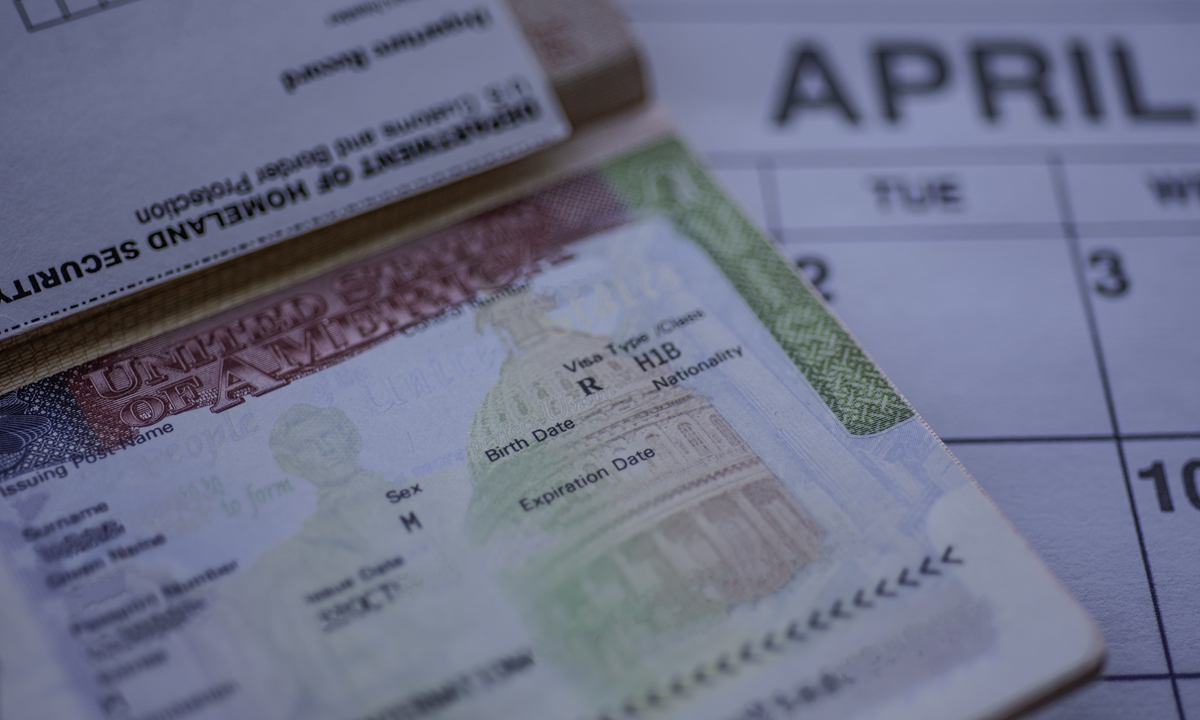
H-1B visa Photo: VCG
The US government's recent move to increase visa fees for highly-skilled foreign workers have prompted countries to seize the opportunity to attract professionals and bolster domestic industries, according to multiple media reports.
On Friday, US President Donald Trump signed an executive action to impose a $100,000 application fee for H-1B visas, according to CNN. These visas, which require at least a bachelor's degree, are meant for high-skilled jobs that tech companies find difficult to fill, AP News reported.
Although the move is seen as a direct hit to US-bound skilled professionals, especially from India, which accounted for 71 percent of approved H-1B beneficiaries last year, a report by The Economic Times raised the question: "Could this be the moment when India turns its long-lamented 'brain drain' into 'brain gain?'"
For years, policymakers and economists in India have worried about the continual exodus of top talent. If this outflow slows down by the clampdown on H-1B visas, India stands to benefit significantly, the Indian media outlet noted.
Not only India, but other countries including South Korea are aiming to take advantage of the move to lure foreign scientists and engineers, boosting their domestic industries and reversing an exodus of talent, Reuters reported.
South Korean Presidential Chief of Staff Kang Hoon-sik stressed with regard to the US administration raising the professional work visa fee that "plans should be prepared to use this as an opportunity to attract global STEM talent to Korea," South Korean media outlet Chosun Biz reported on Monday.
Also, British Prime Minister Keir Starmer is exploring proposals to abolish some visa fees for top global talent at a time when the US has moved sharply in the other direction, The Financial Times (FT) reported.
According to the report, the reforms were being discussed before the Trump administration announced the new fee, but one person involved in the UK discussions said the US decision had put "wind in the sails" of those pushing for changes to Britain's high-end visa system.
"The new US policy could be an opportunity for Germany and Europe to attract top talent," the head of Germany's digital association Bitkom, Bernhard Rohleder, also said, per Reuters.
Regarding US policy change on the application fee, Chinese Foreign Ministry spokesperson Guo Jiakun said on Monday that "we have no comment on the US' visa policy."
In reply to a question on China's policies on attracting foreign tech talents, Guo said that in a globalized world, cross-border flow of talents is instrumental in global technological and economic advancement. China welcomes talents from various sectors and fields across the world to come and find their footing in China for the progress of humanity and career success.
In August, China announced it would add a K visa to its ordinary visa categories, available to eligible young science and technology professionals, according to the Xinhua News Agency. After entering China, K visa holders can engage in exchanges in fields such as education, culture, science and technology, as well as relevant entrepreneurial and business activities, the report said.
Global Times
RELATED ARTICLES