‘China-Europe Arctic Express’ means far more than just a new shipping route: Global Times editorial
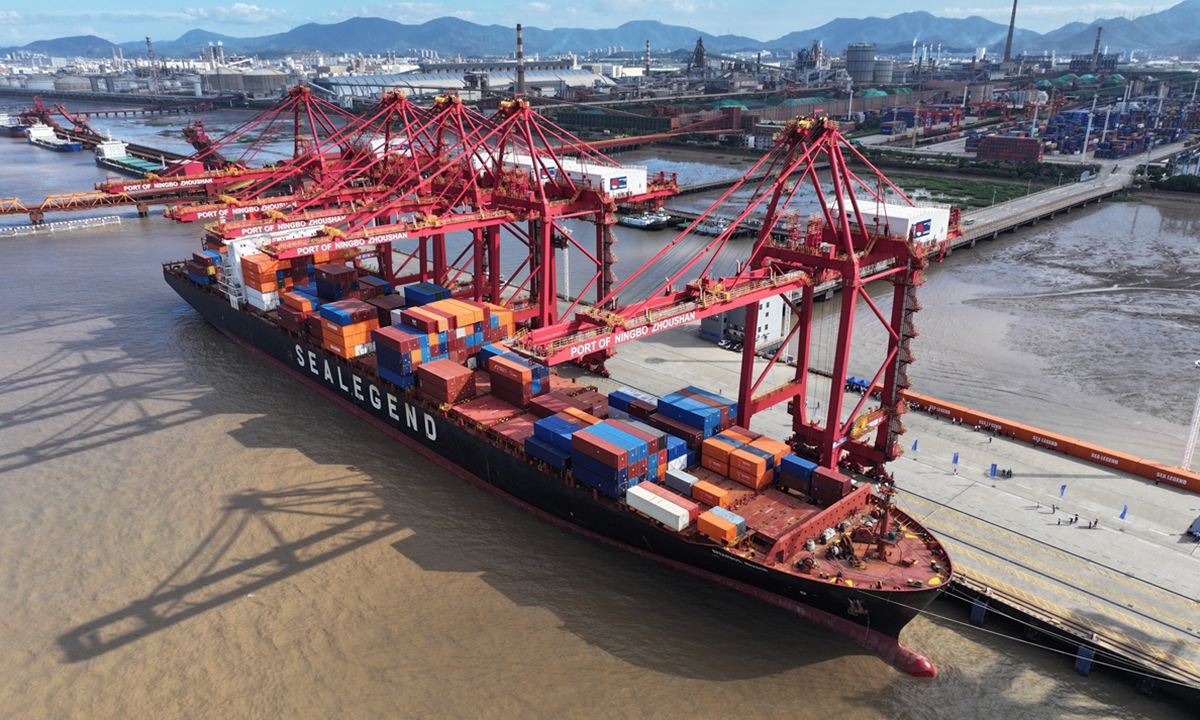
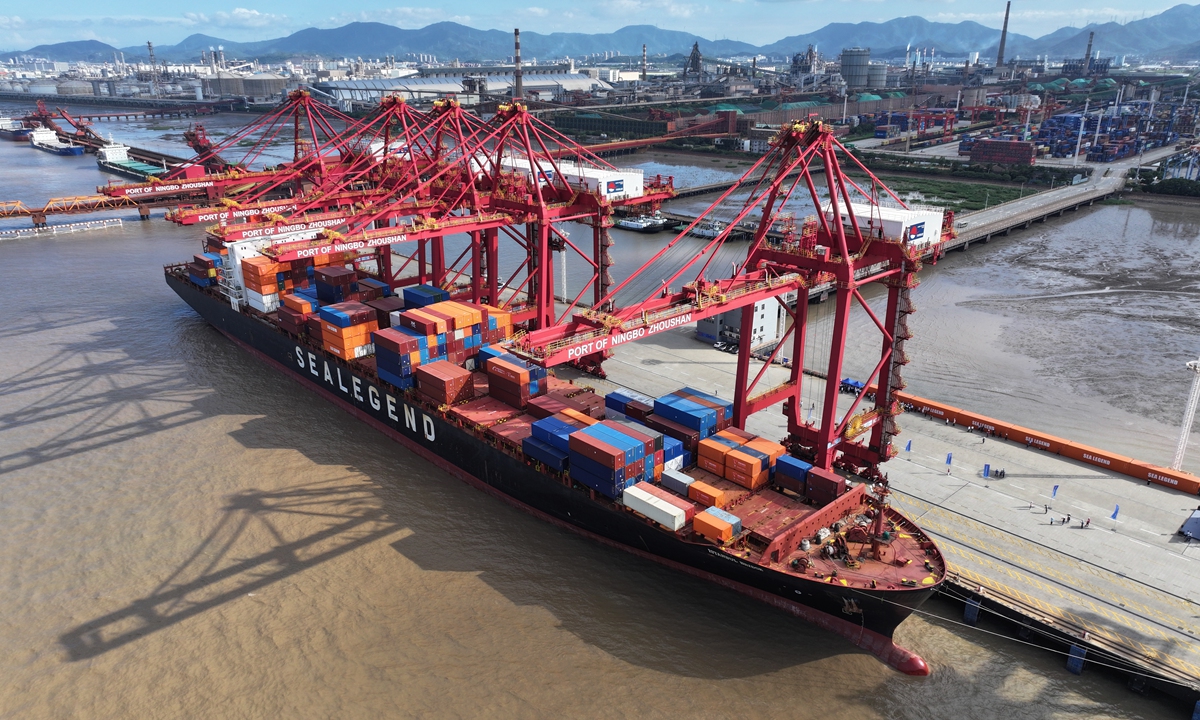
The Istanbul Bridge container ship berths at the Beiyi Container Terminal in Ningbo-Zhoushan Port, East China's Zhejiang Province, on September 22, 2025. Photo: Courtesy of Ningbo Zhoushan Port
At 4:30 am on Tuesday, the container ship Istanbul Bridge departed from the Beilun port area of the Ningbo-Zhoushan Port in East China's Zhejiang Province for the Port of Felixstowe in the UK, marking the official launch of the world's first China-Europe Arctic container express (China-Europe Arctic Express) route.
Carrying over 1,000 standard containers, the ship is taking the Arctic passage, also referred to as the Northeast Passage, and will complete the journey in just 18 days - nearly half the time required via the traditional Suez Canal route. The opening of this route not only demonstrates the commercial viability of Arctic shipping and offers a new logistics route option for the global trade network, but also highlights China's consistent commitment to cooperation and development in Arctic affairs. This is another contribution made by China to safeguarding the stability of global supply chains.
Throughout history, opening a Northern Sea Route across the Arctic Ocean was the dream of countless explorers. However, constrained by geographical conditions and geopolitical factors, as recently as a decade ago the Western shipping industry still widely believed that Arctic container shipping would not become feasible before 2040 or even 2050.
From this perspective, the launch of the China-Europe Arctic Express is therefore nothing short of historic. It is a pioneering attempt to employ technology to adapt nature for human needs. Currently, key maritime channels such as the Panama Canal, the Red Sea, and the Suez Canal are under unprecedented strain. Just days ago, Poland closed its border crossings with Belarus, leaving over 130 China-Europe freight trains stranded on the Belarusian side at the Brest crossing. Against this backdrop, the opening of the China-Europe Arctic Express provides more diversified route options for China-Europe trade, strengthening the resilience of global supply chains.
The launch of the China-Europe Arctic Express is no coincidence. The surging trade demand between China and Europe acted as a "catalyst." On board the Istanbul Bridge are not only emerging products such as energy storage cabinets and power batteries, but also more than 4,000 cross-border e-commerce parcels - precisely aligned with the demand of Europe's pre-Christmas stocking rush. At the same time, the China-Europe Arctic Express stands as a significant achievement of China and countries along the route in jointly building the "Polar Silk Road," underscoring the growing international resonance in the Belt and Road Initiative.
In July 2017, during his visit to Russia, President Xi Jinping first proposed the concept of the "Ice Silk Road." In 2018, China released the White Paper on China's Arctic Policy, which formally put forward the idea of jointly building the "Polar Silk Road" with all parties. In promoting cooperation on Arctic shipping routes, China attaches great importance to coordination with coastal states and stakeholders, respects the legitimate rights and interests of Arctic states in route management, and advocates peaceful use and international collaboration. This model of cooperation has brought tangible economic development opportunities to regions along the route.
Today, the China-Europe Arctic Express route not only links Chinese ports such as Ningbo, Shanghai, and Qingdao seamlessly with European hubs like Felixstowe, Rotterdam, and Hamburg, but also facilitates consolidation and transshipment of goods from Southeast Asia and South Korea, boosting overall foreign trade in Asia. Moreover, compared with the Suez Canal route, it reduces carbon emissions by 30 percent, enabling countries and enterprises along the route to share a green, fast, and safe supply chain.
In recent years, some countries have treated the Arctic as their own "backyard," competing for energy resources and strengthening military deployments in this international commons. From vision to reality, the "Polar Silk Road" has broken through an "Arctic narrative" once dominated by territorial disputes, strategic standoffs, and competition for oil and gas development, demonstrating that the Arctic can serve as a hotbed for human cooperation and shared development rather than a battlefield of zero-sum game.
The opening of the China-Europe Arctic Express route is fundamentally built upon the growing trust among countries along the route. Looking ahead, the comprehensive development of Arctic shipping lanes will require improved infrastructure support and the establishment of international cooperation mechanisms covering route management, environmental protection, crisis response, and other areas, highlighting the urgency for multilateral governance.
In advancing global shipping from the "canal era" to the "polar era," the launch of the China-Europe Arctic Express route fills a critical gap. The "Polar Silk Road" not only adds a new route to global shipping and offers a new paradigm for Arctic development, but also provides a new approach to "working together for this one and only planet Earth" among countries with different civilizations, systems, and development paths.
RELATED ARTICLES