Average number of mine accidents in China per year decreases by 29.7% from 2021 to 2024: Ministry
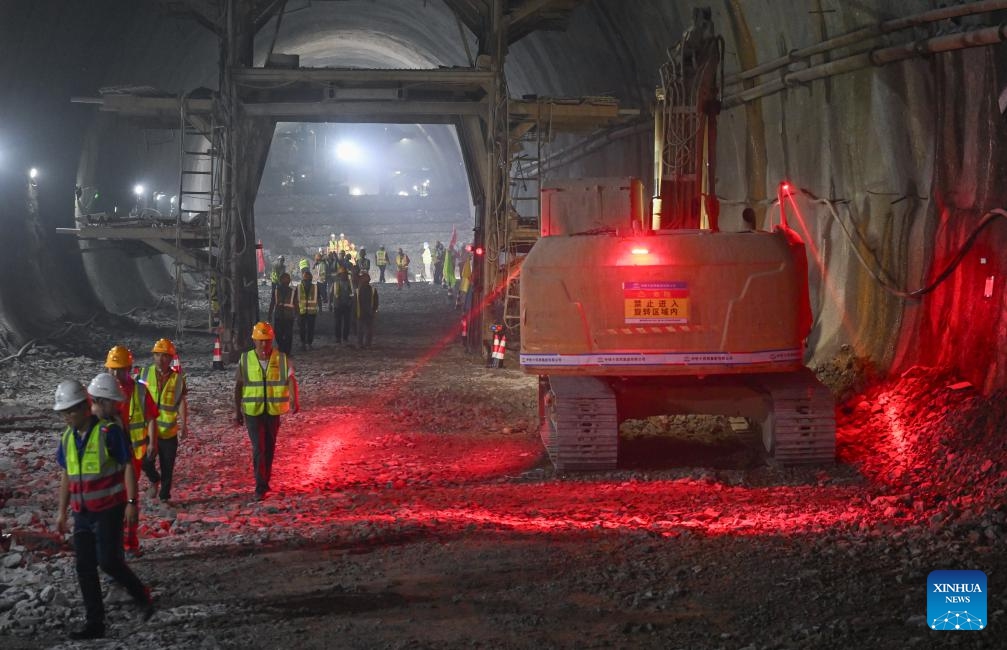
Workers perform their tasks in the Zhongliangshan tunnel, a key project along Chongqing Rail Transit Line 15, in southwest China's Chongqing Municipality, June 3, 2025. (Xinhua/Chen Cheng)
During the 14th Five-Year Plan period (2021-25), the annual average number of mining accidents and fatalities from 2021 to 2024 dropped by 29.7 percent and 29.1 percent respectively compared to the 13th Five-Year Plan period, officials from the Ministry of Emergency Management said at a press conference on emergency management on Wednesday.
Officials said that a unified network of monitoring and early warning has been established, which has integrated data from all operational coal mines, all active tailings ponds, and most high-steep-slope metal and non-metal open-pit mines.
So far, the system has carried out over 10,000 remote supervision and law enforcement inspections at mining sites, uncovering more than 42,000 potential hazards.
Of these, over 480 were classified as major accident risks, allowing many critical hazards to be resolved in time. Compared to 2020, the number of intelligent mining and excavation working in coal mines nationwide has risen from 494 to 1,930, according to the ministry.
Meanwhile, China has built the world's largest earthquake early warning system during the 14th Five-Year Plan, providing second-level warnings covering over 90 percent of key risk zones, according to Wang Kun, director of the China Earthquake Administration.
Since its launch, the system has issued 359 early warnings for earthquakes of magnitude 4 or above, giving the public valuable time to evacuate and enabling emergency responses in sectors such as high-speed rail and precision manufacturing, according to Wang.
During the period, China carried out its first national census on seismic disaster risks. Efforts were coordinated across relevant departments to promote the reinforcement of buildings and facilities in 229 high-risk counties across seismically active areas such as Southwest China's Sichuan, Yunnan, and Northwest China's Xinjiang. The reinforced structures have withstood multiple earthquakes, effectively reducing casualties.
To improve emergency response, large and medium-sized drone communication platforms, emergency base stations, and satellite phones have been pre-positioned in high-risk areas. 102,000 remote villages vulnerable to multiple disasters have been equipped with basic communication equipment, the ministry said.
Helicopter landing sites have been planned and built in remote disaster-prone areas. A cooperative mechanism now allows social drone resources to be mobilized in major disasters has been established, enabling the rapid deployment of rescue personnel, equipment, and supplies.
The officials also mentioned that central government reserves have risen by 39.6 percent compared to the end of the 13th Five-Year Plan period (2016-20). Emergency supply reserves now cover the provincial, municipal, and county levels, supported by a system for coordinated allocation and fast transport channels.
Meanwhile, during 14th Five-Year Plan period, the national emergency response headquarters was set up, maintaining 24/7 audio-video links with emergency command centers at the provincial, municipal, and county levels, thus building a well-coordinated and interconnected emergency command system, Wang Xiangxi, Minister of the Ministry of Emergency Management, said on Wednesday.
During the period, the national disaster relief mechanism was activated 85 times, responding effectively to major disasters such as the Luding earthquake in Sichuan, the mountain fire in Chongqing, the extreme rainstorms and floods in Beijing-Tianjin-Hebei, and the flash flood in Gansu.
Global Times
RELATED ARTICLES