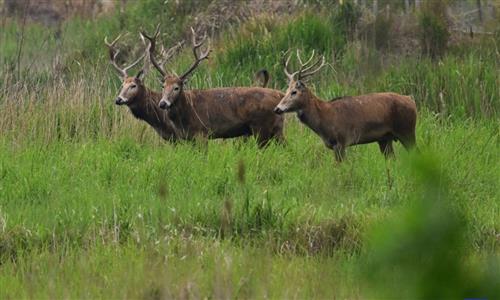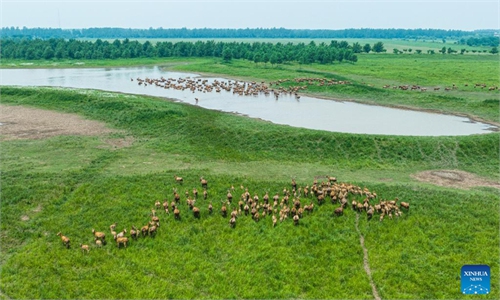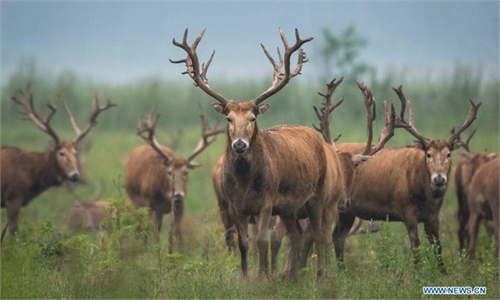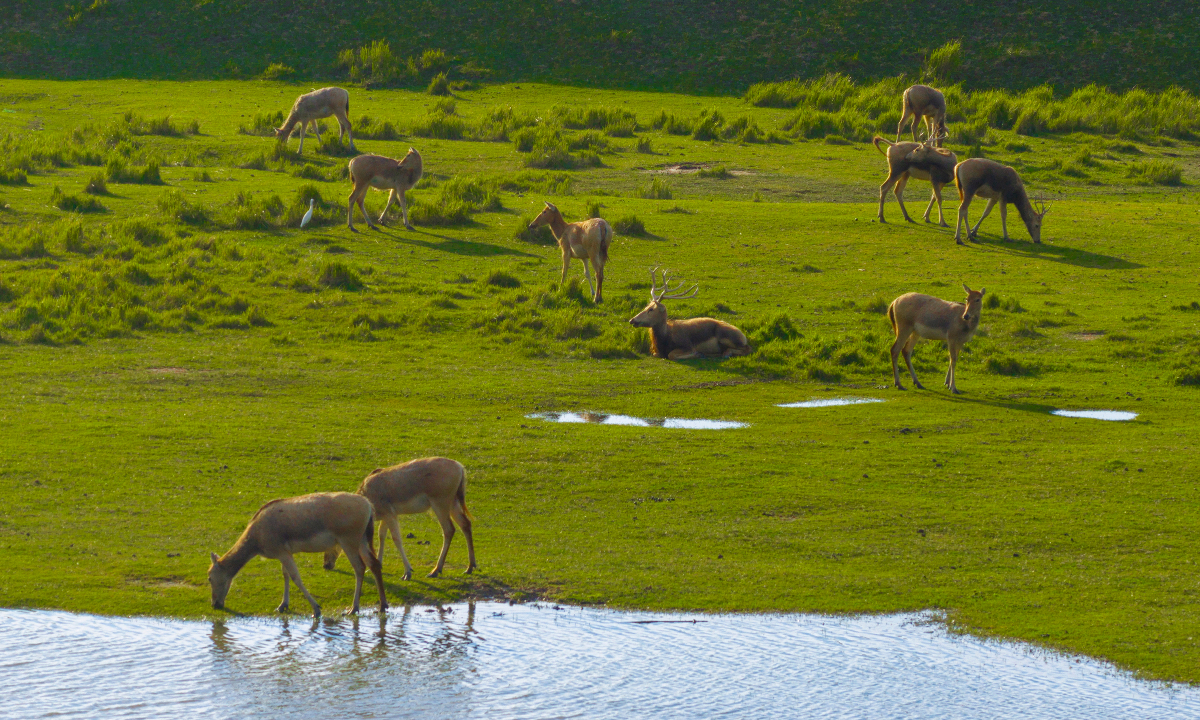
A herd of wild milu deer chase and play, joyfully inhabiting at the Dafeng Milu National Nature Reserve in Jiangsu Province on September 21, 2025. Photo: IC
The population of milu deer at the Dafeng Milu National Nature Reserve in East China's Jiangsu Province has surpassed 8,500, up from just 39 when they were first introduced to the nature reserve in 1986. It has become the largest genetic repository for milu deer, with the highest reproduction, survival and annual growth rates worldwide, Xinhua News Agency reported on Wednesday.
According to the Guidelines for Re-introductions released by the International Union for Conservation of Nature, milu deer ranks among the 15 most successful reintroduction cases worldwide, Xinhua reported.
Commonly known as the "sibuxiang," literally meaning "four unlikes," milu deer once lived across China for over 1 million years. It used to be a species unique to China and plays an important role in maintaining the health and nutrient balance of wetland ecosystems. However, due to human hunting and habitat destruction, the population of milu deer gradually declined. As of late Qing Dynasty (1644-1911), only a few dozen milu deer survived in Beijing's Nanhaizi imperial deer park, before being dispersed overseas during wartime, according to Xinhua.
In 1986, the World Wildlife Fund gathered 39 milu deer from zoos and parks in the UK and sent them to the Dafeng National Nature Reserve for conservation and breeding.
In 1987, the milu deer reproduced successfully for the first time. Their population surpassed 100 in 1992 and exceeded 1,000 in 2006. Thanks to sustained protection efforts of the local government and the reserve, the milu deer population at the reserve has continuously set new records.
Meanwhile, the herd's rapid growth has also brought problems such as environmental strain and localized vegetation degradation. To address these problems, the reserve has launched ex-situ conservation trails, identifying new habitats suitable for the species to promote biodiversity.
According to Liu Bin, a deputy director of the nature reserve, although local population density has risen, the milu deer overall remain endangered. The reserve will therefore continue creating favorable conditions to support the species' recovery and revitalization, Xinhua reported.
Located in the economically developed Yangtze River Delta, Dafeng faces great challenges in resisting development pressures and preserving natural habitat for the milu deer. As governments at all levels in China continue to increase investment in ecological and environmental protection, the milu deer population has rebounded rapidly, and protecting the species has become a shared societal goal, according to Xinhua.
Over the past 40 years, China's milu deer population has grown to more than 14,000, an increase of over 180 times. Wild milu deer are mainly distributed across Jiangsu, Hubei, Hunan, Jiangxi provinces, and Inner Mongolia Autonomous Region, with over 5,000 living in the wild, according to a report by Beijing Daily.
China is also planning to establish Asia's largest comprehensive milu deer gene bank, aimed at tackling genetic decline caused by inbreeding and providing strong data support for scientific conservation.
China also plans to build a microecological gene bank for milu deer to preserve vital microbial communities essential for the species' survival, including gut and environmental microbiota, ensuring the healthy growth of the population in an all-round way.
The ultimate goal of milu deer conservation is to restore the species to natural ecosystems, where they can contribute to the sustainability, stability, and biodiversity of the environment, Beijing Daily reported.
Global Times
RELATED ARTICLES