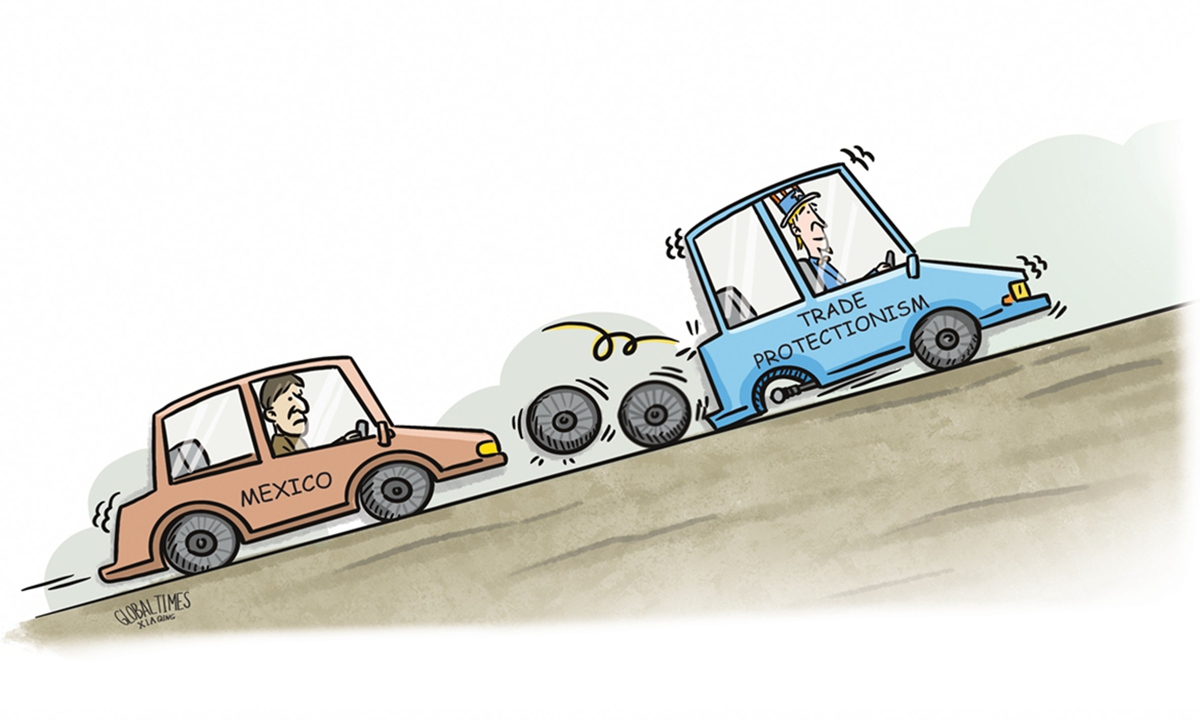
Illustration: Xia Qing/GT
Recent reports indicate that Mexico, apparently under pressure from the US, is considering imposing additional tariffs on Chinese exports.
This move clearly reveals the dilemmas faced by small and medium-sized countries amid major power rivalry, as well as the severe damage unilateralism and protectionism has inflicted on international economic and trade relations.
First, it is not good for Mexico's own economy. From an economic perspective, these tariffs will directly increase import costs and drive up domestic consumer prices. Chinese goods, known for their good quality and low prices, have deeply penetrated the Mexican market in areas such as electronic products, machinery equipment, textiles and daily consumer goods. Once these tariffs are imposed on Chinese goods, it can be expected that Mexican businesses will face higher production costs, weakening their export competitiveness and ultimately harming the development of their own manufacturing sector.
Tariffs will translate into price increases. In the long run, this will worsen inflation levels within Mexico and increase social discontent. Particularly for low-income groups, who rely on affordable Chinese goods, the implementation of tariff policies will significantly raise their cost of living and impact social harmony.
Second, it is harmful to China-Mexico relations. Cooperation between China and Mexico has been developing rapidly over the past two or three decades in trade, investment and cultural exchange. China has become Mexico's second-largest trading partner. Bilateral win-win cooperation has not only driven Mexico's export growth but also provided funding and technical support for its infrastructure construction and energy development, among other fields. If Mexico adopts tariff measures against China under US pressure, it will inevitably send an unfriendly political signal, damaging bilateral trust.
More importantly, cooperation between Mexico and China is not limited to the bilateral level but also involves the broader pattern of China's cooperation with Latin America. If Mexico takes the lead in imposing tariffs on China, it might set a negative example for other countries, thereby affecting the stable development of China's overall relations with Latin America. This move would undoubtedly cause Mexico to lose the constructive role it could have played in the regional diplomacy toward China.
Third, it damages the international trade rules. Mexico's imposition of tariffs on Chinese exports is not based on its own needs for fair trade but is a passive move under US coercion. This action violates the principles of non-discrimination, free and fair trade advocated by the World Trade Organization (WTO) and weakens the developing world's united stance against protectionism.
In recent years, the US has frequently used unilateral tariffs, long-arm jurisdiction and other means to coerce other countries to take sides, essentially politicizing economic issues to serve its geopolitical strategy. If Mexico follows suit, it not only damages its image as a supporter of multilateralism but also objectively contributes to the fragmentation of the international economic and trade order. This approach will lead to fragmentation of the rules.
China hopes that Mexico will be extremely cautious, and think twice before acting. As a matter of fact, by strengthening cooperation with China and others, Mexico can reduce its excessive dependence on the US and enhance its resilience. Leveraging the market differences between China and the US, Mexico can play a bridging role in areas like global value chains, logistics hub and cross-border investment, thereby gaining more development space amid major power rivalry.
Historical experience shows that over-reliance on a single market only leads to passivity, while diversification and autonomy are key to sustainable development. China offers an option for Mexico to diversify its external economic relations. If Mexico can view its economic relationship with China with strategic vision, it can be a good partner to both the US and others in the face of the complex international landscape.
Mexico needs to recognize that the path that truly serves its national interests lies not in succumbing to external pressure but in insisting on independence, autonomy and deepening multilateral cooperation. Only in this way can Mexico find its position for development within the wave of globalization and achieve long-term prosperity.
The author is a professor at Macau University of Science and Technology. opinion@globaltimes.com.cn
RELATED ARTICLES