China's decision not to seek new special, differential treatment in WTO negotiations underscores role as responsible power
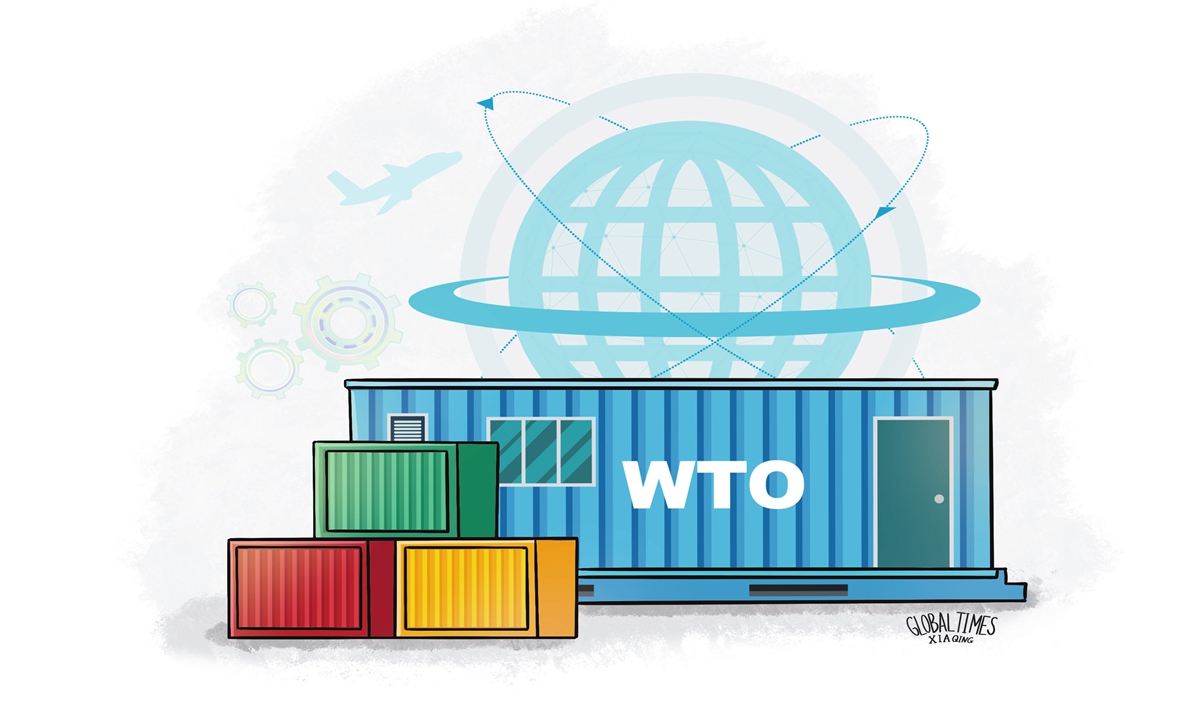
Illustration: Xia Qing/GT
China, while retaining its status as a developing country, has voluntarily decided not to seek any new special and differential treatment (SDT) in current and future World Trade Organization (WTO) negotiations. This reflects China's sense of responsibility as a major country in global governance.China's decision not to seek SDT is a natural outcome of its development reaching a certain stage. At the time of its WTO accession, given China's relatively low development level and modest economic size, it was entitled to SDT both during the negotiations for joining and after its accession to the WTO. Despite being a developing country, China actually enjoyed limited SDT benefits.
Today, China's per capita GDP has risen significantly, placing it among middle-income countries. China is capable of not seeking SDT in future WTO negotiations. This will not harm China's interests in the WTO.
China's decision not to seek SDT also responds to external expectations. With the significant improvement in China's development level and international competitiveness, especially the high development level reached by China's coastal regions in the east, some WTO members have looked for China to play a larger role and assume greater responsibilities. China has always been willing to assess its role in global governance in light of its actual capabilities. Its decision not to seek SDT is a positive response to these expectations of greater responsibility.
This step is also a vivid example of China putting the Global Governance Initiative into practice. China has always advocated for a global governance approach of extensive consultation, joint contribution, and shared benefits. By not seeking SDT, China demonstrates its commitment to multilateralism and to safeguarding the central role of the WTO's multilateral trading system. This action-oriented approach is also a model for others, encouraging various economies to take proactive steps and to contribute to reforms of the global governance system.
China's retention of its developing-country status is determined by its stage of development. It should be recognized that, despite the steady and significant progress it has made, China remains the world's largest developing country. Many of its economic and social indicators still lag behind those of advanced economies. There are issues of uneven development across different regions within China. Chinese modernization is still in progress. China is fully aware of this reality. It is not yet a developed country, but remains in the primary stage of socialism. This is the basic rationale for retaining its developing-country status.
Maintaining its status as a developing country also helps safeguard the interests of the Global South. Regardless of its own development, China is committed to defending the interests of developing countries. To advance the democratization of international relations and bridge the North-South development gap, China sees it as essential to firmly support developing countries in their pursuit of legitimate rights and interests, and to promote a more equitable and inclusive international economic order. Retaining its developing-country status is a powerful signal of this stance and a necessary declaration of principle.
China's retention of its developing-country status is in line with WTO practices. In the WTO, whether a member is considered a developing country is based on "self- designation," rather than per capita income or GDP. China's choice to retain its developing-country status fully conforms to established practice.
In summary, China's decision not to seek SDT is a responsible act and the latest step in advancing global governance and providing global public goods. It will not only help safeguard the existing global governance system but also contribute to driving its reform in a constructive direction.
The author is director and research fellow in the Department of International Trade, Institute of World Economics and Politics, Chinese Academy of Social Sciences. bizopinion@globaltimes.com.cn
RELATED ARTICLES