China won’t seek new special, differential treatment in WTO negotiations; Decision will not change China’s developing-country status, identity: official
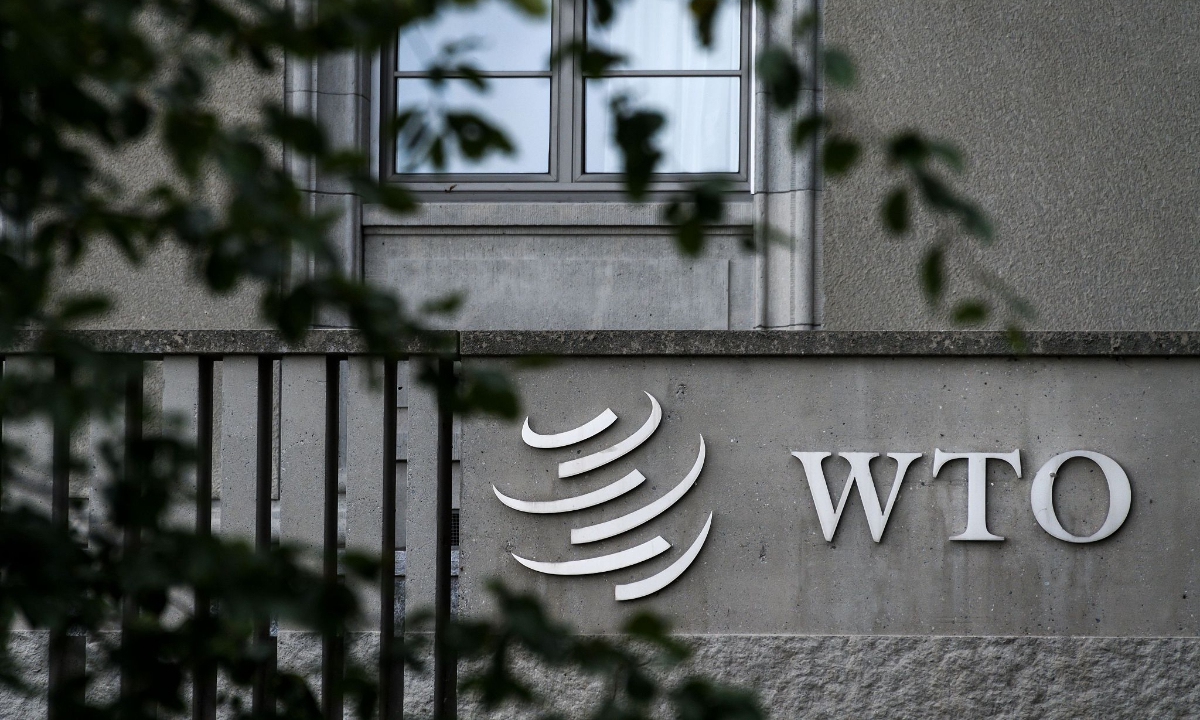
A sign of the WTO on its headquarters in Geneva Photo: VCG
China announced on Tuesday that as a responsible major developing country, it will not seek any new special and differential treatment in the current and future World Trade Organization (WTO) negotiations. The country also voiced readiness to work with all parties to further implement the Global Development Initiative (GDI), the Xinhua News Agency reported.
Chinese Premier Li Qiang made the remarks at a high-level meeting on the GDI held by China on the sidelines of the general debate of the 80th session of the United Nations (UN) General Assembly.
WTO Director-General Ngozi Okonjo-Iweala hailed the decision as "major news key to WTO reform" in a post on her X account on Wednesday, saying that "this is a culmination of many years of hard work and I want to applaud China's leadership on this issue."
The move stands as an important step in firmly upholding the multilateral trading system and actively advancing the GDI and the Global Governance Initiative (GGI), Li Chenggang, China's international trade representative and vice minister of commerce (MOFCOM), told a press briefing following the announcement.
Li Chenggang noted that it will give fresh impetus to the liberalization and facilitation of global trade and investment, and will inject positive momentum into the reform of the economic governance framework, per a MOFCOM statement.
Han Yong, director general of the Department of WTO Affairs at MOFCOM, stressed at the briefing that China will continue to approach current and future WTO negotiations with three "unchanged" principles, which are specifically its status as a developing member, its determination to safeguard the legitimate rights and interests of developing members, and its commitment to advancing the liberalization and facilitation of global trade and investment.
Foreign Ministry spokesperson Guo Jiakun noted on the same day that the decision is not only a proactive step taken by China in supporting multilateral trading system, but also an important move in China's effort of implementing the GDI and the GGI. China will stay committed to high-quality development and high-standard opening up…and continue to uphold multilateral trading system, participate in the WTO reform, Guo said.
Trade experts said that amid rising global protectionism, this step aligns with China's role as a key stabilizer of global economic growth and its sense of global responsibility, signaling that the country is willing to safeguard the multilateral trading system and to contribute proactively to building a more open global economic and trade framework.
Unchanged commitment
The WTO Agreements contain provisions which give developing countries special rights called "special and differential treatment" provisions, according to the WTO's official website. These special provisions include longer time periods for implementing agreements and commitments or measures to increase trading opportunities for developing countries.
China joined the WTO in 2001 as a developing member. It's entitled to special and differential treatment as an institutional right under the WTO framework, Li Chenggang stressed.
Since joining the WTO, while benefiting from the treatment, China has actively participated in multilateral trade negotiations, pragmatically addressing relevant issues in specific talks based on its development level and capabilities, the MOFCOM official noted, adding that this approach has significantly contributed to achieving multiple WTO negotiation outcomes, promoting freer global trade.
Cui Fan, a professor at the School of International Trade and Economics, University of International Business and Economics, clarified that while China will not seek new special and differential treatment in future WTO negotiations, it is not relinquishing all its existing rights or its status as a developing nation.
"It will not alter China's developing-country status, which is affirmed by both the WTO's self-designation mechanism and its accession protocol. Also the country's per capita GDP remains significantly lower than that of developed nations," Cui said. It also does not affect the country's entitlements as a developing member in other international frameworks such as the World Bank and the Paris Agreement, Cui told the Global Times on Wednesday.
Yang Shuiqing, associate researcher at the Institute of American Studies, Chinese Academy of Social Sciences, told the Global Times that China's proactive stance conveys a clear message: the country is not only a beneficiary of globalization but also a defender and builder of the multilateral trading system, participating in and helping shape the formulation of new rules with a more equal and constructive approach.
The expert believes that this move will also enhance China's international discourse power and rule-making ability.
The announcement comes at a time when unilateralism and protectionism are on the rise, international development cooperation has been severely disrupted, and the momentum of global economic growth has weakened.
Amid challenges, Chinese premier called for creating a stable and open international development environment, jointly safeguarding the international system with the UN at its core, adhering to multilateralism and free trade, and striving to build an open world economy, per Xinhua.
MOFCOM officials reiterated on Wednesday China's commitment to high-standard opening-up and to working relentlessly with other developing members to place development at the core of WTO reform.
Li Chenggang emphasized that China remains the largest developing country in the world, and its status and identity as a developing country have not changed. China has always been a part of the "Global South" and will always stand with developing countries.
China's decision will provide strong support for WTO reform and will inject critical momentum into multilateral talks. "While China itself will not seek new such treatment, it staunchly supports other developing countries' right to such treatment, viewing it as a vital principle for an inclusive and equitable trading system,'' Cui said.
The decision helps maintain the vitality of the WTO system and promotes its reform towards a more fair, inclusive, and effective direction, said Yang.
Concrete progress
In recent years, China has taken concrete actions to assume greater international responsibilities in upholding global trade rules and stability.
Demonstrating its commitment, China has granted zero-tariff treatment on 100 percent of product lines to all Least Developed Countries (LDCs) that have diplomatic relations with it, effective December 1, 2024. This landmark move makes China the first major developing country and major global economy to implement such a policy, according to the Ministry of Finance.
China also announced in June of this year the implementation of a full zero-tariff policy for 53 African nations with which it has diplomatic ties, Foreign Ministry data showed, this was followed by additional trade facilitation measures specifically for African LDCs.
As a pillar of global growth, China's commitment to WTO principles and market rules, coupled with its proactive and even unilateral market opening, injects vital momentum and confidence into the world economy, Cong Yi, a professor at the Tianjin School of Administration, told the Global Times on Wednesday. "This particularly benefits developing countries by fostering broader economic growth," he added.
RELATED ARTICLES